 AP Chemistry Tutoring
7.4 Calculating the equilibrium constant
AP Chemistry Unit 7: Equilibrium · 1 simulation · 6 practice questions
Updated · Aligned to the AP Chemistry Course and Exam Description
An equilibrium constant is calculated by substituting equilibrium concentrations (or partial pressures) into the expression. When only initial amounts and one equilibrium value are known, an ICE table (Initial, Change, Equilibrium) uses the reaction stoichiometry to find all equilibrium values first. For , .
The equilibrium constant
Products over reactants, raised to coefficients.
Leave out pure solids and liquids: their concentrations don't change, so they are left out of the expression. has no units, and it changes only with temperature.
e.g. at equilibrium.
e.g. . is never negative.
Same expression with partial pressures.
= moles of gas, products − reactants.
Change the equation, watch K
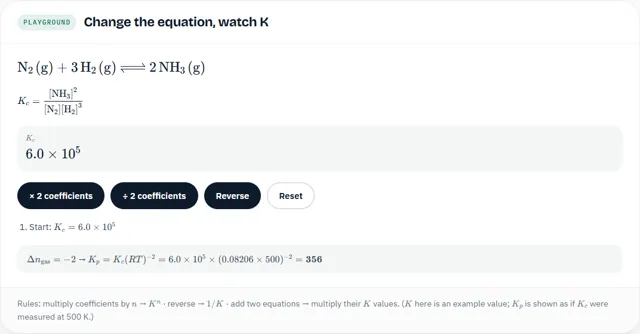
? has . What is for ?Think, then tap to check
Doubled: . Reversed: .
Q vs K: which way?
is 's formula with the concentrations you have now.
: not enough products yet → shifts toward products.
: too many products → shifts toward reactants.
: at equilibrium.
On the AP exam, say "toward products/reactants", not "right/left".
,
Study notes
Key concepts
K comes from experiment (TRA-7.B.1). If you can measure the equilibrium concentrations or partial pressures of all species, you put them into the K expression and calculate K.
Often you only measure one species. Then you use an ICE table (Initial, Change, Equilibrium) and the coefficients of the balanced equation to find the others. The change row is always in the ratio of the coefficients.
Step-by-step method
- Write the balanced equation and the K expression.
- Make an ICE table with the initial values (in M for Kc, in atm for Kp).
- Use the measured equilibrium value to find the change for that species.
- Use the coefficients to find the changes for all other species.
- Add to get every equilibrium value, then substitute into K.
Useful facts
- Units must match the K: molarity for Kc, atm for Kp. If you are given moles and a volume, divide to get molarity first.
- For a gas at constant T and V, partial pressure is proportional to moles, so pressures can be used in the ICE table directly.
- K depends only on temperature. The same K is obtained from any starting mixture at the same temperature (the slides show this for N₂O₄/NO₂).
- For a heterogeneous equilibrium such as CaCO₃(s) ⇌ CaO(s) + CO₂(g), K = P_CO₂ as long as some of each solid remains. Changing the mass of solid does not change the equilibrium pressure.
Key equations
Worked examples
Example 7.4a (from the Unit 7 slides). A closed system initially contains 1.000 × 10⁻³ M H₂ and 2.000 × 10⁻³ M I₂ at 448 °C. At equilibrium, [HI] = 1.87 × 10⁻³ M. Calculate Kc for H₂(g) + I₂(g) ⇌ 2 HI(g).
Solution. HI increased by 1.87 × 10⁻³ M, so H₂ and I₂ each decreased by half of that, 9.35 × 10⁻⁴ M.
| [H₂] (M) | [I₂] (M) | [HI] (M) | |
|---|---|---|---|
| Initial | 1.000 × 10⁻³ | 2.000 × 10⁻³ | 0 |
| Change | −9.35 × 10⁻⁴ | −9.35 × 10⁻⁴ | +1.87 × 10⁻³ |
| Equilibrium | 6.5 × 10⁻⁵ | 1.065 × 10⁻³ | 1.87 × 10⁻³ |
Example 7.4b. For 2 NH₃(g) ⇌ N₂(g) + 3 H₂(g) at 500 K, the equilibrium concentrations are [N₂] = 3.0 × 10⁻² M, [H₂] = 3.7 × 10⁻² M and [NH₃] = 1.6 × 10⁻² M. Calculate Kc.
Example 7.4c. At 1000 K, CH₄(g) + 2 H₂S(g) ⇌ CS₂(g) + 4 H₂(g) has equilibrium pressures P_CH₄ = 0.20 atm, P_H₂S = 0.25 atm, P_CS₂ = 0.52 atm and P_H₂ = 0.10 atm. Calculate Kp.
Unit 7 study guide: exam-style free-response set, worksheet and answers.
Worked example
- .
- Answer:
Free-response practice
Write your answer first, then open the solution and mark yourself against it.
FRQ 7.4. Modelled on 2017 AP FRQ Q3(a)–(b). At very high temperature, nitrogen and oxygen react: N₂(g) + O₂(g) ⇌ 2 NO(g). A student puts N₂ and O₂ into an evacuated rigid vessel and heats it. At the reaction temperature, the initial partial pressures are P_N₂ = 5.00 atm and P_O₂ = 2.00 atm. At equilibrium PNO = 0.100 atm.
(a) Write the Kp expression for the reaction.
(b) Calculate Kp.
(c) What is the total pressure at equilibrium? Explain why it equals the initial total pressure.
Show the solution
(a) Kp = (PNO)² / ((P_N₂)(P_O₂)).
(b) To make 0.100 atm NO, 0.050 atm of each of N₂ and O₂ react.
| P_N₂ (atm) | P_O₂ (atm) | PNO (atm) | |
|---|---|---|---|
| I | 5.00 | 2.00 | 0 |
| C | −0.050 | −0.050 | +0.100 |
| E | 4.95 | 1.95 | 0.100 |
(c) 4.95 + 1.95 + 0.100 = 7.00 atm. There are 2 moles of gas on each side, so the total number of gas molecules (and therefore the total pressure at constant T and V) does not change.
FRQ 7.4b. Pure NOCl(g) at 0.500 atm is placed in a rigid flask and heated. It decomposes: 2 NOCl(g) ⇌ 2 NO(g) + Cl₂(g). At equilibrium P_Cl₂ = 0.040 atm.
(a) Calculate the equilibrium pressures of NOCl and NO.
(b) Calculate Kp.
(c) Calculate the total pressure at equilibrium.
Show the solution
(a) Cl₂ rose by 0.040 atm, so NO rose by 0.080 atm and NOCl fell by 0.080 atm. PNOCl = 0.500 − 0.080 = 0.420 atm; PNO = 0.080 atm.
(b)
(c) 0.420 + 0.080 + 0.040 = 0.540 atm.
Common mistake
Students substitute initial concentrations into the expression. Only equilibrium values give ; initial values give .
Frequently asked questions
?Do I use initial or equilibrium concentrations to find K?
Equilibrium concentrations. If you know only initial values, use an ICE table to find the equilibrium values first.
?Does K have units?
On the AP exam, values are reported without units.
Practice questions on 7.4
- Q1What is the equilibrium constant expression for ?
- Q2A particle diagram of an equilibrium mixture of CO, and shows 10 molecules, 3 of them CO. The total pressure is 12 atm. What is the partial pressure of CO?
- Q3For 2 SO₃(g) ⇌ 2 SO₂(g) + O₂(g), the equilibrium partial pressures are P_SO₃ = 0.40 atm, P_SO₂ = 0.20 atm and P_O₂ = 0.10 atm. What is Kp?
- Q4Gases A and B react in a rigid vessel at constant temperature: 2 A(g) + B(g) → C(g). Initially P_A = 2.00 atm, P_B = 1.50 atm and no C is present. What is P_C when P_A has fallen to 1.40 atm?
- Q5H₂(g) and I₂(g), each at 0.50 M, are placed in a flask. At equilibrium [HI] = 0.78 M. What is Kc for H₂(g) + I₂(g) ⇌ 2 HI(g)?
- Q6Two rigid containers of the same volume at 1100 K each reach equilibrium for CaCO₃(s) ⇌ CaO(s) + CO₂(g). Container 1 started with 50 g of CaCO₃ and container 2 with 100 g. Some solid CaCO₃ remains in both. How do the equilibrium pressures of CO₂ compare?
Stuck on a unit? Let us fix it this week.
Book a 30-minute one-to-one session for $20. Bring a test, a homework set or the topic that is not clicking.
Book a session