 AP Chemistry Tutoring
7.5 Magnitude of the equilibrium constant
AP Chemistry Unit 7: Equilibrium · 1 simulation · 4 practice questions
Updated · Aligned to the AP Chemistry Course and Exam Description
The size of shows the relative amounts of products and reactants at equilibrium. When , products are favored and the reaction goes nearly to completion; when , reactants are favored and little product forms; when is near 1, significant amounts of both are present. For example, acetic acid has , so it is only slightly ionized in water.
The equilibrium constant
Products over reactants, raised to coefficients.
Leave out pure solids and liquids: their concentrations don't change, so they are left out of the expression. has no units, and it changes only with temperature.
e.g. at equilibrium.
e.g. . is never negative.
Same expression with partial pressures.
= moles of gas, products − reactants.
Change the equation, watch K
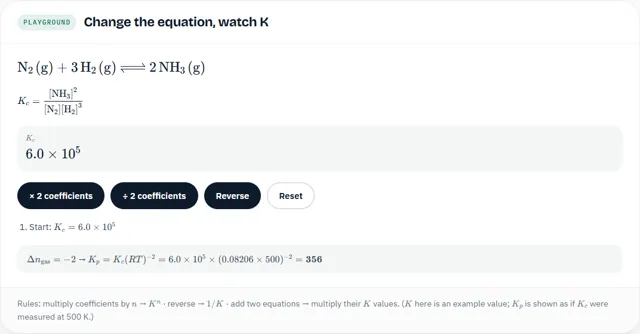
? has . What is for ?Think, then tap to check
Doubled: . Reversed: .
Study notes
Key concepts
What the size of K tells you (TRA-7.C.1). K is a ratio of products to reactants at equilibrium.
| Value of K | What the equilibrium mixture contains | Description |
|---|---|---|
| Very large (K >> 1, for example 10¹⁰) | Almost all products | "Product-favoured"; the reaction goes essentially to completion |
| About 1 | Similar amounts of reactants and products | Neither side strongly favoured |
| Very small (K << 1, for example 10⁻¹⁰) | Almost all reactants | "Reactant-favoured"; the reaction barely proceeds |
Using a very large K. If K is huge, treat the reaction like a limiting-reactant problem. Let the limiting reactant react completely, then find the amounts left over. The amount of the limiting reactant left at equilibrium is tiny but not zero.
Using a very small K. If K is tiny, almost none of the reactants change. Their equilibrium values are very close to their initial values, and the products are present only in tiny amounts. (This is the basis of the "x is small" approximation in 7.7.)
K and speed are different. A large K says nothing about how fast equilibrium is reached. That is kinetics (Unit 5). A reaction can have a huge K and still be very slow.
K and acid strength (link to Unit 8). For a reaction such as HF + CH₃COO⁻ ⇌ F⁻ + CH₃COOH, K > 1 means the products are favoured, so the stronger acid (HF) gives its proton to the stronger base, forming the weaker acid and weaker base.
Worked examples
Example 7.5. Modelled on the CED sample MC question about silver–ammonia complex formation (Exam Information, Q8). Equal volumes of 0.10 M AgNO₃ and 0.60 M Na₂S₂O₃ are mixed. The reaction is Ag⁺(aq) + 2 S₂O₃²⁻(aq) ⇌ [Ag(S₂O₃)₂]³⁻(aq), K = 2.9 × 10¹³. Rank the equilibrium concentrations of Ag⁺, S₂O₃²⁻ and the complex.
Solution. Mixing equal volumes halves each concentration: [Ag⁺] = 0.050 M and [S₂O₃²⁻] = 0.30 M. K is huge, so the reaction goes essentially to completion. Ag⁺ is limiting (0.050 M needs only 0.10 M S₂O₃²⁻). After reaction: [complex] ≈ 0.050 M, [S₂O₃²⁻] ≈ 0.30 − 0.10 = 0.20 M, and [Ag⁺] is tiny. Ranking: [Ag⁺] < [complex] < [S₂O₃²⁻].
Unit 7 study guide: exam-style free-response set, worksheet and answers.
Worked example
- is much less than 1.
- At equilibrium the numerator (products) is much smaller than the denominator (reactants).
- Answer: Reactants are favored; most acetic acid remains un-ionized.
Free-response practice
Write your answer first, then open the solution and mark yourself against it.
FRQ 7.5. Two reactions at 298 K are given.
Reaction 1: H₂(g) + Cl₂(g) ⇌ 2 HCl(g), K = 2.5 × 10³³
Reaction 2: N₂(g) + O₂(g) ⇌ 2 NO(g), K = 4.5 × 10⁻³¹
(a) Which reaction goes essentially to completion? Justify your answer.
(b) A rigid flask starts with P_H₂ = 1.00 atm and P_Cl₂ = 1.00 atm at 298 K. Estimate PHCl at equilibrium. Justify your estimate.
(c) A rigid flask starts with P_N₂ = 0.80 atm and P_O₂ = 0.20 atm at 298 K. Calculate PNO at equilibrium.
(d) Air in a car engine reaches about 2000 K, and measurable NO forms. What can you conclude about how K for Reaction 2 depends on temperature?
Show the solution
(a) Reaction 1. Its K is extremely large, so at equilibrium the mixture is almost entirely product.
(b) About 2.00 atm. Because K is huge, essentially all of the H₂ and Cl₂ react. Each mole of H₂ gives 2 mol HCl, so 1.00 atm H₂ gives 2.00 atm HCl.
(c) K is tiny, so P_N₂ ≈ 0.80 atm and P_O₂ ≈ 0.20 atm at equilibrium.
PNO = 2.7 × 10⁻¹⁶ atm.
(d) K for Reaction 2 must be much larger at 2000 K than at 298 K. K increases with temperature, so (by Le Châtelier, see 7.9) the forward reaction is endothermic.
Common mistake
Students think a large means a fast reaction. describes how far a reaction goes at equilibrium; how fast it gets there depends on kinetics.
Frequently asked questions
?What does K greater than 1 mean?
At equilibrium products are favored over reactants; the larger is, the more completely the reaction proceeds.
?Does a large K mean a reaction is fast?
No. says nothing about rate; a product-favored reaction can still be extremely slow.
Practice questions on 7.5
- Q1A reaction has . What does this tell you about the mixture at equilibrium?
- Q2For N₂(g) + O₂(g) ⇌ 2 NO(g) at 25 °C, K = 4.5 × 10⁻³¹. Which statement best describes an equilibrium mixture at 25 °C that began with only N₂ and O₂?
- Q3Which reaction, at the temperature given, would have the GREATEST fraction of reactants converted to products at equilibrium?
- Q4Equal volumes of 0.20 M Zn(NO₃)₂ and 2.0 M NH₃ are mixed. The reaction Zn²⁺(aq) + 4 NH₃(aq) ⇌ [Zn(NH₃)₄]²⁺(aq) has K = 3 × 10⁹. Which lists the equilibrium concentrations from least to greatest?
Terms used in this topic
Stuck on a unit? Let us fix it this week.
Book a 30-minute one-to-one session for $20. Bring a test, a homework set or the topic that is not clicking.
Book a session