 AP Chemistry Tutoring
8.5 Acid-base titrations
AP Chemistry Unit 8: Acids and Bases · 1 simulation · 29 practice questions
Updated · Aligned to the AP Chemistry Course and Exam Description
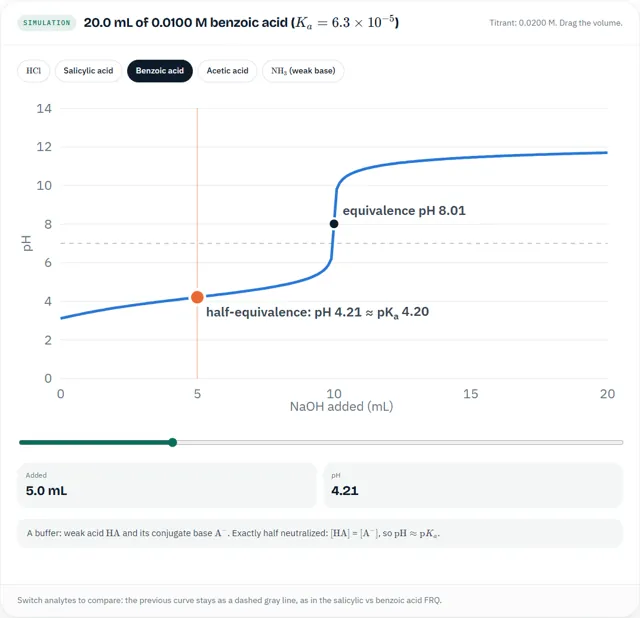
An acid-base titration curve plots pH against the volume of titrant added. At the equivalence point, moles of base added equal moles of acid initially present; for a weak acid titrated with a strong base the pH there is above 7 because the conjugate base remains. At the half-equivalence point , so , which lets you determine from the curve.
Titration curves
Read straight off the curve.
Halfway to equivalence, half the acid has become its conjugate base: , so .
At equivalence a weak acid has become all , so the pH is above 7. A strong acid gives exactly 7.
| Start | only |
| Before equivalence | + : a buffer |
| Half-equivalence | → |
| Equivalence | only → pH > 7 |
| After | excess |
20.0 mL of 0.0100 M
?A weak acid's half-equivalence point is at pH 3.0. At pH 4.0 during the titration, is there more or more ?Think, then tap to check
More . pH 4 is past the half-equivalence point (): , so .
?Benzoic acid has . What is its , and where would its half-equivalence point be?Think, then tap to check
. Same volumes as salicylic acid, so half-equivalence is at the same volume (5.0 mL here), but at pH ≈ 4.2.
Study notes
Key concepts
What a titration is (SAP-9.E.1). In a titration, a solution of known concentration (the titrant, usually in a buret) is added in measured volumes to a known volume of the solution being analysed (the analyte, in a flask). The progress of the reaction is followed with a pH meter or an indicator. A titration curve is a graph of pH (y-axis) against volume of titrant added (x-axis). It summarises the whole experiment.
Equivalence point (SAP-9.E.2). The equivalence point is reached when the moles of titrant added equal the moles of analyte originally present (taking the reaction's mole ratio into account). This is true for strong and for weak acids and bases. It is the basis of every titration calculation:
moles of analyte = (mole ratio) × M(titrant) × V(titrant at equivalence)
The end point is where the indicator changes colour. A good indicator makes the end point match the equivalence point closely.
Strong acid titrated with strong base. Example: 25.00 mL of 0.100 M HCl titrated with 0.100 M NaOH.
| V(NaOH) added (mL) | Species controlling pH | pH |
|---|---|---|
| 0.00 | H₃O⁺ from HCl | 1.00 |
| 12.50 | excess H₃O⁺ | 1.48 |
| 24.00 | excess H₃O⁺ | 2.69 |
| 25.00 (equivalence) | Na⁺, Cl⁻, H₂O only | 7.00 |
| 26.00 | excess OH⁻ | 11.29 |
| 30.00 | excess OH⁻ | 11.96 |
The curve starts low, rises slowly, then shoots almost vertically from about pH 3 to pH 11 around the equivalence point, which is at pH 7.00. There is no buffer region and no meaningful half-equivalence pKa.
Weak acid titrated with strong base. Example: 25.00 mL of 0.100 M CH₃COOH (Ka = 1.8 × 10⁻⁵, pKa = 4.74) titrated with 0.100 M NaOH.
| V(NaOH) added (mL) | Region | Major species | pH |
|---|---|---|---|
| 0.00 | initial weak acid | CH₃COOH | 2.87 |
| 5.00 | buffer | CH₃COOH > CH₃COO⁻ | 4.14 |
| 12.50 | half-equivalence | CH₃COOH = CH₃COO⁻ | 4.74 = pKa |
| 20.00 | buffer | CH₃COO⁻ > CH₃COOH | 5.35 |
| 25.00 | equivalence | CH₃COO⁻ (weak base) | 8.72 |
| 30.00 | after equivalence | excess OH⁻ + CH₃COO⁻ | 11.96 |
Compare the two curves:
| Feature | Strong acid + strong base | Weak acid + strong base |
|---|---|---|
| Initial pH (same concentration) | lower | higher (weak acid only partly ionized) |
| Shape before equivalence | flat, then rises sharply | quick rise, then a gently sloping buffer region |
| Half-equivalence point | not useful | pH = pKa |
| pH at equivalence | 7.00 | above 7 (A⁻ is a weak base) |
| Vertical jump | long (about pH 3 to 11) | shorter (about pH 7 to 11) |
| Volume to reach equivalence | depends only on moles of acid | the same, if moles of acid are the same |
| After equivalence | identical: controlled by excess OH⁻ | identical |
Weak base titrated with strong acid. The curve is the mirror image: it starts at a basic pH, falls through a buffer region, passes the half-equivalence point where pOH = pKb (equivalently pH = pKa of HB⁺), and has an equivalence point below 7 because HB⁺ is a weak acid. For 25.0 mL of 0.100 M NH₃ titrated with 0.100 M HCl, the equivalence pH is 5.28 and the half-equivalence pH is 9.26.
The half-equivalence point (SAP-9.E.3). Halfway to the equivalence point, exactly half of the weak acid has been converted to its conjugate base, so [HA] = [A⁻]. Then the Ka expression simplifies to Ka = [H₃O⁺], so pH = pKa. This is how pKa is measured experimentally: read the equivalence volume from the curve, halve it, and read the pH at that volume. This is the single most tested idea in this topic.
Choosing an indicator. An indicator is itself a weak acid (HIn) whose acid and base forms have different colours (see 8.7). It changes colour over roughly pKa(HIn) ± 1. Choose an indicator whose colour-change range contains the pH at the equivalence point, that is, whose pKa is close to the equivalence pH.
| Indicator | Approximate colour-change range | Good for |
|---|---|---|
| Methyl orange | 3.2–4.4 | strong acid titrated with weak base |
| Methyl red | 4.8–6.0 | weak base with strong acid (equivalence pH about 5) |
| Bromothymol blue | 6.0–7.6 | strong acid with strong base |
| Phenolphthalein | 8.2–10.0 | weak acid with strong base (equivalence pH about 8–9) |
For a strong acid–strong base titration, phenolphthalein also works well, because the vertical jump is so long that the pH passes through 8–10 within a fraction of a drop of the equivalence point.
Polyprotic acids (SAP-9.E.4). A polyprotic acid has more than one acidic proton, removed one at a time, each with its own Ka (Ka₁ > Ka₂ > Ka₃, because it is harder to remove H⁺ from an already negative ion). Examples: H₂CO₃ (pKa₁ = 6.35, pKa₂ = 10.33), H₃PO₄ (pKa₁ = 2.15, pKa₂ = 7.20, pKa₃ = 12.35), H₂C₂O₄ (oxalic acid). When the pKa values are well separated, the titration curve shows one equivalence point (vertical jump) and one buffer region for each acidic proton, so you can count the acidic protons from the curve.
For a diprotic acid H₂A titrated with NaOH, with first equivalence volume V₁ (the second is at 2V₁):
| Volume of NaOH | Major species | pH relationship |
|---|---|---|
| 0 | H₂A | from Ka₁ |
| ½V₁ | H₂A = HA⁻ | pH = pKa₁ |
| V₁ (first equivalence) | HA⁻ | about (pKa₁ + pKa₂)/2 |
| 1½V₁ | HA⁻ = A²⁻ | pH = pKa₂ |
| 2V₁ (second equivalence) | A²⁻ | basic, from Kb of A²⁻ |
| beyond 2V₁ | A²⁻ + excess OH⁻ | from excess OH⁻ |
Important: the volume between the first and second equivalence points is the same as the volume to reach the first one, because each proton needs the same number of moles of OH⁻. The CED states that you must identify species and pKa values on a polyprotic curve qualitatively, but calculating the concentration of every species on a polyprotic titration curve will not be assessed.
Laboratory technique and error analysis. Burets are read to two decimal places in mL (for example 22.45 mL), at the bottom of the meniscus, and the volume delivered is final reading minus initial reading. Rinse the buret with the titrant (not water) so it is not diluted. Water added to the flask does not change the moles of analyte, so it has no effect on the result.
| Error | Effect on V(titrant) | Effect on calculated analyte concentration |
|---|---|---|
| Overshooting the end point (too much titrant added) | too large | too high |
| Stopping before the true equivalence point | too small | too low |
| Buret rinsed with water, so titrant is diluted | too large | too high |
| Air bubble in buret tip that disappears during titration | reading too large | too high |
| Extra distilled water added to the flask | none | no effect |
Key equations
Worked examples
Worked example 8.5-A (concentration from a titration; modelled on 2014 AP FRQ Q2(d)). A 20.00 mL sample of propanoic acid is titrated with 0.150 M NaOH. The end point is reached after 18.64 mL. Calculate the molarity of the acid.
n(OH⁻) = 0.01864 L × 0.150 M = 2.796 × 10⁻³ mol = n(acid) (1: 1). M(acid) = 2.796 × 10⁻³ / 0.02000 L = 0.140 M.
Worked example 8.5-B. 50.0 mL of 0.20 M HA (Ka = 1.0 × 10⁻⁴) is titrated with 0.10 M KOH. Find the pH at the equivalence point.
n(HA) = 0.0500 × 0.20 = 0.010 mol, so V(KOH) = 0.010 / 0.10 = 0.100 L. Total volume = 150. mL. [A⁻] = 0.010 / 0.150 = 0.0667 M. Kb = 1.0 × 10⁻¹⁴ / 1.0 × 10⁻⁴ = 1.0 × 10⁻¹⁰. [OH⁻] = √(1.0 × 10⁻¹⁰ × 0.0667) = 2.6 × 10⁻⁶ M; pOH = 5.59; pH = 8.41. (The original key forgot to add the volume of base.)
Worked example 8.5-C (reading a curve). A 0.50 g sample of an unknown monoprotic acid is titrated with 0.100 M NaOH. The data show a steep rise centred at 34.0 mL, and the pH at 17.0 mL is 4.20. Find pKa and the molar mass.
Half-equivalence volume = 17.0 mL, so pKa = 4.20 (Ka = 6.3 × 10⁻⁵). n(acid) = 0.0340 L × 0.100 M = 3.40 × 10⁻³ mol. Molar mass = 0.50 g / 3.40 × 10⁻³ mol = 1.5 × 10² g/mol.
Worked example 8.5-D. 50.0 mL of a diprotic acid H₂A requires 10.0 mL of 0.200 M KOH to reach the second equivalence point. Find [H₂A].
H₂A + 2 OH⁻ → A²⁻ + 2 H₂O. n(OH⁻) = 0.0100 × 0.200 = 2.00 × 10⁻³ mol, so n(H₂A) = 1.00 × 10⁻³ mol. [H₂A] = 1.00 × 10⁻³ / 0.0500 = 0.0200 M.
Unit 8 study guide: exam-style free-response set, worksheet and answers.
Worked example
- Equivalence needs 25.0 mL of base; at 12.5 mL, .
- At equivalence: 0.00250 mol in 50.0 mL, ; .
- ; , .
- Answer: pH 4.74 at half-equivalence; pH 8.72 at equivalence
Free-response practice
Write your answer first, then open the solution and mark yourself against it.
FRQ 8.5-1 (modelled on 2015 AP FRQ Q3). Sodium benzoate, NaC₆H₅COO, is a food preservative. A student titrates 40.00 mL of a sodium benzoate solution with 1.00 M HCl, using a pH meter. Ka for benzoic acid, C₆H₅COOH, is 6.3 × 10⁻⁵.
(a) Write the net ionic equation for the titration reaction.
(b) 24.60 mL of HCl is needed to reach the equivalence point. Calculate [C₆H₅COO⁻] in the original solution.
(c) The pH at the equivalence point is 2.31. Which indicator would be best: thymol blue (pKa 2.0), methyl red (pKa 5.0), bromothymol blue (pKa 7.0) or phenolphthalein (pKa 9.3)? Justify your answer.
(d) Calculate the pH at the half-equivalence point.
(e) Describe the shape of the titration curve from 0 mL to 30 mL of HCl, mentioning where the half-equivalence point lies.
(f) A soft drink containing benzoate has pH 3.10. Which species, C₆H₅COOH or C₆H₅COO⁻, has the higher concentration in the drink? Justify your answer.
Show the solution
(a) C₆H₅COO⁻(aq) + H₃O⁺(aq) → C₆H₅COOH(aq) + H₂O(l). (1 point)
(b) n(H₃O⁺) = 0.02460 L × 1.00 M = 0.02460 mol = n(C₆H₅COO⁻). Concentration = 0.02460 / 0.04000 = 0.615 M. (1 point)
(c) Thymol blue. Its pKa (2.0) is closest to the equivalence-point pH of 2.31, so it changes colour (over about pH 1–3) at the equivalence point. (1 point)
(d) At half-equivalence [C₆H₅COOH] = [C₆H₅COO⁻], so pH = pKa = −log(6.3 × 10⁻⁵) = 4.20. (1 point)
(e) The curve starts at a basic pH (a solution of a weak base), falls gradually through a buffer region, passes pH 4.20 at 12.30 mL (the half-equivalence point), drops steeply near 24.60 mL to the equivalence point at pH 2.31, and then levels off at low pH as excess HCl is added. (1 point)
(f) C₆H₅COOH. The pH (3.10) is below the pKa (4.20), so the protonated form predominates: [C₆H₅COO⁻]/[C₆H₅COOH] = 10^(3.10 − 4.20) = 0.079. (1 point)
FRQ 8.5-2 (modelled on 2016 AP FRQ Q7). A student titrates 20.0 mL of an unknown monoprotic acid with 0.120 M NaOH. The buret reads 1.25 mL before the titration and 23.70 mL at the end point.
(a) What volume of NaOH should be recorded?
(b) Calculate the concentration of the acid.
(c) In a second trial the student adds NaOH past the end point and records the final reading. Will the calculated acid concentration be too high, too low or unaffected? Justify.
Show the solution
(a) 23.70 − 1.25 = 22.45 mL. (1 point)
(b) n(OH⁻) = 0.02245 × 0.120 = 2.694 × 10⁻³ mol = n(acid). [acid] = 2.694 × 10⁻³ / 0.0200 = 0.135 M. (1 point)
(c) Too high. The recorded volume of NaOH is larger than needed, so the calculated moles of NaOH, and hence moles of acid, are too large; dividing by the same 20.0 mL gives a concentration that is too high. (1 point)
Common mistake
Students assume the equivalence point is always at pH 7. Only for strong acid-strong base titrations; titrating a weak acid gives a basic equivalence point because the conjugate base hydrolyzes.
Frequently asked questions
?Why is pH equal to pKa at the half-equivalence point?
Half the weak acid has been converted to its conjugate base, so and the log term in the Henderson-Hasselbalch equation is zero.
?How do you choose an indicator for a titration?
Pick an indicator whose color change range (about ) includes the pH at the equivalence point.
Practice questions on 8.5
- Q1A weak acid is titrated with NaOH. How does the pH at the equivalence point compare with 7?
- Q2At the half-equivalence point in the titration of a weak acid HA with NaOH,
- Q3A weak acid is titrated with NaOH; the half-equivalence point is at pH 3.0. At pH 4.0, which is true?
- Q4A weak base B with Kb = 1.0 × 10⁻⁹ is titrated with HCl. What is the pH at the half-equivalence point?
- Q550.0 mL of 0.050 M benzoic acid (pKa 4.20) is titrated with 0.100 M NaOH. The pH at the equivalence point is about 8.4. Which indicator is the best choice?
- Q650.0 mL of 0.050 M benzoic acid (pKa 4.20) is titrated with 0.100 M NaOH. At which volume of NaOH is the solution the most effective buffer?
- Q7Equal volumes of two monoprotic acids, A and B, are titrated with the same 0.2 M KOH. Acid A needs twice the volume of KOH to reach equivalence, and its pH at the half-equivalence point is higher. Which is correct?
- Q8A weak diprotic acid H₂A is titrated with 0.1 M NaOH. The first equivalence point is at 7.0 mL and the second at 14.0 mL. At what volume does [HA⁻] = [A²⁻]?
- Q9A titration curve of an unknown acid with NaOH starts at pH 2.3, shows a buffer region, a first steep rise centred at 20.0 mL, a second buffer region, and a second steep rise centred at 40.0 mL. Which description fits the acid?
- Q10A student stops a titration of a monoprotic acid with 0.10 M NaOH before the true equivalence point is reached and uses that volume to calculate the acid concentration. The calculated concentration will be
- Q11An antacid tablet containing Mg(OH)₂ (molar mass 58.32 g/mol) is titrated with 0.150 M HCl. The initial buret reading is 1.20 mL and the final reading is 17.20 mL. What mass of Mg(OH)₂ was in the tablet?
- Q12Equal volumes of 0.10 M HCl and 0.10 M CH₃COOH are each titrated with 0.10 M NaOH. Which is the same for the two titrations?
- Q13H₃PO₄ (0.10 M) is titrated with NaOH. Which species is present in the largest amount at the first equivalence point?
- Q14A student rinses a clean buret with distilled water but not with the NaOH titrant, then uses it to titrate an acid. How does this affect the calculated acid concentration?
- Q1540.0 mL of 0.10 M HA () is titrated with 0.10 M NaOH. What is the pH at the equivalence point?
- Q16HF is titrated with KOH to the phenolphthalein endpoint. Which best describes the solution?
- Q17Where is the equivalence point on a titration curve?
- Q18What volume of 0.40 M KOH titrates 25.0 mL of 0.80 M ?
- Q19A weighed solid acid is dissolved in roughly 30 mL of water and titrated to an indicator endpoint. What equipment is needed, besides ordinary glassware?
- Q20A weak base () is titrated with a strong acid. What is the pH at the half-equivalence point?
- Q21A titration curve shows two distinct steep rises as a strong base is added. What does this indicate?
- Q2220.0 mL of reaches its first equivalence point after 15.0 mL of 0.200 M NaOH. What is ?
- Q23In a weak acid titration, the equivalence point is at 30.0 mL. At what volume does pH = ?
- Q2440.0 mL of a diprotic acid is completely neutralized by 24.0 mL of 0.250 M NaOH. What is the acid concentration?
- Q25Monoprotic acid X needs half as much base as acid Y (same volume of each), and its pH at the half-equivalence point is lower. Which is true?
- Q26A titration curve starts at pH 11 and has its equivalence point at pH 5.2. What does it represent?
- Q27A student overshoots the endpoint when titrating an acid of unknown concentration with standard NaOH. How does the calculated acid concentration compare with the true value?
- Q2820.0 mL of a saturated MOH solution requires 8.00 mL of M HCl. What is the of MOH?
- Q29A weak diprotic acid reaches its first equivalence point at 12.0 mL. At what volume does ?
Terms used in this topic
Stuck on a unit? Let us fix it this week.
Book a 30-minute one-to-one session for $20. Bring a test, a homework set or the topic that is not clicking.
Book a session