 AP Chemistry Tutoring
8.4 Acid-base reactions and buffers
AP Chemistry Unit 8: Acids and Bases · 1 simulation · 14 practice questions
Updated · Aligned to the AP Chemistry Course and Exam Description
When an acid and a base are mixed, they first react by stoichiometry (to completion if either is strong), and what remains sets the pH. Excess strong acid or base sets the pH directly; a mixture of a weak acid and its conjugate base forms a buffer; and a solution containing only a conjugate base, such as , is basic. The net ionic equation for a strong acid with a strong base is .
Reactions & salts
Mixing acids and bases.
If either one is strong, the reaction goes to completion: find the limiting reactant with a table of moles, then see what's left over.
| Strong + strong | · neutral at equivalence |
| Strong acid + weak base | makes · acidic |
| Weak acid + strong base | makes · basic |
| Weak + weak | depends on vs |
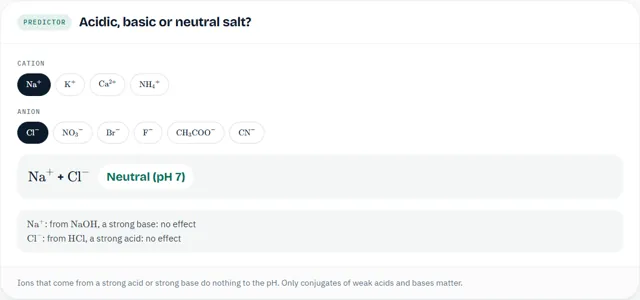
Acidic, basic or neutral salt?
500 mL of 1.0 M KOH is mixed with 300 mL of 2.0 M HBr. What is the pH?
- : . : .
- They react 1 : 1 to completion. is limiting: 0.10 mol is left.
- Total volume 0.800 L: .
? and are each dissolved in water. Which gives a slightly acidic solution, and why?Think, then tap to check
: . (from strong ) does nothing. is actually slightly basic: is the conjugate base of the weak acid .
Study notes
Key concepts
When an acid and a base are mixed, the first job is always the same: write the reaction, do the stoichiometry in moles, then decide what is left over. Reactions involving a strong acid or a strong base go essentially to completion ("react quantitatively"), so you treat them like a limiting-reagent problem before you think about any equilibrium.
Case 1: strong acid + strong base (SAP-9.D.1). The net ionic equation is H₃O⁺(aq) + OH⁻(aq) → 2 H₂O(l) (often written H⁺ + OH⁻ → H₂O). The spectator ions (Na⁺, Cl⁻, etc.) do not affect pH. The pH is set by whichever reagent is in excess, divided by the total volume. If they are exactly equimolar, the pH is 7.00 at 25 °C.
Case 2: weak acid + strong base (SAP-9.D.2). Net ionic equation: HA(aq) + OH⁻(aq) → A⁻(aq) + H₂O(l). The K for this reaction is huge (K = Ka / Kw; for acetic acid 1.8 × 10⁹), so it goes to completion. After the reaction:
- Weak acid in excess: the beaker now contains both HA and A⁻, which is a buffer. Find pH with the Henderson–Hasselbalch equation (topic 8.9).
- Strong base in excess: pH is set by the moles of excess OH⁻ divided by the total volume. (The A⁻ is a much weaker base and its contribution is negligible.)
- Equimolar: only A⁻ remains, so the solution is slightly basic. Find pH from the equilibrium A⁻ + H₂O ⇌ HA + OH⁻ using Kb = Kw / Ka.
Case 3: weak base + strong acid (SAP-9.D.3). Net ionic equation: B(aq) + H₃O⁺(aq) → HB⁺(aq) + H₂O(l), which goes to completion.
- Weak base in excess: B and HB⁺ are both present, a buffer; use Henderson–Hasselbalch.
- Strong acid in excess: pH from the moles of excess H₃O⁺ and the total volume.
- Equimolar: only HB⁺ remains, so the solution is slightly acidic. Use HB⁺ + H₂O ⇌ B + H₃O⁺ with Ka = Kw / Kb.
Case 4: weak acid + weak base (SAP-9.D.4). HA(aq) + B(aq) ⇌ A⁻(aq) + HB⁺(aq) reaches an equilibrium rather than going to completion. Its equilibrium constant is K = Ka(HA) × Kb(B) / Kw. The reaction favours the side with the weaker acid and weaker base. When equimolar amounts are mixed, the solution is acidic if Ka of HB⁺ is larger than Kb of A⁻, and basic if Kb of A⁻ is larger.
Major species. On the AP Exam you are often asked to identify the major species after mixing. Do the stoichiometry and list what is present in large amounts. For example, after mixing equal moles of NH₃ and HCl, the major species are NH₄⁺, Cl⁻ and H₂O; there are no HCl molecules and only a tiny amount of NH₃ and H₃O⁺.
Where buffers come from. A buffer is a solution that contains significant amounts of a weak acid and its conjugate base (or a weak base and its conjugate acid). You can make one by (i) mixing a weak acid with a salt of its conjugate base (CH₃COOH + CH₃COONa), (ii) partially neutralizing a weak acid with a strong base (2017 FRQ Q3(c) idea), or (iii) partially neutralizing a weak base with a strong acid. How buffers work is covered in 8.8 and their pH in 8.9.
Decision table for any mixture.
| After the reaction, what is present? | Type of solution | How to find pH |
|---|---|---|
| Excess strong acid or strong base | Strong | moles excess ÷ total volume |
| Weak acid only | Weak acid | Ka, ICE table |
| Weak base only (including A⁻ at equivalence) | Weak base | Kb = Kw/Ka, ICE table |
| Weak acid + its conjugate base | Buffer | pH = pKa + log([A⁻]/[HA]) |
| Neutral salt only (strong + strong at equivalence) | Neutral | pH = 7.00 at 25 °C |
Key equations
Worked examples
Worked example 8.4-A (strong + strong). 25.0 mL of 0.200 M HCl is mixed with 30.0 mL of 0.150 M NaOH. Find the pH.
n(H₃O⁺) = 0.0250 × 0.200 = 5.00 × 10⁻³ mol; n(OH⁻) = 0.0300 × 0.150 = 4.50 × 10⁻³ mol.
H₃O⁺ is in excess by 5.0 × 10⁻⁴ mol. Total volume = 55.0 mL. [H₃O⁺] = 5.0 × 10⁻⁴ / 0.0550 = 9.1 × 10⁻³ M; pH = 2.04.
Worked example 8.4-B (weak acid + strong base, acid in excess). 50.0 mL of 0.100 M HNO₂ (pKa = 3.40) is mixed with 20.0 mL of 0.100 M NaOH. Find the pH.
| mol | HNO₂ | OH⁻ | NO₂⁻ |
|---|---|---|---|
| Before | 5.00 × 10⁻³ | 2.00 × 10⁻³ | 0 |
| Change | −2.00 × 10⁻³ | −2.00 × 10⁻³ | +2.00 × 10⁻³ |
| After | 3.00 × 10⁻³ | 0 | 2.00 × 10⁻³ |
Both HNO₂ and NO₂⁻ are present, so this is a buffer. Both are in the same volume, so the mole ratio equals the concentration ratio: pH = 3.40 + log(2.00/3.00) = 3.22.
Worked example 8.4-C (weak acid + strong base, equimolar). 50.0 mL of 0.100 M CH₃COOH is mixed with 50.0 mL of 0.100 M NaOH. Ka = 1.8 × 10⁻⁵. Find the pH.
All 5.00 × 10⁻³ mol of acid is converted to acetate, in 100.0 mL: [CH₃COO⁻] = 0.0500 M. Kb = 1.0 × 10⁻¹⁴ / 1.8 × 10⁻⁵ = 5.6 × 10⁻¹⁰. [OH⁻] = √(5.6 × 10⁻¹⁰ × 0.0500) = 5.3 × 10⁻⁶ M; pOH = 5.28; pH = 8.72. Note that this is basic, not 7 (2014 FRQ Q2(c)(i) idea).
Worked example 8.4-D (weak base + strong acid, three cases). NH₃ has Kb = 1.8 × 10⁻⁵ (pKb = 4.74, so pKa of NH₄⁺ = 9.26).
(i) 50.0 mL of 0.20 M NH₃ + 25.0 mL of 0.20 M HCl: 0.010 mol NH₃ reacts with 0.0050 mol H₃O⁺, leaving 0.0050 mol NH₃ and 0.0050 mol NH₄⁺. Buffer with equal amounts: pH = pKa = 9.26.
(ii) 40.0 mL of 0.10 M NH₃ + 40.0 mL of 0.10 M HCl: equimolar; only NH₄⁺ remains, 0.0040 mol in 80.0 mL = 0.050 M. Ka = 5.6 × 10⁻¹⁰; [H₃O⁺] = √(5.6 × 10⁻¹⁰ × 0.050) = 5.3 × 10⁻⁶ M; pH = 5.28 (acidic).
(iii) 20.0 mL of 0.10 M NH₃ + 30.0 mL of 0.10 M HCl: excess H₃O⁺ = 0.0030 − 0.0020 = 0.0010 mol in 50.0 mL = 0.020 M; pH = 1.70.
Worked example 8.4-E (weak acid + weak base; modelled on 2021 AP FRQ Q1(d)). Equal volumes of 0.10 M NH₃ (Kb = 1.8 × 10⁻⁵) and 0.10 M HCN (Ka = 6.2 × 10⁻¹⁰) are mixed. Write the net ionic equation and decide if the result is acidic or basic.
NH₃(aq) + HCN(aq) ⇌ NH₄⁺(aq) + CN⁻(aq). K = (6.2 × 10⁻¹⁰)(1.8 × 10⁻⁵)/(1.0 × 10⁻¹⁴) = 1.1, so the reaction proceeds only partly. Compare the products: Ka(NH₄⁺) = 5.6 × 10⁻¹⁰, Kb(CN⁻) = 1.0 × 10⁻¹⁴ / 6.2 × 10⁻¹⁰ = 1.6 × 10⁻⁵. Since Kb(CN⁻) > Ka(NH₄⁺), CN⁻ produces more OH⁻ than NH₄⁺ produces H₃O⁺, and the solution is basic.
Unit 8 study guide: exam-style free-response set, worksheet and answers.
Worked example
- Moles: mol, mol; they react 1 : 1.
- Excess : mol in L, so .
- .
- Answer: pH = 1.602
Free-response practice
Write your answer first, then open the solution and mark yourself against it.
FRQ 8.4-1. Methanoic acid, HCOOH, has Ka = 1.8 × 10⁻⁴ (pKa = 3.74). A student has 0.10 M HCOOH and 0.10 M KOH.
(a) Write the net ionic equation for the reaction between HCOOH(aq) and KOH(aq).
(b) The student mixes 50.0 mL of the HCOOH with 25.0 mL of the KOH. Identify the major species (other than water and K⁺) and calculate the pH.
(c) The student mixes 30.0 mL of the HCOOH with 40.0 mL of the KOH. Calculate the pH.
(d) The student mixes 50.0 mL of the HCOOH with 50.0 mL of the KOH. Calculate the pH and explain why it is not 7.00.
Show the solution
(a) HCOOH(aq) + OH⁻(aq) → HCOO⁻(aq) + H₂O(l). (1 point)
(b) n(HCOOH) = 5.0 × 10⁻³ mol, n(OH⁻) = 2.5 × 10⁻³ mol. After reaction: 2.5 × 10⁻³ mol HCOOH and 2.5 × 10⁻³ mol HCOO⁻. Major species: HCOOH and HCOO⁻ (a buffer). pH = pKa + log(1) = 3.74. (2 points)
(c) n(HCOOH) = 3.0 × 10⁻³ mol, n(OH⁻) = 4.0 × 10⁻³ mol; excess OH⁻ = 1.0 × 10⁻³ mol in 70.0 mL. [OH⁻] = 0.0143 M; pOH = 1.85; pH = 12.15. (2 points)
(d) Only HCOO⁻ remains: 5.0 × 10⁻³ mol in 100.0 mL = 0.050 M. Kb = 1.0 × 10⁻¹⁴ / 1.8 × 10⁻⁴ = 5.6 × 10⁻¹¹. [OH⁻] = √(5.6 × 10⁻¹¹ × 0.050) = 1.7 × 10⁻⁶ M; pOH = 5.78; pH = 8.22. The pH is above 7 because the conjugate base of a weak acid, HCOO⁻, reacts with water to produce OH⁻. (2 points)
FRQ 8.4-2 (modelled on 2021 AP FRQ Q1(d)). Hydrazine, H₂NNH₂, is a weak base (Kb = 1.3 × 10⁻⁶). 50.0 mL of 0.25 M H₂NNH₂ is mixed with 50.0 mL of 0.25 M HF (Ka = 6.8 × 10⁻⁴).
(a) Write the balanced net ionic equation for the reaction.
(b) Is the resulting solution acidic, basic or neutral? Justify your answer with Ka and Kb values.
Show the solution
(a) H₂NNH₂(aq) + HF(aq) ⇌ H₂NNH₃⁺(aq) + F⁻(aq). (1 point)
(b) Acidic. Ka(H₂NNH₃⁺) = Kw / Kb = 1.0 × 10⁻¹⁴ / 1.3 × 10⁻⁶ = 7.7 × 10⁻⁹. Kb(F⁻) = 1.0 × 10⁻¹⁴ / 6.8 × 10⁻⁴ = 1.5 × 10⁻¹¹. Equal amounts of the two ions are formed, and H₂NNH₃⁺ is a stronger acid than F⁻ is a base (7.7 × 10⁻⁹ > 1.5 × 10⁻¹¹), so more H₃O⁺ than OH⁻ is produced. (1 point for comparing the correct constants, 1 point for the conclusion)
Common mistake
Students forget to use the combined volume after mixing. After the reaction, divide the moles left over by the total volume of both solutions.
Frequently asked questions
?Is the solution neutral after an acid-base reaction?
Only if equal moles of a strong acid and strong base react. A weak acid neutralized by a strong base gives a basic solution because the conjugate base remains.
?Is a solution of sodium acetate acidic or basic?
Basic: acetate is the conjugate base of a weak acid and reacts with water to form .
Practice questions on 8.4
- Q1500 mL of 1.0 M KOH is mixed with 300 mL of 2.0 M HBr. What is the pH of the mixture?
- Q2Equal volumes of equimolar NH₃(aq) and HCl(aq) are mixed. Which species are present in the largest amounts (apart from water) after the reaction?
- Q310.0 mL of 2.0 M HCl is mixed with 5.0 mL of 1.0 M NaOH. What is the pH of the mixture?
- Q41.00 L of 2.0 M HCl is mixed with 1.50 L of 1.0 M NaOH. What is the approximate pH?
- Q540.0 mL of 0.10 M HNO₂ (Ka = 4.0 × 10⁻⁴) is mixed with 20.0 mL of 0.15 M NaOH. What is the pH?
- Q6In which mixture (in 1 L of water) is pH equal to the pKa of the weak acid HA?
- Q7For the reaction CH₃COOH(aq) + CN⁻(aq) ⇌ HCN(aq) + CH₃COO⁻(aq), K = 3.7 × 10⁴ at 25 °C. Which conclusion is justified?
- Q8Which pair, mixed in a 1: 1 mole ratio in water, gives a solution with pH greater than 7 at 25 °C?
- Q9Each solution contains a 1: 1 mole ratio of the two substances, each at 1 M. Which solution has the lowest pH?
- Q10Each solution contains a 1:1 mole ratio of the two substances, each at 1 M. Which solution is most nearly neutral?
- Q110.10 mol of a weak acid HA is mixed with 0.050 mol of NaOH in water. Which list gives the major solute species in the final solution?
- Q12Equal moles of and NaOH react. Which species are mainly present afterwards?
- Q13500 mL of 1.0 M is mixed with 400 mL of 2.0 M KOH. What is the approximate pH?
- Q1420.0 mL of 1.0 M HCl is mixed with 10.0 mL of 1.0 M NaOH. What is the pH?
Terms used in this topic
Stuck on a unit? Let us fix it this week.
Book a 30-minute one-to-one session for $20. Bring a test, a homework set or the topic that is not clicking.
Book a session