 AP Chemistry Tutoring
9.10 Electrolysis and Faraday's law
AP Chemistry Unit 9: Thermodynamics and Electrochemistry · 1 simulation · 17 practice questions
Updated · Aligned to the AP Chemistry Course and Exam Description
Electrolysis uses an external electrical current to drive a thermodynamically unfavorable redox reaction, such as plating a metal from its ions. Faraday's law relates the charge passed to the amount of reaction: charge (amperes seconds), moles of electrons with , and moles of product follow from the half-reaction stoichiometry.
Nonstandard cells & Faraday's law
Concentration moves the voltage.
Treat the cell like any equilibrium. A smaller (more reactant ions) raises . A larger (more product ions) lowers . At equilibrium and : the battery is dead.
The AP exam asks for the direction qualitatively. Try the concentration sliders on the cell above.
?In the / cell, is lowered to 0.010 M while stays at 1.0 M. Is above or below 1.10 V?Think, then tap to check
Current × time = charge. Charge ÷ = moles of electrons.
Then use the half-reaction's mole ratio to get moles of metal, and the molar mass to get grams.
| current in amperes () | |
| time in seconds | |
| per mole of |
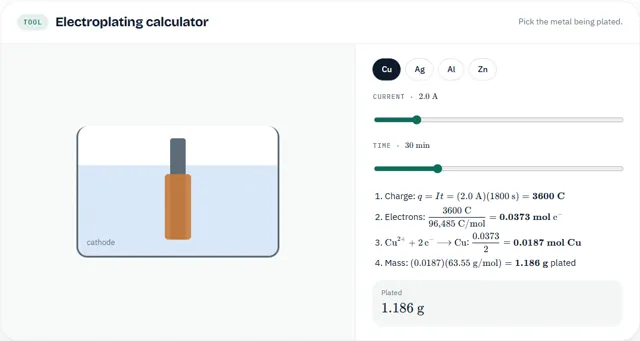
Electroplating calculator
?How long does a 2.00 A current take to plate 1.00 g of copper from ?Think, then tap to check
; ; . .
?The same charge passes through and solutions. Which plates more moles of metal?Think, then tap to check
Silver, twice as many moles. needs 1 electron per atom; needs 2.
Study notes
Key concepts
Charge, current and time. Electric current I is the rate of flow of charge: I = q/t, where q is charge in coulombs (C), t is time in seconds (s), and I is in amperes (A = C/s). So q = I × t. Always convert minutes or hours to seconds.
The Faraday constant. One mole of electrons carries a charge of F = 96,485 C (often rounded to 96,500 C in older material). F is simply Avogadro's number times the charge on one electron: (6.022 × 10²³)(1.602 × 10⁻¹⁹ C) = 96,485 C/mol. So moles of electrons = q/F.
Faraday's laws as stoichiometry (ENE-6.D.1). The half-reaction at an electrode connects moles of electrons to moles of substance. For example:
| Half-reaction | Moles e⁻ per mole of product |
|---|---|
| Ag⁺ + e⁻ → Ag | 1 |
| Cu²⁺ + 2 e⁻ → Cu | 2 |
| Al³⁺ + 3 e⁻ → Al | 3 |
| 2 Cl⁻ → Cl₂ + 2 e⁻ | 2 per Cl₂ |
| 2 H₂O → O₂ + 4 H⁺ + 4 e⁻ | 4 per O₂ |
This lets you calculate any one of the following from the others: (a) number of electrons transferred, (b) mass deposited on (or removed from) an electrode, (c) current, (d) time, (e) the charge of an ionic species.
The road map. Every Faraday calculation follows the same chain. Use it forwards or backwards:
current and time → charge (q = It) → moles of e⁻ (÷ F) → moles of substance (÷ electrons per formula unit, from the half-reaction) → grams (× molar mass) or litres of gas (PV = nRT).
Same charge, different products. When cells are connected in series, the same charge passes through each. The moles of each product are then in the ratio set by the electrons each needs: 1 mol e⁻ deposits 1 mol Ag but only 1/2 mol Cu and 1/3 mol Al.
Practical points. The mass of the cathode increases when metal is plated; the mass of an active (metal) anode decreases. Real cells are rarely 100% efficient, because side reactions (such as reduction of water to H₂) use some of the charge. If an experiment gives less product than predicted, inefficiency is a common reason.
Key equations
(ℳ is molar mass.)
Worked examples
Example 9.10-A (mass from current and time). A current of 2.00 A passes through CuSO₄(aq) for 30.0 min. What mass of copper is deposited at the cathode?
Solution.
q = It = (2.00 C/s)(30.0 × 60 s) = 3600 C.
mol e⁻ = 3600 ÷ 96,485 = 0.03731 mol.
Cu²⁺ + 2 e⁻ → Cu, so mol Cu = 0.03731 ÷ 2 = 0.01866 mol.
mass Cu = 0.01866 × 63.55 = 1.19 g.
Example 9.10-B (time from mass). How long does it take to plate 2.00 g of silver from AgNO₃(aq) using a current of 0.500 A?
Solution. mol Ag = 2.00 ÷ 107.87 = 0.01854 mol = mol e⁻ (1 e⁻ per Ag). q = 0.01854 × 96,485 = 1789 C. t = q/I = 1789 ÷ 0.500 = 3.58 × 10³ s (59.6 min).
Example 9.10-C (charge of an ion). A current passes through a solution of a chromium salt until 965 C have been delivered. The cathode gains 0.1733 g of Cr. What is the charge on the chromium ion?
Solution. mol e⁻ = 965 ÷ 96,485 = 0.01000 mol. mol Cr = 0.1733 ÷ 52.00 = 0.003333 mol. Electrons per Cr = 0.01000 ÷ 0.003333 = 3.00. The ion is Cr³⁺.
Example 9.10-D (volume of gas). Water containing a little H₂SO₄ is electrolysed with 1.50 A for 1.00 h. What volume of H₂(g) is collected at 298 K and 1.00 atm?
Solution. q = 1.50 × 3600 = 5400 C; mol e⁻ = 5400 ÷ 96,485 = 0.05597 mol. 2 H⁺ + 2 e⁻ → H₂, so mol H₂ = 0.02798 mol. V = nRT/P = (0.02798)(0.08206)(298) ÷ 1.00 = 0.684 L. (Half as many moles of O₂, 0.0140 mol, form at the anode, because O₂ needs 4 e⁻.)
Unit 9 study guide: exam-style free-response set, worksheet and answers.
Worked example
- Charge: .
- Moles of electrons: ; gives 0.0187 mol Cu.
- Mass: .
- Answer: 1.19 g Cu
Free-response practice
Write your answer first, then open the solution and mark yourself against it.
FRQ 9.10-1. Sodium metal and chlorine gas are made by electrolysis of molten NaCl. A cell runs at a steady current of 25.0 A for 2.00 h.
(a) Write the half-reactions at the anode and at the cathode.
(b) Calculate the number of moles of electrons transferred.
(c) Calculate the mass of Na produced.
(d) Calculate the volume of Cl₂(g) produced, measured at 298 K and 1.00 atm.
(e) Explain why the NaCl must be molten and not solid.
Show the solution
(a) Anode: 2 Cl⁻ → Cl₂(g) + 2 e⁻. Cathode: Na⁺ + e⁻ → Na(l) (1 point).
(b) q = 25.0 × 2.00 × 3600 = 1.80 × 10⁵ C; mol e⁻ = 1.80 × 10⁵ ÷ 96,485 = 1.87 mol (1 point).
(c) mol Na = 1.87 mol; mass = 1.866 × 22.99 = 42.9 g (1 point).
(d) mol Cl₂ = 1.866 ÷ 2 = 0.933 mol; V = (0.933)(0.08206)(298) ÷ 1.00 = 22.8 L (1 point).
(e) In solid NaCl the ions are fixed in the lattice and cannot move to the electrodes, so the solid does not conduct and no current can flow. When molten, the ions are mobile (1 point).
FRQ 9.10-2. Based on the CED sample activity for this topic. A student weighs a clean copper penny, connects it to the electrode of a 9-volt battery that supplies electrons, and connects a zinc strip to the other terminal. Both are placed in a solution containing zinc ions for 10.0 min. The penny is then dried and weighed.
| Measurement | Value |
|---|---|
| Mass of penny before | 2.5013 g |
| Mass of penny after | 2.5275 g |
| Time | 10.0 min |
(a) Is the penny the anode or the cathode? Write the half-reaction occurring on it.
(b) Calculate the average current, assuming all the charge was used to deposit zinc.
(c) The student did not dry the penny completely before the final weighing. Would the calculated current be too high, too low or unaffected? Explain.
(d) Another student finds that her calculated current is lower than the value read on an ammeter in the circuit. Suggest a chemical reason.
Show the solution
(a) Cathode (1 point). Zn²⁺(aq) + 2 e⁻ → Zn(s).
(b) mass Zn = 2.5275 − 2.5013 = 0.0262 g; mol Zn = 0.0262 ÷ 65.38 = 4.01 × 10⁻⁴ mol; mol e⁻ = 8.01 × 10⁻⁴ mol; q = 8.01 × 10⁻⁴ × 96,485 = 77.3 C; I = 77.3 ÷ 600. s = 0.129 A (1 point set-up, 1 point answer).
(c) Too high (1 point). Leftover water adds to the final mass, so the calculated mass of Zn, the moles of electrons and the current are all too large.
(d) Some of the charge was used by a side reaction, such as reduction of water to H₂(g) at the penny, so less zinc was deposited than the charge would predict.
Common mistake
Students forget to convert time to seconds or ignore the number of electrons in the half-reaction. Use in seconds, and divide moles of electrons by the electrons per ion (2 for ).
Frequently asked questions
?What is the formula for Faraday's law?
and moles of electrons ; then use the half-reaction to convert to moles of product.
?Is the anode positive or negative in electrolysis?
In an electrolytic cell the anode is connected to the positive terminal, but oxidation still occurs at the anode, as in every cell.
Practice questions on 9.10
- Q1A current of 2.00 A is passed through a solution of for 965 s. What mass of copper is deposited? (; Cu = 63.55 g/mol)
- Q2The same charge is passed through solutions of and . How do the moles of metal deposited compare?
- Q3A current of 2.0 A passes through 1.0 M PdSO₄(aq). About how long does it take to deposit 100. g of Pd (molar mass 106.42 g/mol) by reduction of Pd²⁺?
- Q4A steady current deposits 6.0 g of Cu from CuSO₄(aq) in 1.00 × 10⁵ s. What is the current?
- Q5A current of 6.0 A flows for 200. s. How many moles of electrons are transferred?
- Q6In electroplating with Cu²⁺(aq), a current of 20.0 A flows for 1000. s. About how many moles of copper are deposited?
- Q7Which expression correctly relates the charge q passed during electrolysis to the moles of electrons, n(e⁻)?
- Q8The same quantity of charge is passed through three cells in series containing molten NaCl, molten MgCl₂ and molten AlCl₃. If 0.60 mol of Na is produced, how many moles of Al are produced?
- Q9Which combination of measured values can be used to estimate Avogadro's number, N_A, from an electrolysis experiment, given the charge of one electron e = 1.602 × 10⁻¹⁹ C?
- Q10How long must a 3.00 A current run to deposit 12.7 g of Cu from a solution?
- Q115.40 g of Ag is deposited from an solution in 1800 s. What current was used?
- Q12A 4.00 A current flows for 965 s. How many moles of electrons are transferred?
- Q13A 10.0 A current flows for 1930 s through a solution. How many moles of Ni are deposited?
- Q14How long does a 100 A current take to produce 27.0 g of Al from ?
- Q15Which equation relates the charge passed to the moles of electrons?
- Q16The same charge passes through cells containing , and connected in series. Which deposits the most moles of metal?
- Q17Which expression gives Avogadro's number from the Faraday constant and the electron charge ?
Terms used in this topic
Stuck on a unit? Let us fix it this week.
Book a 30-minute one-to-one session for $20. Bring a test, a homework set or the topic that is not clicking.
Book a session