 AP Chemistry Tutoring
9.9 Cell potential under nonstandard conditions
AP Chemistry Unit 9: Thermodynamics and Electrochemistry · 1 simulation · 14 practice questions
Updated · Aligned to the AP Chemistry Course and Exam Description
When concentrations are not 1 M, the cell potential differs from according to the Nernst equation, . If (more reactant), ; if (more product), . As a galvanic cell operates, increases toward and falls until at equilibrium, when the battery is dead.
Nonstandard cells & Faraday's law
Concentration moves the voltage.
Treat the cell like any equilibrium. A smaller (more reactant ions) raises . A larger (more product ions) lowers . At equilibrium and : the battery is dead.
The AP exam asks for the direction qualitatively. Try the concentration sliders on the cell above.
?In the / cell, is lowered to 0.010 M while stays at 1.0 M. Is above or below 1.10 V?Think, then tap to check
Current × time = charge. Charge ÷ = moles of electrons.
Then use the half-reaction's mole ratio to get moles of metal, and the molar mass to get grams.
| current in amperes () | |
| time in seconds | |
| per mole of |
Electroplating calculator
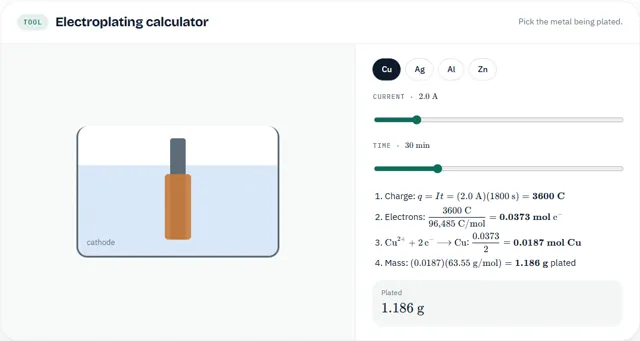
?How long does a 2.00 A current take to plate 1.00 g of copper from ?Think, then tap to check
; ; . .
?The same charge passes through and solutions. Which plates more moles of metal?Think, then tap to check
Silver, twice as many moles. needs 1 electron per atom; needs 2.
Study notes
Key concepts
Concentration changes the cell potential (ENE-6.C.1). E° applies only when every solution is 1 M and every gas is 1 atm, so that the reaction quotient Q = 1 (ENE-6.C.3). In a real cell the concentrations are different, and the cell potential E differs from E°. The cell potential is a driving force toward equilibrium: the farther the reaction is from equilibrium, the larger the size of E.
The rule to remember. Compare Q with 1 for a cell whose reaction is favored (E° > 0, K > 1):
| Condition | Effect | Why |
|---|---|---|
| Q < 1 (more reactant ions, fewer product ions than standard) | E > E° | System is further from equilibrium (Q is further below K) |
| Q = 1 | E = E° | Standard conditions |
| 1 < Q < K | 0 < E < E° | System is closer to equilibrium |
| Q = K | E = 0 | At equilibrium: the battery is "dead" |
As a galvanic cell runs, reactant ions are used up and product ions build up, so Q rises toward K and E falls. When Q = K, ΔG = 0, E = 0, and no current flows.
The Nernst equation (ENE-6.C.4). The CED expects you to use it qualitatively (to reason about the direction of change). Algorithmic calculations alone are not enough on the exam: you must explain in words. In the equation, a larger Q makes the subtracted term larger, so E decreases; a smaller Q (ln Q negative) makes E larger than E°. When writing Q, leave out solids and pure liquids, just as for K.
At 298 K the equation can also be written E = E° − (0.0592/n) log Q. You may see this in older material; use it only for checking.
Why Le Châtelier is not the explanation (ENE-6.C.2). The CED points out that equilibrium arguments such as Le Châtelier's principle do not apply to a working electrochemical cell, because the system is not at equilibrium. Justify changes in cell potential with Q compared with 1 (or with K), or with the Nernst equation, not with "the equilibrium shifts". A good exam sentence: "Increasing [Cu²⁺] decreases Q. Since E = E° − (RT/nF) ln Q, a smaller Q makes E larger."
Diluting both solutions. If both ion concentrations change by the same factor and the ions appear with the same power in Q (for example Q = [Zn²⁺]/[Cu²⁺]), then Q is unchanged and E is unchanged. However, there are fewer moles of reactant ions, so the cell runs for a shorter time.
Concentration cells. Both half-cells use the same half-reaction but different concentrations, for example Cu in 0.010 M Cu²⁺ and Cu in 1.0 M Cu²⁺. E° = 0, but E > 0 because the system is not at equilibrium. The system moves toward equal concentrations: in the dilute half-cell, Cu is oxidized to Cu²⁺ (raising that concentration), so it is the anode. In the concentrated half-cell, Cu²⁺ is reduced (lowering that concentration), so it is the cathode. Electrons flow from the dilute side to the concentrated side. The cell is dead when the two concentrations are equal.
Gases. For a reaction that uses a gas, lower partial pressure of a reactant gas increases Q and lowers E (for example, a zinc–air cell used at high altitude, where P(O₂) is lower, gives a slightly lower voltage).
Key equations
Worked examples
Example 9.9-A (qualitative). In a Zn/Cu cell, Zn(s) + Cu²⁺(aq) → Zn²⁺(aq) + Cu(s), E° = 1.10 V. Predict whether E is greater than, less than or equal to 1.10 V when (a) [Zn²⁺] = 1.0 M and [Cu²⁺] = 0.010 M; (b) [Zn²⁺] = 0.010 M and [Cu²⁺] = 1.0 M; (c) both are 0.10 M.
Solution. Q = [Zn²⁺]/[Cu²⁺].
(a) Q = 100 > 1. ln Q is positive, so E < E°. Check with numbers: E = 1.10 − (0.0592/2) log 100 = 1.04 V.
(b) Q = 0.010 < 1. ln Q is negative, so E > E°: E = 1.10 + 0.059 = 1.16 V.
(c) Q = 1, so E = E° = 1.10 V. The cell would run for a shorter time than a 1.0 M cell of the same volume, because there are fewer Cu²⁺ ions to react.
Example 9.9-B (concentration cell). Two Cu electrodes dip into 0.010 M Cu²⁺ (beaker A) and 1.0 M Cu²⁺ (beaker B), joined by a wire and salt bridge. Identify the anode, the direction of electron flow, and how E changes over time.
Solution. The system moves toward equal concentrations. In A (dilute), Cu → Cu²⁺ + 2 e⁻ raises [Cu²⁺], so A is the anode. In B, Cu²⁺ + 2 e⁻ → Cu lowers [Cu²⁺], so B is the cathode. Electrons flow through the wire from A to B. The initial E is (0.0592/2) log(1.0/0.010) = 0.059 V, and it falls to 0 when the concentrations become equal.
Unit 9 study guide: exam-style free-response set, worksheet and answers.
Worked example
- , so and .
- Check with the Nernst equation: .
- Answer: ;
Free-response practice
Write your answer first, then open the solution and mark yourself against it.
FRQ 9.9-1. Modelled on 2014 AP FRQ Q3(d). A standard galvanic cell is made from a Ni electrode in 1.0 M Ni(NO₃)₂ and a Cu electrode in 1.0 M Cu(NO₃)₂, each solution 100. mL. The cell reaction is Ni(s) + Cu²⁺(aq) → Ni²⁺(aq) + Cu(s), E° = +0.59 V.
(a) A second cell is identical except that both solutions are 0.20 M instead of 1.0 M. Is its initial cell potential greater than, less than or equal to that of the standard cell? Justify.
(b) Would the second cell power a small clock for a longer time, a shorter time or the same time as the standard cell? Justify.
(c) A third cell uses 1.0 M Cu(NO₃)₂ and 0.010 M Ni(NO₃)₂. Is its initial cell potential greater than, less than or equal to 0.59 V? Justify using the Nernst equation qualitatively.
Show the solution
(a) Equal (1 point). Q = [Ni²⁺]/[Cu²⁺] = 0.20/0.20 = 1, the same as in the standard cell, so E = E° (1 point).
(b) A shorter time (1 point). The second cell contains fewer moles of Cu²⁺ (0.020 mol rather than 0.10 mol), so the reaction reaches equilibrium (Q = K) after less charge has flowed (1 point).
(c) Greater than 0.59 V (1 point). Q = 0.010/1.0 = 0.010 < 1, so ln Q is negative and the term −(RT/nF) ln Q is positive, making E > E°. The cell starts further from equilibrium (1 point).
FRQ 9.9-2. A student builds a concentration cell: Ag electrode in 0.0010 M AgNO₃ (half-cell A) and Ag electrode in 1.0 M AgNO₃ (half-cell B), with a KNO₃ salt bridge.
(a) What is E° for this cell? Explain.
(b) Identify the anode and the direction of electron flow. Justify.
(c) What will the cell potential be after a very long time? Explain.
Show the solution
(a) E° = 0 V. Both half-cells use the same half-reaction, Ag⁺ + e⁻ → Ag, so E°(cathode) − E°(anode) = 0.
(b) Half-cell A is the anode; electrons flow through the wire from A to B. The system moves toward equal [Ag⁺]: Ag is oxidized in A (raising [Ag⁺] there) and Ag⁺ is reduced in B (lowering [Ag⁺] there).
(c) Zero. When the two concentrations become equal, Q = 1 = K for the concentration cell, so the system is at equilibrium and there is no driving force.
Common mistake
Students think changes as a battery is used. is fixed for standard conditions; the actual potential decreases because increases as products build up.
Frequently asked questions
?Why does a battery voltage drop as it is used?
Reactants are consumed and products build up, so increases and decreases until it reaches zero at equilibrium.
?What is E at equilibrium?
Zero. At equilibrium , so there is no driving force for electrons to flow.
Practice questions on 9.9
- Q1In the Zn/Cu galvanic cell (), is lowered to 0.010 M while stays at 1.0 M. The cell voltage is
- Q2A galvanic cell is built from Co and Ni electrodes in 1.0 M Co(NO₃)₂ and 1.0 M Ni(NO₃)₂. The reaction is Co(s) + Ni²⁺(aq) → Co²⁺(aq) + Ni(s), E° = +0.03 V. Which change decreases the cell potential?
- Q3When a galvanic battery is "dead", which statement is true?
- Q4A galvanic cell uses Cu²⁺ + 2 e⁻ → Cu (+0.34 V) and Fe²⁺ + 2 e⁻ → Fe (−0.44 V), starting with 1.0 M solutions. Which describes the cell after it has run for a long time and is close to equilibrium?
- Q5A galvanic cell runs on Fe(s) + Cu²⁺(aq) → Fe²⁺(aq) + Cu(s), E° = +0.78 V. At 25 °C, which starting concentrations give the largest cell voltage?
- Q6In the cell 2 Ag⁺(aq) + Cu(s) → 2 Ag(s) + Cu²⁺(aq), started under standard conditions, [Ag⁺] is increased. What happens to the cell potential?
- Q7Which quantities are equal to zero for every electrochemical system at equilibrium?
- Q8For ( V), which change increases ?
- Q9When a galvanic cell is completely "dead":
- Q10A Zn/Cu cell () has been running and is close to equilibrium. Which describes the concentrations?
- Q11Which conditions give the highest voltage for a Zn/Cu cell ()?
- Q12In a cell running , is decreased. What happens to ?
- Q13Which quantities are zero for any system at equilibrium?
- Q14Given (0.22 V) and (0.80 V), what can be said about of AgCl?
Terms used in this topic
Stuck on a unit? Let us fix it this week.
Book a 30-minute one-to-one session for $20. Bring a test, a homework set or the topic that is not clicking.
Book a session