 AP Chemistry Tutoring
1.3 Elemental composition of pure substances
AP Chemistry Unit 1: Atomic Structure and Properties · 1 simulation · 22 practice questions
Updated · Aligned to the AP Chemistry Course and Exam Description
A pure substance has a fixed composition, so every sample has the same mass percent of each element (the law of definite proportions). Mass percent is , and converting mass percents to mole ratios gives the empirical formula, the simplest whole-number ratio of atoms in the compound.
Formulas from data
Empirical vs molecular.
A pure compound always has the same mass ratio of elements. From that ratio you get the empirical formula: the simplest whole-number ratio.
The molecular formula is a whole-number multiple of it. You need the molar mass to find it.
A compound is 40.0% C, 6.67% H and 53.3% O. Find its empirical formula.
- Assume 100 g: 40.0 g C, 6.67 g H, 53.3 g O.
- C: · H: · O: mol
- Divide by the smallest (3.33):
- . (If you get a ratio ending in .5, multiply everything by 2.)
Empirical formula , molar mass 70 g/mol. Molecular formula?
- Mass of :
- Multiply every subscript by 5:
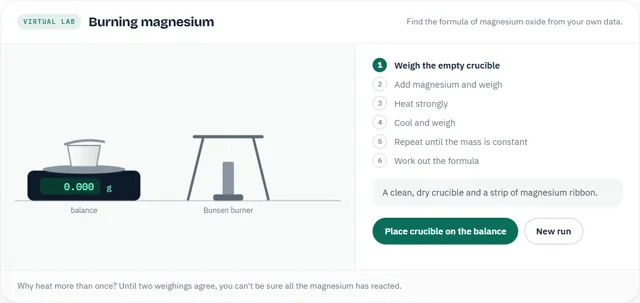
Burning magnesium
?A 42 g sample has 36 g C and 6 g H. Can you find its molecular formula?Think, then tap to check
No, only the empirical formula: mol C, mol H, so . Masses give a ratio; you'd need the molar mass for the molecular formula.
Study notes
Key concepts
Pure substances (SPQ-2.A.1). A pure substance has a fixed composition. There are two kinds of pure substance. Elements contain only one kind of atom. Compounds contain two or more elements chemically combined in a fixed ratio. Some compounds are made of separate molecules (for example H₂O, CO₂, C₆H₁₂O₆). Others, especially ionic compounds, are extended networks of atoms or ions with no separate molecules. For these we use a formula unit: the smallest whole-number ratio of ions (for example NaCl or MgCl₂).
Law of definite proportions (SPQ-2.A.2). This law is also called the law of constant composition (Proust). Any pure sample of a compound always has the same ratio of masses of its elements, no matter where the sample came from or how it was made. Pure water is always 11.19% H and 88.81% O by mass. If a sample's mass percentages do not match the compound's, the sample is impure (or it is a different compound).
Law of multiple proportions (Dalton). When two elements form more than one compound, the masses of one element that combine with a fixed mass of the other are in a ratio of small whole numbers. In CO, 1.000 g of C combines with 1.332 g of O; in CO₂, 1.000 g of C combines with 2.664 g of O. The ratio is 2.664: 1.332 = 2: 1. This was early evidence that atoms combine as whole units.
Percent composition by mass. The percent of an element in a compound is the mass of that element in one mole of the compound divided by the molar mass, times 100.
Empirical vs molecular formula (SPQ-2.A.3). The empirical formula gives the lowest whole-number ratio of atoms. The molecular formula gives the actual number of each atom in one molecule. The molecular formula is always a whole-number multiple of the empirical formula.
| Compound | Molecular formula | Empirical formula |
|---|---|---|
| Glucose | C₆H₁₂O₆ | CH₂O |
| Benzene | C₆H₆ | CH |
| Styrene | C₈H₈ | CH |
| Hydrogen peroxide | H₂O₂ | HO |
| Water | H₂O | H₂O |
Different compounds can share the same empirical formula (for example benzene and styrene, both CH; or glucose and formaldehyde, both CH₂O). They have the same percent composition by mass but different molar masses and different properties. Ionic compounds are always written with their empirical formula (the formula unit).
How to find an empirical formula from mass data.
-
Assume 100 g of compound if you are given percentages, so each percentage becomes grams.
-
Convert the mass of each element to moles (divide by molar mass).
-
Divide every mole value by the smallest one.
-
If the ratios are not all close to whole numbers, multiply them all by a small integer (for example, 1.5 → × 2; 1.33 → × 3; 1.25 → × 4).
How to find a molecular formula. Find the empirical formula and its mass. Then n = (molar mass) ÷ (empirical formula mass). Multiply every subscript by n.
Combustion analysis. A compound containing C, H (and possibly O) is burned in excess oxygen. All of the carbon ends up in CO₂ and all of the hydrogen ends up in H₂O. Mass of C = mass of CO₂ × (12.01 ÷ 44.01). Mass of H = mass of H₂O × (2.016 ÷ 18.02). Any oxygen in the compound is found by difference (mass of sample − mass of C − mass of H).
Hydrates. A hydrate contains water molecules in its crystal, for example CuSO₄·5H₂O. Heating drives off the water. From the mass lost you can find the ratio of moles of water to moles of anhydrous salt.
Common misconceptions.
-
When finding moles, use the molar mass of the atom, not of the diatomic element (use 16.00 for O, not 32.00).
-
Do not round ratios too early. 1.33 is not "about 1"; it means multiply by 3.
-
A compound with more atoms of an element does not always have a higher percent of that element. Compare masses, not numbers of atoms: H₂O (88.8% O) has a higher percent of oxygen than CO₂ (72.7% O).
Key equations
Worked examples
Worked example 1.3a — empirical formula from percentages. A compound is 40.0% C, 6.71% H and 53.3% O by mass. Its molar mass is 180. g/mol. Find the empirical and molecular formulas.
| Element | Mass in 100 g | Moles | Divide by smallest |
|---|---|---|---|
| C | 40.0 g | 40.0 ÷ 12.01 = 3.33 | 1.00 |
| H | 6.71 g | 6.71 ÷ 1.008 = 6.66 | 2.00 |
| O | 53.3 g | 53.3 ÷ 16.00 = 3.33 | 1.00 |
Empirical formula = CH₂O (mass 30.03 g/mol). n = 180. ÷ 30.03 = 6. Molecular formula = C₆H₁₂O₆.
Worked example 1.3b — combustion analysis. A 0.255 g sample of a compound containing only C, H and O is burned completely. It produces 0.561 g CO₂ and 0.306 g H₂O. Find the empirical formula.
Mass of C = 0.561 g × (12.01 ÷ 44.01) = 0.1531 g, so moles C = 0.01275 mol.
Mass of H = 0.306 g × (2.016 ÷ 18.02) = 0.0342 g, so moles H = 0.0340 mol.
Mass of O = 0.255 − 0.1531 − 0.0342 = 0.0677 g, so moles O = 0.00423 mol.
Divide by 0.00423: C 3.01, H 8.03, O 1.00. Empirical formula = C₃H₈O.
Worked example 1.3c — hydrate. A 2.50 g sample of CuSO₄·xH₂O is heated until all water is removed. The anhydrous CuSO₄ has a mass of 1.60 g. Find x.
Mass of water = 2.50 − 1.60 = 0.90 g, which is 0.90 ÷ 18.02 = 0.0500 mol. Moles CuSO₄ = 1.60 ÷ 159.61 = 0.01002 mol. Ratio = 0.0500 ÷ 0.01002 = 4.99, so x = 5. The formula is CuSO₄·5H₂O.
Unit 1 study guide: exam-style free-response set, worksheet and answers.
Worked example
- Assume 100 g: 40.0 g C, 6.7 g H, 53.3 g O.
- Moles: mol C, mol H, mol O.
- Divide by the smallest (3.33): C = 1.00, H = 2.0, O = 1.00.
- Answer:
Free-response practice
Write your answer first, then open the solution and mark yourself against it.
FRQ 1.3-1. A sample of a hydrocarbon (contains only C and H) is burned completely in oxygen. It produces 44.0 g of CO₂ and 36.0 g of H₂O.
(a) Calculate the number of moles of carbon atoms and hydrogen atoms in the original sample.
(b) Determine the empirical formula of the hydrocarbon.
(c) The molar mass of the hydrocarbon is found to be 16.0 g/mol. Determine its molecular formula.
Show the solution
(a) Moles C = moles CO₂ = 44.0 ÷ 44.01 = 1.00 mol. Moles H = 2 × moles H₂O = 2 × (36.0 ÷ 18.02) = 4.00 mol.
(b) C: H = 1.00: 4.00, so the empirical formula is CH₄.
(c) Empirical mass = 16.04 g/mol, so n = 1. Molecular formula = CH₄ (methane).
FRQ 1.3-2. A student analyses a hydrated salt, MgCl₂·xH₂O. The hydrate is 53.2% water by mass.
(a) Determine the value of x. Show your work.
(b) The student heats a sample but stops before all of the water is driven off. Will the calculated value of x be too high, too low or unaffected? Justify your answer.
Show the solution
(a) In 100 g of hydrate: 53.2 g H₂O (53.2 ÷ 18.02 = 2.95 mol) and 46.8 g MgCl₂ (46.8 ÷ 95.21 = 0.492 mol). x = 2.95 ÷ 0.492 = 6.0. The formula is MgCl₂·6H₂O.
(b) Too low. Some water remains in the "anhydrous" solid, so the measured mass loss (water) is too small and the mass of MgCl₂ appears too large. The ratio of moles water to moles salt is therefore too small.
Common mistake
Students take mass percents as the atom ratio directly. Percent by mass must first be converted to moles by dividing by each element's molar mass, because atoms of different elements have different masses.
Frequently asked questions
?What is the difference between an empirical and a molecular formula?
The empirical formula is the simplest whole-number ratio of atoms; the molecular formula is the actual number of atoms in one molecule and is a whole-number multiple of the empirical formula.
?Why do we assume a 100 g sample?
With 100 g, each mass percent becomes a mass in grams directly, which makes the conversion to moles quick.
Practice questions on 1.3
- Q1A compound is 40.0% C, 6.7% H and 53.3% O by mass. What is its empirical formula?
- Q2A compound has the empirical formula and a molar mass of 56 g/mol. What is its molecular formula?
- Q3What is the mass percent of nitrogen in ? (Molar mass = 80.04 g/mol)
- Q4A sample of a compound contains 1.20 g of carbon and 0.30 g of hydrogen. What is its empirical formula?
- Q5A 42 g sample of a compound of carbon and hydrogen contains 36 g of carbon and 6 g of hydrogen. Which question can be answered from these data alone?
- Q6A student weighs a sample of metal M, heats it in air until it has completely become the oxide MO, and weighs the oxide. Which can be determined from the results?
- Q7When vanadium metal is heated in chlorine gas, the product contains 32.4% V and 67.6% Cl by mass. What is the empirical formula of the product?
- Q8Which of the following has the greatest percent oxygen by mass?
- Q9The empirical formula of benzene is CH and its molar mass is 78.1 g/mol. What mass of hydrogen is in 156 g of benzene?
- Q10Two samples of a pure compound are analysed. Sample 1 (5.00 g) contains 4.00 g of copper. Sample 2 has a mass of 18.0 g. What mass of oxygen does sample 2 contain if the compound contains only copper and oxygen?
- Q11Which pair of substances must have the same percent composition by mass?
- Q12A compound contains 2.00 mol K, 1.00 mol C and 3.00 mol O. What is its empirical formula?
- Q13What is the empirical formula of ?
- Q14Which nitrogen oxide has the greatest percent oxygen by mass?
- Q15Which pair contains the same number of oxygen atoms?
- Q16Two volumes of gas X combine with one volume of gas Z to give two volumes of gas W (same and ). Which conclusion is justified?
- Q17A 20.0 g sample labelled contains 10.8 g of Mg. What is the percent purity of the ?
- Q18Which pair of compounds has identical percent composition by mass?
- Q19An 8.0 g sample of pure contains 4.8 g of Mg. What mass of oxygen is in 30.0 g of ?
- Q20A carbon–oxygen compound decomposes into 30 g of carbon and 40 g of oxygen. What is its empirical formula?
- Q21An oxide of sulfur is 40.0% sulfur by mass. The options are and . Which is it?
- Q22A compound is 52.2% C, 13.0% H and 34.8% O by mass. What is its empirical formula?
Stuck on a unit? Let us fix it this week.
Book a 30-minute one-to-one session for $20. Bring a test, a homework set or the topic that is not clicking.
Book a session