 AP Chemistry Tutoring
1.4 Composition of mixtures
AP Chemistry Unit 1: Atomic Structure and Properties · 2 simulations · 22 practice questions
Updated · Aligned to the AP Chemistry Course and Exam Description
A mixture contains two or more substances in proportions that can vary, so its elemental composition is not fixed. Elemental analysis of a mixture (for example the mass of one element measured in a sample) lets you calculate how much of each component is present and its mass percent: .
Types of matter
Pure substances have one formula. Mixtures have several.
One kind of atom.
, , , ,Two or more kinds of atom, fixed ratio.
, ,Evenly mixed: every part looks the same.
salt water, alcohol in waterYou can see the separate parts.
salad, pizza, sand in watermixed with is still a mixture: same atoms, but two different substances.
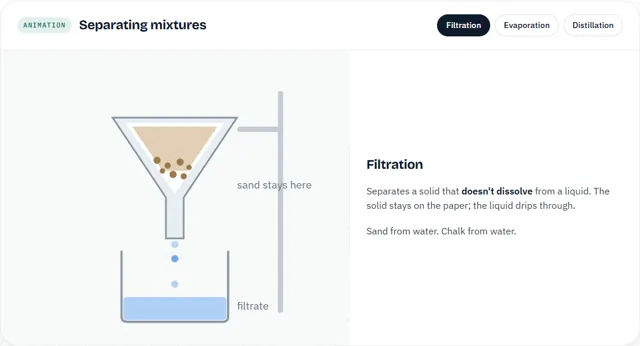
Separating mixtures
Is it pure?
A pure compound has a fixed composition.
Pure NaCl is always 39.3% sodium. If a "NaCl" sample measures differently, something else is in it.
So: calculate what a pure sample should give, measure what it does give, and compare.
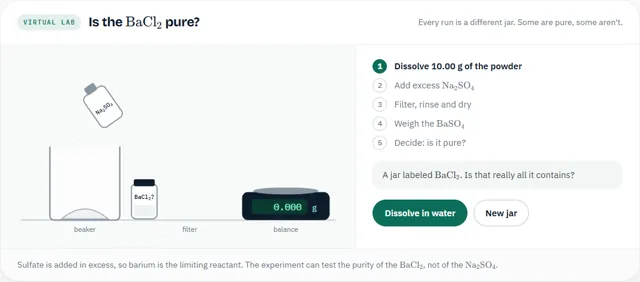
Is the pure?
Metal M is weighed, heated in air until it all becomes MO, then the oxide is weighed. What can you find?
- Oxide mass − metal mass = mass of oxygen → moles of O
- The formula MO means moles of M = moles of O
- Molar mass of M = mass of M ÷ moles of M. You can find the molar mass, not the density (no volume was measured).
?Pure NaCl is 60.7% Cl. A sample labeled NaCl is 55.0% Cl. Pure or not?Think, then tap to check
Not pure. A pure compound always has the same percent composition. Something with less chlorine is diluting it.
Study notes
Key concepts
Pure substances vs mixtures (SPQ-2.B.1). A pure substance contains only one type of molecule or formula unit, so its composition is fixed. A mixture contains two or more types of molecules or formula units, and their relative amounts can vary. Air, salt water, brass and a tablet containing an active drug plus filler are all mixtures. Because the proportions can vary, the percent of an element in a mixture is not fixed by any law. It depends on how much of each component is present.
| Property | Pure substance | Mixture |
|---|---|---|
| Composition | Fixed (law of definite proportions) | Variable |
| Particles present | One type of molecule or formula unit | Two or more types |
| Percent by mass of an element | Always the same | Depends on the proportions |
| Separation | Only by chemical reactions (for compounds) | By physical methods (filtration, distillation, chromatography) |
class notes list three common physical separation methods: distillation (separates a homogeneous mixture by differences in boiling point), filtration (separates an insoluble solid from a liquid) and chromatography (separates substances by differences in how strongly they are attracted to a moving solvent compared with a stationary surface).
Elemental analysis and purity (SPQ-2.B.2). Elemental analysis measures the mass percent of an element in a sample. You can use it in two ways.
-
To find the relative numbers of atoms in a substance (the empirical formula, Topic 1.3).
-
To judge purity. Compare the measured percent with the percent expected for the pure compound. If they differ, the sample contains something else.
How an impurity changes a mass percent. If an impurity contains a lower percent of the element (or none of it), the measured percent goes down. If the impurity contains a higher percent of the element, the measured percent goes up. Example from class notes: pure NaCl is 60.7% Cl. Mixing it with KCl (47.6% Cl) lowers the percent Cl of the mixture. Mixing it with LiCl (83.6% Cl) or CaCl₂ (63.9% Cl) raises it.
| Compound | Percent Cl by mass |
|---|---|
| LiCl | 83.6% |
| CaCl₂ | 63.9% |
| NaCl | 60.7% |
| KCl | 47.6% |
Strategy for mixture problems.
-
Identify what was measured (mass of sample, mass of a product, mass of an element, mass lost on heating).
-
Write which component that measurement comes from. Often only one component reacts or contains the element.
-
Convert the measurement to moles of that component, then to its mass.
-
Percent of component = mass of component ÷ mass of whole sample × 100.
Common misconceptions.
-
Mixing a compound with something else does not change the composition of the compound itself. NO₂ molecules are still 30.4% N even if the container also holds Cl₂. What changes is the percent of N in the whole sample.
-
Do not use the total sample mass as if it were all the pure compound.
-
A sample with a lower-than-expected percent of an element is not automatically "pure with errors"; it may contain an impurity with a lower percent of that element.
Key equations
Worked examples
Worked example 1.4a — purity from elemental analysis. A 10.0 g sample labelled "CuO" contains 7.50 g of copper. Is the sample pure? If the impurity contains no copper, what is the percent CuO in the sample?
Pure CuO is 63.55 ÷ 79.55 = 79.9% Cu, so 10.0 g of pure CuO would contain 7.99 g Cu. The sample has less copper, so it is impure. Mass of CuO present = 7.50 g ÷ 0.799 = 9.39 g. Percent CuO = 9.39 ÷ 10.0 = 93.9%.
Worked example 1.4b — heating a carbonate mixture (CED activity for Topic 1.4). A 5.00 g mixture of NaHCO₃ and Na₂CO₃ is heated strongly. Only NaHCO₃ decomposes:
2 NaHCO₃(s) → Na₂CO₃(s) + H₂O(g) + CO₂(g)
The mass decreases by 1.24 g. Find the mass percent of NaHCO₃ in the mixture.
The mass lost is H₂O + CO₂. For every 2 mol NaHCO₃ that decompose, 1 mol H₂O (18.02 g) and 1 mol CO₂ (44.01 g) are lost, a total of 62.03 g. Moles NaHCO₃ = 2 × (1.24 ÷ 62.03) = 0.0400 mol. Mass NaHCO₃ = 0.0400 × 84.01 = 3.36 g. Percent NaHCO₃ = 3.36 ÷ 5.00 × 100 = 67.2%.
Worked example 1.4c — two compounds with a common element. A 10.00 g mixture of NaCl and KCl contains 5.54 g of Cl. Find the mass of NaCl.
Let x = mass of NaCl, so the mass of KCl = 10.00 − x. Cl from NaCl = 0.6066x. Cl from KCl = 0.4755(10.00 − x). Then 0.6066x + 4.755 − 0.4755x = 5.54. So 0.1311x = 0.785 and x = 5.99 g NaCl (59.9% of the mixture).
Unit 1 study guide: exam-style free-response set, worksheet and answers.
Worked example
- Moles of Cl: , which equals moles of .
- Mass of : .
- Mass percent: .
- Answer: 65.9% by mass
Free-response practice
Write your answer first, then open the solution and mark yourself against it.
FRQ 1.4-1. A 10.00 g mixture of CuSO₄·5H₂O (molar mass 249.70 g/mol) and anhydrous CuSO₄ (molar mass 159.61 g/mol) is heated until all water is removed. The mass of the solid decreases by 2.70 g.
(a) Calculate the number of moles of water released.
(b) Calculate the mass of CuSO₄·5H₂O in the original mixture.
(c) Calculate the mass percent of CuSO₄·5H₂O in the mixture.
(d) If some of the solid spatters out of the crucible during heating, will the calculated percent of CuSO₄·5H₂O be too high, too low or unchanged? Justify your answer.
Show the solution
(a) n(H₂O) = 2.70 g ÷ 18.02 g/mol = 0.150 mol.
(b) 5 mol H₂O come from 1 mol hydrate, so n(hydrate) = 0.150 ÷ 5 = 0.0300 mol. Mass = 0.0300 × 249.70 = 7.48 g.
(c) 7.48 ÷ 10.00 × 100 = 74.8%.
(d) Too high. Lost solid adds to the measured mass loss, which is all counted as water. More "water" means more calculated hydrate.
FRQ 1.4-2. A student wants to determine the percent by mass of NaHCO₃ in a mixture of NaHCO₃ and Na₂CO₃ (Na₂CO₃ does not decompose on heating).
(a) Describe the measurements the student must make.
(b) Explain how the student can be sure the reaction is complete.
Show the solution
(a) Mass of the empty crucible; mass of the crucible plus mixture before heating (to get the sample mass); mass of the crucible plus residue after heating. The mass lost equals the mass of H₂O + CO₂ released, which is used as in worked example 1.4b.
(b) Heat, cool and weigh repeatedly until two successive masses agree (heating to constant mass). Then no more gas is being released, so all of the NaHCO₃ has decomposed.
Common mistake
Students assume all of the sample's mass is the compound of interest. Only the component that contains the measured element counts, so convert element mass to moles, then to the mass of that compound, and divide by the total sample mass.
Frequently asked questions
?How can you tell a pure substance from a mixture with data?
Samples of a pure substance always show the same mass percent of each element; samples of a mixture can show different percents.
?Does an impurity always lower the mass percent of an element?
Not always. It lowers the percent if the impurity contains less of that element by mass than the main compound, and raises it if the impurity contains more.
Practice questions on 1.4
- Q1A 2.00 g sample of impure (molar mass 100.1 g/mol) releases 0.0150 mol of when heated: . The impurities do not react. What is the mass percent of in the sample?
- Q2Pure NaCl is 60.7% Cl by mass and pure KCl is 47.6% Cl by mass. A mixture of only these two salts is 52.0% Cl by mass. Which statement is true?
- Q3A jar labeled NaCl contains a white powder. Which measurement on a sample of the powder is most helpful in deciding whether it is pure NaCl?
- Q4A student dissolves 10.0 g of a powder labeled in water and adds excess . The precipitate is filtered, rinsed and dried to constant mass. Which question can the experiment best answer?
- Q5A mixture contains only the chlorides XCl and ZCl. The percent by mass of X and of Z in the mixture are known. What else is needed to calculate the mole percent of XCl and ZCl?
- Q6Which of these is a homogeneous mixture?
- Q7Which method is best for separating ethanol (boiling point 78 °C) from water?
- Q8A sample of pure NaCl is accidentally mixed with some KCl. Compared with pure NaCl, the mass percent of chlorine in the mixture is
- Q9Household bleach is 5.25% NaOCl by mass and has a density of 1.11 g/mL. What mass of NaOCl is in 800. mL of bleach?
- Q10A sealed flask contains pure NO₂(g). Some Cl₂(g) leaks into the flask. Which of the following changes?
- Q11A 20.0 g sample of electrum (an alloy of gold and silver) is treated with nitric acid, which dissolves only the silver. The silver is then precipitated completely as 15.68 g of AgCl (molar mass 143.32 g/mol). What is the mass percent of silver in the alloy?
- Q12A student measures the chlorine content of a white powder labelled NaCl and gets 58.0% Cl. Pure NaCl is 60.7% Cl. Which conclusion is best supported?
- Q13A protein is 0.320% iron by mass, and each molecule contains one Fe atom. What is its approximate molar mass?
- Q14In compound XY, X is 60.0% by mass. What is the percent of Y by mass in ?
- Q15A 250 g sample of contains 90.0 g of water. What is ?
- Q16An impure ore containing is roasted: . If 80.0 g of ore produces 12.8 g of , what is the percent copper in the ore?
- Q17A disinfectant is 3.00% by mass with a density of 1.01 g/mL. What mass of is in 500 mL?
- Q18A 25.0 g piece of brass (Cu and Zn) reacts with excess HCl. Only the zinc reacts (), producing 0.250 g of . What is the percent zinc by mass?
- Q19A sealed flask of pure is accidentally contaminated with argon. Which statement is true?
- Q2055.85 g of iron is heated in oxygen and forms 76.0 g of oxide product. What does the product contain? (One mole of Fe would form 71.85 g of FeO or 79.85 g of .)
- Q21A copper object has a volume of 5.00 (density 8.96 ). If 25.0% of the copper by mass is converted to CuO, what is the new mass of the object?
- Q22150.0 g of a mixture of and anhydrous loses 36.0 g of water on heating. What was the percent Cu by mass in the original mixture?
Terms used in this topic
Stuck on a unit? Let us fix it this week.
Book a 30-minute one-to-one session for $20. Bring a test, a homework set or the topic that is not clicking.
Book a session