 AP Chemistry Tutoring
1.5 Atomic structure and electron configuration
AP Chemistry Unit 1: Atomic Structure and Properties · 1 simulation · 23 practice questions
Updated · Aligned to the AP Chemistry Course and Exam Description
An atom has a small, dense nucleus of protons and neutrons surrounded by electrons arranged in shells and subshells. The electron configuration lists how electrons fill subshells in order of increasing energy (aufbau principle), e.g. : . Coulomb's law, , explains why electrons closer to the nucleus are held more strongly.
Where the electrons are
One law explains the whole unit.
Electrons are held by the pull of the nucleus. More charge, stronger pull. More distance, much weaker pull.
An atom is a hotel.
Shell () is the floor. Subshell (s, p, d, f) is a wing. Each orbital is a room for two electrons.
Three rules for filling.
1s → 2s → 2p → 3s → 3p → 4s → 3d. 4s is slightly lower than 3d, so it fills first.
An orbital holds at most two electrons, one ↑ and one ↓.
In p or d, one electron per orbital (same spin) before any pair up. That's Hund's rule.
Fill the orbitals
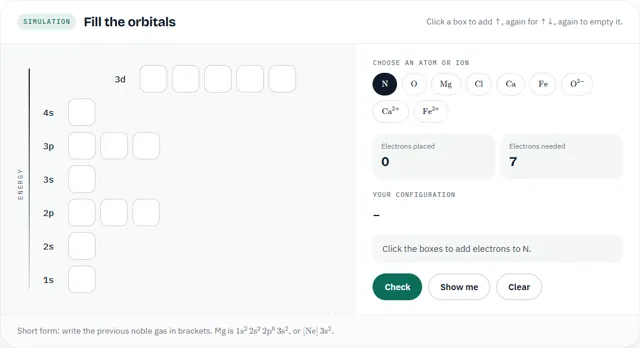
Transition metals fill 4s before 3d, but also lose 4s first. Fe is , so is . Try it above.
Study notes
Key concepts
The parts of an atom (SAP-1.A.1). An atom has a tiny, dense, positively charged nucleus made of protons and neutrons, surrounded by negatively charged electrons. Rutherford's gold-foil experiment showed that most of the atom is empty space and that the positive charge and almost all the mass are concentrated in a small nucleus (most alpha particles passed straight through; a few bounced back).
| Particle | Charge | Relative mass | Location |
|---|---|---|---|
| Proton | +1 | 1 | Nucleus |
| Neutron | 0 | 1 | Nucleus |
| Electron | −1 | about 1/1836 | Outside the nucleus |
Atomic number Z = number of protons, which defines the element. Mass number A = protons + neutrons. In a neutral atom, electrons = protons. A cation has lost electrons; an anion has gained electrons. The number of protons never changes in a chemical reaction.
Coulomb's law (SAP-1.A.2). The force between two charged particles is proportional to the product of their charges and inversely proportional to the square of the distance between them. Opposite charges attract; like charges repel. In AP Chemistry you use Coulomb's law qualitatively, to compare.
-
Larger charges → stronger force. A 2+ nucleus attracts an electron more strongly than a 1+ nucleus at the same distance.
-
Larger distance → much weaker force (it falls as 1/r²). Doubling the distance cuts the force to one quarter.
-
Coulomb's law also gives the potential energy of two charges, which is proportional to q₁q₂/r. The more strongly an electron is attracted, the more energy is needed to remove it.
Shells, subshells and orbitals (SAP-1.A.3). Electrons are arranged in shells (energy levels) numbered n = 1, 2, 3, … Higher n means the electrons are, on average, farther from the nucleus and higher in energy. Each shell contains subshells (sublevels) called s, p, d and f. Each subshell contains orbitals, and each orbital holds a maximum of two electrons.
| Subshell | Number of orbitals | Maximum electrons | First appears in shell |
|---|---|---|---|
| s | 1 | 2 | n = 1 |
| p | 3 | 6 | n = 2 |
| d | 5 | 10 | n = 3 |
| f | 7 | 14 | n = 4 |
Shell n holds at most 2n² electrons (2, 8, 18, 32). There is no 1p, 2d or 3f subshell. An s orbital is spherical; a p orbital has two lobes on opposite sides of the nucleus.
Three rules for building configurations.
-
Aufbau principle: electrons fill the lowest-energy subshells first. The order is 1s, 2s, 2p, 3s, 3p, 4s, 3d, 4p, 5s, 4d, 5p, 6s, 4f, 5d, 6p, 7s, 5f, 6d, 7p. You can read this order straight off the periodic table: the s-block is groups 1–2, the p-block is groups 13–18, the d-block is the transition metals (groups 3–12) and the f-block is the lanthanides and actinides. The d-block in period 4 fills 3d (one shell behind the period number).
-
Pauli exclusion principle: an orbital can hold at most two electrons, and they must have opposite spins.
-
Hund's rule: when filling orbitals of equal energy (for example the three 2p orbitals), put one electron in each orbital, all with the same spin, before pairing any. This keeps electrons apart and lowers repulsion.
Writing configurations. A full configuration lists every occupied subshell with the number of electrons as a superscript. A noble-gas (condensed) configuration replaces the core with the symbol of the previous noble gas in square brackets.
| Element | Full configuration | Noble-gas notation | Valence electrons |
|---|---|---|---|
| N (7) | 1s² 2s² 2p³ | [He] 2s² 2p³ | 5 |
| Na (11) | 1s² 2s² 2p⁶ 3s¹ | [Ne] 3s¹ | 1 |
| P (15) | 1s² 2s² 2p⁶ 3s² 3p³ | [Ne] 3s² 3p³ | 5 |
| Ca (20) | 1s² 2s² 2p⁶ 3s² 3p⁶ 4s² | [Ar] 4s² | 2 |
| Fe (26) | 1s² 2s² 2p⁶ 3s² 3p⁶ 4s² 3d⁶ | [Ar] 4s² 3d⁶ | 2 (4s) |
| Br (35) | 1s² 2s² 2p⁶ 3s² 3p⁶ 4s² 3d¹⁰ 4p⁵ | [Ar] 4s² 3d¹⁰ 4p⁵ | 7 |
Orbital diagrams in words. An orbital diagram shows each orbital as a box and each electron as a half-arrow (up or down for its spin). For nitrogen: the 1s box has a pair (one up, one down), the 2s box has a pair, and the three 2p boxes each have one up-arrow. So N has 3 unpaired electrons. For oxygen, the fourth 2p electron must pair up in one of the 2p boxes, leaving 2 unpaired electrons.
Core and valence electrons. Core electrons are the inner electrons, matching the previous noble gas plus any filled d or f subshells. Valence electrons are those in the outermost shell (highest n), for main-group elements the ns and np electrons. Valence electrons are the ones involved in bonding.
Configurations of ions.
-
Anions: add electrons to the next available orbital. O²⁻ is 1s² 2s² 2p⁶, the same as Ne.
-
Main-group cations: remove electrons from the outermost shell. Na⁺ is 1s² 2s² 2p⁶.
-
Transition-metal cations: remove the 4s electrons before the 3d electrons, even though 4s filled first. The 4s electrons are in the higher shell (n = 4) and are farther out. Fe is [Ar] 4s² 3d⁶; Fe²⁺ is [Ar] 3d⁶; Fe³⁺ is [Ar] 3d⁵. Zn²⁺ is [Ar] 3d¹⁰. Ti²⁺ is [Ar] 3d².
-
Isoelectronic species have the same number of electrons and the same configuration, for example O²⁻, F⁻, Ne, Na⁺, Mg²⁺ (all 10 electrons), or Br⁻ and Kr (36 electrons).
Ionization energy and Coulomb's law (SAP-1.A.4). Ionization energy (IE) is the energy needed to remove an electron from a gaseous atom or ion. You can estimate which electron is harder to remove with Coulomb's law. Two factors matter.
-
Distance from the nucleus: electrons in a higher shell are farther away, so they are attracted less and easier to remove.
-
Effective nuclear charge (Zeff): inner (core) electrons shield outer electrons from the full nuclear charge. A simple estimate is Zeff ≈ Z − (number of core electrons). For Na, Zeff ≈ 11 − 10 = +1. For Cl, Zeff ≈ 17 − 10 = +7. Electrons in the same shell shield each other only a little.
So in any one atom, core electrons (small n, close to a large charge) need far more energy to remove than valence electrons. Comparing atoms, the same subshell (for example 1s) in a heavier atom is harder to remove because the nuclear charge is larger.
Excited states. In the ground state, all electrons are in the lowest available orbitals. If an electron absorbs energy and moves to a higher orbital, the atom is in an excited state, for example 1s² 2s² 2p³ 3s¹ is an excited oxygen atom (8 electrons; ground state 1s² 2s² 2p⁴). When an electron falls back down, a photon is emitted; a larger energy drop gives light of higher frequency (shorter wavelength).
What is not tested. Assigning the four quantum numbers (n, l, ml, ms) to electrons will not be assessed on the AP Exam. Writing configurations of exceptions such as Cr ([Ar] 4s¹ 3d⁵) and Cu ([Ar] 4s¹ 3d¹⁰) will not be assessed either, although you may see them in data.
Common misconceptions.
-
"4s is always lower than 3d, so remove 3d electrons first." No: when transition metals form ions, the 4s electrons leave first.
-
"Atoms want a full octet." Atoms do not have wants. Ions with noble-gas configurations are common because removing further electrons (core electrons) costs a huge amount of energy, and adding electrons into a new shell is strongly opposed by repulsion.
-
Isoelectronic species have the same configuration but are not the same size or the same element; they have different numbers of protons.
Key equations
The potential energy of two charges is proportional to q₁q₂/r; a larger attraction means more energy is needed to separate them.
Worked examples
Worked example 1.5a — configurations of an atom and its ions. Write ground-state configurations for S, S²⁻, Fe and Fe³⁺, and state the number of unpaired electrons in S.
S (16 electrons): 1s² 2s² 2p⁶ 3s² 3p⁴. The four 3p electrons go one in each orbital, then one pairs: 2 unpaired electrons.
S²⁻ (18 electrons): 1s² 2s² 2p⁶ 3s² 3p⁶, isoelectronic with Ar.
Fe (26 electrons): 1s² 2s² 2p⁶ 3s² 3p⁶ 4s² 3d⁶.
Fe³⁺ (23 electrons): remove the two 4s electrons, then one 3d electron: 1s² 2s² 2p⁶ 3s² 3p⁶ 3d⁵.
Worked example 1.5b — Coulomb's law comparison. Which pair has the stronger attraction: Na⁺ and Cl⁻ (distance between centres 283 pm) or Mg²⁺ and O²⁻ (distance 212 pm)?
Compare q₁q₂/r². Na⁺/Cl⁻: (1)(1) ÷ 283². Mg²⁺/O²⁻: (2)(2) ÷ 212². The ratio is 4 × (283 ÷ 212)² ≈ 7. The Mg²⁺–O²⁻ attraction is about seven times stronger, because both the charges are larger and the distance is smaller. This is why MgO has a much higher melting point (about 2800 °C) than NaCl (801 °C).
Worked example 1.5c — which electron is harder to remove? In a potassium atom, compare a 3p electron with the 4s electron.
The 3p electron is in shell n = 3, closer to the nucleus, and is shielded only by the 10 electrons in shells 1 and 2. The 4s electron is in shell n = 4, farther out, and is shielded by all 18 inner electrons (Zeff ≈ 19 − 18 = +1). By Coulomb's law, the 3p electron feels a stronger attraction and needs much more energy to remove.
Unit 1 study guide: exam-style free-response set, worksheet and answers.
Worked example
- Fe has 26 electrons: .
- has 23 electrons; remove the two electrons first, then one electron.
- Answer: : ; :
Free-response practice
Write your answer first, then open the solution and mark yourself against it.
FRQ 1.5-1. Answer the following questions about cobalt and its ions. Modelled on 2018 AP Chemistry FRQ Q3(a)–(c).
(a) Write the ground-state electron configuration of the Co²⁺ ion.
| Ion | Ionic radius (pm) |
|---|---|
| Co²⁺ | 75 |
| Co³⁺ | 61 |
(b) Using principles of atomic structure, explain why Co²⁺ is larger than Co³⁺.
(c) Co³⁺ ions attract water molecules more strongly than Co²⁺ ions do. Give one reason, and justify it using Coulomb's law.
Show the solution
(a) Co has 27 electrons: [Ar] 4s² 3d⁷. Co²⁺ loses the two 4s electrons: 1s² 2s² 2p⁶ 3s² 3p⁶ 3d⁷ (or [Ar] 3d⁷). (1 point)
(b) Both ions have the same nuclear charge (27 protons), but Co³⁺ has one fewer electron. With fewer electrons there is less electron–electron repulsion, and each remaining electron is pulled closer by the same nuclear charge. So Co³⁺ is smaller. (1 point)
(c) Co³⁺ has a larger charge (3+ vs 2+) and a smaller radius. By Coulomb's law the force is proportional to q₁q₂/r², so a larger charge and a smaller distance to the partially negative oxygen end of a water molecule both give a stronger attraction. (1 point for the charge or size reason; 1 point for linking it to Coulomb's law.)
FRQ 1.5-2. Consider the atoms N and O.
(a) Write the ground-state electron configuration of each atom.
(b) Describe the orbital diagram for the 2p electrons of each atom and state the number of unpaired electrons.
(c) The configuration 1s² 2s² 2p³ 3s¹ belongs to a neutral atom. Identify the element and explain whether this is a ground state or an excited state.
Show the solution
(a) N: 1s² 2s² 2p³. O: 1s² 2s² 2p⁴.
(b) N: three 2p orbitals, each with one electron, all with parallel spins (Hund's rule): 3 unpaired. O: one 2p orbital holds a pair (opposite spins), the other two hold one electron each: 2 unpaired.
(c) The total is 2 + 2 + 3 + 1 = 8 electrons, so the element is oxygen. It is an excited state: one electron is in 3s while the lower-energy 2p subshell is not full (ground state is 1s² 2s² 2p⁴).
Common mistake
Students remove electrons first when forming transition-metal cations. The electrons are lost first, so is , not .
Frequently asked questions
?Do I need to know the chromium and copper exceptions for AP Chemistry?
No. The AP Course and Exam Description states that exceptions to the aufbau principle are not assessed on the exam.
?Why does 4s fill before 3d?
In neutral atoms of the fourth period the subshell is filled first, but once the atom becomes a cation the electrons are the ones removed first.
Practice questions on 1.5
- Q1What is the ground-state electron configuration of ? (Fe has atomic number 26.)
- Q2Which ion has the same electron configuration as an argon atom?
- Q3Which element has the ground-state electron configuration ?
- Q4How many neutrons are in an atom of xenon-131? (Xe has atomic number 54.)
- Q5Carbon-12 and carbon-13 are isotopes. How do their atoms differ?
- Q6Which of the following species has the ground-state configuration 1s² 2s² 2p⁶?
- Q7Which is the ground-state electron configuration of Fe²⁺?
- Q8Which atom, in its ground state, has exactly two unpaired electrons?
- Q9Which of the following electron configurations is impossible?
- Q10Which statement about Br⁻ and Kr is correct?
- Q11In a single atom of copper, electrons in which subshell experience the greatest attraction to the nucleus?
- Q12How many unpaired electrons are in a ground-state sulfur atom?
- Q13Which electron configuration is impossible?
- Q14Gallium is [Ar] . How many valence electrons does it have?
- Q15Which configuration represents a metal atom in its ground state?
- Q16Which statement about and Kr is true?
- Q17In a zinc atom, electrons in which subshell feel the greatest effective nuclear charge?
- Q18Which configuration belongs to a transition metal?
- Q19An atom in an excited state has the configuration . Which element is it?
- Q20What is the ground-state configuration of ?
- Q21An element's configuration ends in . What is the element?
- Q22What is the valence configuration of element 114?
- Q23Copper's configuration is [Ar] rather than [Ar] . Why?
Stuck on a unit? Let us fix it this week.
Book a 30-minute one-to-one session for $20. Bring a test, a homework set or the topic that is not clicking.
Book a session