 AP Chemistry Tutoring
5.2 Introduction to rate law
AP Chemistry Unit 5: Kinetics · 1 simulation · 20 practice questions
Updated · Aligned to the AP Chemistry Course and Exam Description
A rate law shows how the rate depends on reactant concentrations: , where is the rate constant and the orders and must be determined experimentally, not from the coefficients. Orders are found by the method of initial rates: if doubling quadruples the rate, the reaction is second order in A. The overall order is , and the units of depend on it.
Rate laws
The exponents are the orders. They come only from experiments, never from the coefficients of the balanced equation. That's the most common mistake in this unit.
Method: compare two trials where only one concentration changes. If doubling quadruples the rate, , so .
| Order 0 | double → rate unchanged |
| Order 1 | double → rate × 2 |
| Order 2 | double → rate × 4 |
Units of depend on the overall order: (0th), (1st), (2nd), (3rd).
Find the rate law
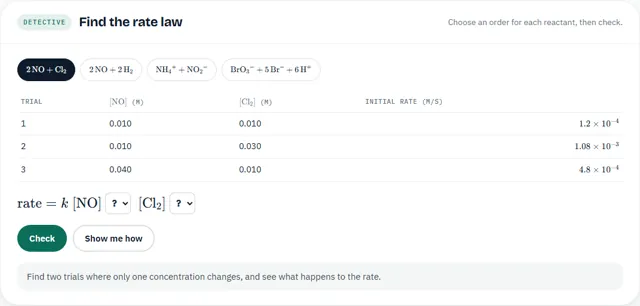
- : , so .
- : , so .
- : third order overall, even though the coefficients are 2 and 1.
Study notes
Key concepts
Monitoring a reaction (TRA-3.B.1). In the lab you follow the amount of a reactant or product over time (by absorbance, pressure, volume of gas, titration, and so on) and use the data to find the rate.
The rate law (TRA-3.B.2). A rate law (rate equation) says how the rate depends on reactant concentrations. Each reactant concentration is raised to a power:
Order (TRA-3.B.3). The power m is the order with respect to A; n is the order with respect to B. The overall order is m + n. Orders in AP are usually 0, 1 or 2 (occasionally 3).
| Order in A | Effect of doubling [A] on rate | Effect of tripling [A] on rate |
|---|---|---|
| 0 | No change (× 1) | No change (× 1) |
| 1 | × 2 | × 3 |
| 2 | × 4 | × 9 |
| 3 | × 8 | × 27 |
A general rule: if [A] is multiplied by x, the rate is multiplied by xᵐ.
The big idea: orders come from experiment, not from the balanced equation. For an overall reaction you cannot read the orders from the coefficients. 2 NO₂ + F₂ → 2 NO₂F has the experimental rate law rate = k[NO₂][F₂], not k[NO₂]²[F₂]. Only for an elementary step (5.4) do the coefficients give the orders. Products and catalysts can sometimes appear in a rate law; solids and pure liquids never do (their "concentration" does not change).
The rate constant k (TRA-3.B.4). k is the proportionality constant. It depends on temperature (k gets larger as T rises) and on whether a catalyst is present. It does not depend on concentration. Its units depend on the overall order, because rate always has units of M s⁻¹.
| Overall order | Rate law example | Units of k |
|---|---|---|
| 0 | rate = k | M s⁻¹ |
| 1 | rate = k[A] | s⁻¹ |
| 2 | rate = k[A]² or k[A][B] | M⁻¹ s⁻¹ |
| 3 | rate = k[A]²[B] | M⁻² s⁻¹ |
Quick rule: units of k = M^(1 − overall order) s⁻¹.
Method of initial rates (TRA-3.B.5). Run several experiments with different starting concentrations and measure the initial rate of each. Pick two experiments in which only one reactant's concentration changes. The ratio of the rates tells you the order in that reactant. Repeat for each reactant. Then put any one experiment's numbers into the rate law to find k.
If no pair keeps one concentration fixed, divide out the known order first, then solve for the unknown order.
Graph of rate vs. [A]. Zero order: a horizontal line. First order: a straight line through the origin. Second order: an upward-curving parabola through the origin.
Rate constant vs. rate. Changing the concentration changes the rate but not k. Changing temperature or adding a catalyst changes k (and therefore the rate). Put another way: concentration effects show up explicitly in the rate law; temperature, catalyst and the nature of the reactants are "hiding" inside k.
Key equations
Worked examples
Worked example 5.2-A (method of initial rates). For 2 NO(g) + 2 H₂(g) → N₂(g) + 2 H₂O(g) at a fixed temperature:
| Experiment | [NO]₀ (M) | [H₂]₀ (M) | Initial rate (M s⁻¹) |
|---|---|---|---|
| 1 | 0.010 | 0.010 | 2.4 × 10⁻⁵ |
| 2 | 0.020 | 0.010 | 9.6 × 10⁻⁵ |
| 3 | 0.010 | 0.030 | 7.2 × 10⁻⁵ |
Order in NO: compare 1 and 2 ([H₂] constant). [NO] doubles; rate goes from 2.4 × 10⁻⁵ to 9.6 × 10⁻⁵, a factor of 4 = 2². Second order in NO.
Order in H₂: compare 1 and 3 ([NO] constant). [H₂] triples; rate triples (7.2/2.4 = 3 = 3¹). First order in H₂.
Rate law: rate = k[NO]²[H₂]. Overall order 3.
k from experiment 1: k = 2.4 × 10⁻⁵ ÷ [(0.010)²(0.010)] = 2.4 × 10⁻⁵ ÷ 1.0 × 10⁻⁶ = 24 M⁻² s⁻¹.
Notice: the coefficient of H₂ is 2 but the order in H₂ is 1. The balanced equation did not predict the rate law. (5.9 shows a mechanism that explains it.)
Worked example 5.2-B (predicting a new rate). For H₂ + F₂ → 2 HF, rate = k[H₂][F₂]. The rate is 3.15 × 10⁻⁴ M s⁻¹ when [H₂] = 0.084 M and [F₂] = 0.25 M. Find the rate when [H₂] = 0.039 M and [F₂] = 0.099 M.
k = 3.15 × 10⁻⁴ ÷ (0.084 × 0.25) = 0.015 M⁻¹ s⁻¹. New rate = 0.015 × 0.039 × 0.099 = 5.8 × 10⁻⁵ M s⁻¹.
Unit 5 study guide: exam-style free-response set, worksheet and answers.
Worked example
- Trials 1 and 2: doubles and the rate quadruples, so second order in A.
- Trials 1 and 3: doubles and the rate is unchanged, so zero order in B.
- .
- Answer: ,
Free-response practice
Write your answer first, then open the solution and mark yourself against it.
FRQ 5.2-1. For the gas reaction BF₃(g) + NH₃(g) → F₃BNH₃(g), initial rates were measured.
| Exp. | [BF₃]₀ (M) | [NH₃]₀ (M) | Initial rate (M s⁻¹) |
|---|---|---|---|
| 1 | 0.250 | 0.250 | 0.2130 |
| 2 | 0.250 | 0.125 | 0.1065 |
| 3 | 0.200 | 0.100 | 0.0682 |
| 4 | 0.350 | 0.100 | 0.1193 |
| 5 | 0.175 | 0.100 | 0.0596 |
(a) Determine the order with respect to each reactant. Justify each answer using specific experiments.
(b) Write the rate law and give the overall order.
(c) Calculate k, with units.
(d) Calculate the initial rate when [BF₃] = 0.100 M and [NH₃] = 0.500 M.
Show the solution
(a) NH₃: experiments 1 and 2 have the same [BF₃]. [NH₃] is halved and the rate is halved (0.1065/0.2130 = 0.5), so the reaction is first order in NH₃. BF₃: experiments 4 and 5 have the same [NH₃]. [BF₃] doubles (0.175 → 0.350) and the rate doubles (0.1193/0.0596 = 2.0), so it is first order in BF₃.
(b) Rate = k[BF₃][NH₃]; overall order 2.
(c) From experiment 1: k = 0.2130 ÷ (0.250 × 0.250) = 3.41 M⁻¹ s⁻¹. (Experiments 3, 4 and 5 give the same value.)
(d) Rate = 3.41 × 0.100 × 0.500 = 0.171 M s⁻¹.
FRQ 5.2-2. Compounds A and B react to form C. Initial-rate data:
| Exp. | [A]₀ (M) | [B]₀ (M) | Initial rate (M s⁻¹) |
|---|---|---|---|
| 1 | 0.050 | 0.050 | 4.0 × 10⁻³ |
| 2 | 0.10 | 0.050 | 8.0 × 10⁻³ |
| 3 | 0.050 | 0.10 | 1.6 × 10⁻² |
(a) Write the rate law. Justify.
(b) Calculate k with units.
(c) A student says, "Because the balanced equation is A + B → C, the rate law must be rate = k[A][B]." Explain why the student is wrong.
Show the solution
(a) 1 → 2: [A] doubles and the rate doubles, so first order in A. 1 → 3: [B] doubles and the rate quadruples, so second order in B. Rate = k[A][B]².
(b) k = 4.0 × 10⁻³ ÷ [(0.050)(0.050)²] = 4.0 × 10⁻³ ÷ 1.25 × 10⁻⁴ = 32 M⁻² s⁻¹.
(c) The orders of an overall reaction must be found by experiment. The coefficients give the orders only if the reaction happens in one elementary step. Here the data show second order in B, so the reaction is not a single A + B collision.
Common mistake
Students write the rate law using the coefficients of the overall balanced equation. Orders for an overall reaction can only be found experimentally; coefficients give orders only for an elementary step.
Frequently asked questions
?What are the units of k for a second-order reaction?
. In general the units are , where is the overall order.
?Does the rate constant change with concentration?
No. depends on temperature (and catalysts), not on concentration.
Practice questions on 5.2
- Q1For a reaction between A and B, doubling [A] while [B] is constant makes the rate four times as fast. Doubling [B] while [A] is constant doubles the rate. What is the rate law?
- Q2What are the units of the rate constant for a reaction that is second order overall?
- Q3For , tripling (with fixed) multiplies the rate by 9, and quadrupling (with fixed) multiplies the rate by 4. What is the rate law?
- Q4A reaction obeys rate = k[M][N]². In a new experiment [M] is halved and [N] is tripled. The rate changes by a factor of
- Q5The rate law is rate = k[X][Y]². What are the units of k if rate is in M s⁻¹?
- Q6Which statement about reaction order is correct?
- Q7A reactant A is converted to product B at a constant rate until A runs out. What is the rate law?
- Q8For A + B → C, rate = k[A]ˣ[B]ʸ. Suppose a larger fraction of A–B collisions became successful, with no change in concentrations. Which quantity changes?
- Q9The reaction HNO₃(aq) + NH₃(aq) → NH₄NO₃(aq) is first order in each reactant with k = 14.5 M⁻¹ s⁻¹. What is the rate when [HNO₃] = 0.050 M and [NH₃] = 0.10 M?
- Q10For 2 NO(g) + O₂(g) → 2 NO₂(g), initial rates of formation of NO₂ were measured. Exp. 1: [NO]₀ (M) = 0.020; [O₂]₀ (M) = 0.020; Initial rate (M s⁻¹) = 4.0 × 10⁻⁵ Exp. 2: [NO]₀ (M) = 0.040; [O₂]₀ (M) = 0.020; Initial rate (M s⁻¹) = 1.6 × 10⁻⁴ Exp. 3: [NO]₀ (M) = 0.040; [O₂]₀ (M) = 0.060; Initial rate (M s⁻¹) = 4.8 × 10⁻⁴ What is the rate law?
- Q11If rate , what happens to the rate when [A] is doubled?
- Q12For the reaction of NO with : Experiment 1, [NO] = 0.10 M, [] = 0.10 M, rate = M/s. Experiment 2, [NO] = 0.20 M, [] = 0.10 M, rate = M/s. Experiment 3, [NO] = 0.20 M, [] = 0.20 M, rate = M/s. What is the rate law?
- Q13For rate , what are the orders with respect to P and Q?
- Q14What is the overall order for rate ?
- Q15Only the balanced equation is known. What can be said about its rate law?
- Q16First-order reactant A (half-life 25 s) converts to B. A starts at 4.00 mol. What are the amounts of A and B at 75 s?
- Q17If rate , what are the units of ?
- Q18A reactant is consumed at a constant rate regardless of its concentration. What is the reaction order?
- Q19A change increases the fraction of collisions that are successful, without changing concentrations. Which quantity changes?
- Q20 is 0.100, 0.088, 0.076 and 0.064 M at 0, 10, 20 and 30 s. What is the average rate of disappearance?
Terms used in this topic
Stuck on a unit? Let us fix it this week.
Book a 30-minute one-to-one session for $20. Bring a test, a homework set or the topic that is not clicking.
Book a session