 AP Chemistry Tutoring
5.10 Multistep reaction energy profile
AP Chemistry Unit 5: Kinetics · 1 simulation · 9 practice questions
Updated · Aligned to the AP Chemistry Course and Exam Description
An energy profile for a multistep reaction has one peak (transition state) for each elementary step, with intermediates in the valleys between peaks. The rate-determining step is the step with the highest activation energy measured from the valley before it. The overall is the energy of the final products minus the initial reactants, independent of the number of steps.
Reaction mechanisms
The recipe behind the equation.
A balanced equation is an ingredients list. A mechanism is the recipe: a series of elementary steps that add up to the overall equation.
For an elementary step (and only then) the coefficients are the orders.
The slowest step sets the pace.
Mixing pizza dough takes minutes; letting it rise takes hours. The slowest step is the rate-determining step, and its reactants give the rate law.
A valid mechanism must (1) add up to the overall equation and (2) give the experimental rate law.
Mechanism checker
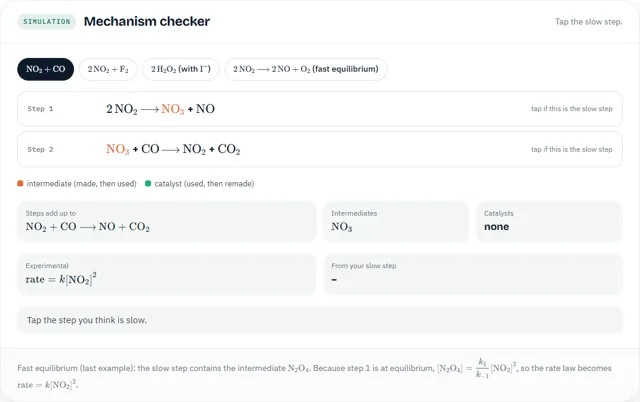
- Step 1 = overall − step 2. Move step 2's species to the opposite side and cancel.
- Step 1: ( is an intermediate).
- Slow step 1 has as reactants: . doesn't appear at all: zero order in .
Study notes
Key concepts
Building the profile (TRA-5.D.1). If you know the energy change and activation energy of each elementary step, you can join their profiles end to end to make the energy profile of the whole mechanism.
How to read a multistep profile.
| Feature | Meaning |
|---|---|
| Number of peaks (humps) | Number of elementary steps |
| Each peak | A transition state (activated complex) for one step |
| Each valley between peaks | An intermediate (a real species with a short lifetime) |
| Highest barrier measured from the valley (or reactants) just before it | The slowest, rate-determining step |
| Products − reactants | ΔH of the overall reaction |
| Highest peak − reactants | The overall activation energy |
The rate-determining step on a profile. For AP purposes, the step with the largest activation energy (the tallest climb from the minimum just before it to its peak) is the slowest step. Usually, if the first step is rate determining, the first peak is the tallest. If a later step is rate determining, the later peak sits higher above its valley.
Intermediates vs. transition states. An intermediate sits in a dip; it is a real species that could, in principle, be detected. A transition state sits at a peak and cannot be isolated.
The overall ΔH depends only on reactants and products, not on the number of steps or the path. Adding a catalyst (5.11) changes the peaks, not the start and end levels.
Describing a profile in words (exam skill). When asked to "draw" a profile, the key features scorers look for are: correct number of humps; relative heights of the humps showing which step is rate determining; an intermediate in each valley between humps; products placed correctly above or below reactants to match the sign of ΔH; and labels (Ea of the rate-determining step as an arrow from the reactant level, or from the preceding valley if asked for the step's own Ea, up to the right peak).
Worked examples
Worked example 5.10-A. A two-step mechanism has these relative energies along the reaction coordinate.
| Point | Energy (kJ mol⁻¹) |
|---|---|
| Reactants | 0 |
| Transition state 1 | +85 |
| Intermediate | +40 |
| Transition state 2 | +60 |
| Products | −30 |
Step 1 Ea = 85 − 0 = 85 kJ mol⁻¹. Step 2 Ea = 60 − 40 = 20 kJ mol⁻¹. Step 1 is rate determining. ΔH(step 1) = +40; ΔH(step 2) = −30 − 40 = −70; overall ΔH = −30 kJ mol⁻¹ (exothermic). The profile has two humps, the first much taller, with an intermediate in the valley at +40 kJ mol⁻¹. The reverse of step 2 has Ea = 60 − (−30) = 90 kJ mol⁻¹.
Worked example 5.10-B. A three-step mechanism has:
| Step | Ea (kJ mol⁻¹) | ΔH (kJ mol⁻¹) |
|---|---|---|
| 1 | +30 | −50 |
| 2 | +25 | +2 |
| 3 | +35 | +25 |
Build the energies: reactants 0; TS1 = 0 + 30 = +30; intermediate 1 = −50; TS2 = −50 + 25 = −25; intermediate 2 = −48; TS3 = −48 + 35 = −13; products = −48 + 25 = −23. Step 3 has the largest activation energy, so it is the rate-determining step. Overall ΔH = −50 + 2 + 25 = −23 kJ mol⁻¹. There are three humps and two valleys (two intermediates).
Worked example 5.10-C (modelled on 2013 AP FRQ Q5(e)–(f)). For C₃H₆(g) + HBr(g) → C₃H₇Br(g), ΔH° = −84 kJ mol⁻¹, with step 1 (C₃H₆ + HBr → C₃H₇⁺ + Br⁻) rate determining and step 2 fast. Describe the energy profile.
Start at the reactant level. Rise to a tall first peak (TS1), then fall into a valley that is above the reactant level (the ion pair C₃H₇⁺ + Br⁻ is a high-energy intermediate). Rise a little to a much smaller second peak (TS2), then fall to the product level, 84 kJ mol⁻¹ below the reactants. The Ea of the rate-determining step is the vertical distance from the reactant level to the top of the first peak.
Unit 5 study guide: exam-style free-response set, worksheet and answers.
Worked example
- Two peaks, so two elementary steps and one intermediate.
- kJ/mol; kJ/mol, so step 2 is rate determining.
- kJ/mol.
- Answer: Two steps; step 2 is rate determining; (exothermic).
Free-response practice
Write your answer first, then open the solution and mark yourself against it.
FRQ 5.10-1 (modelled on 2013 AP FRQ Q5(e)–(f)). The reaction NO₂(g) + CO(g) → NO(g) + CO₂(g) has ΔH° = −226 kJ mol⁻¹. Below 500 K it follows: Step 1: 2 NO₂ → NO₃ + NO (slow); Step 2: NO₃ + CO → NO₂ + CO₂ (fast).
(a) Describe the energy profile of the mechanism. Include the number of peaks, which peak is higher, where the intermediate is, and where the products are.
(b) Describe where you would draw the arrow for Ea of the rate-determining step.
(c) Write the rate law predicted by the mechanism.
Show the solution
(a) Two peaks (two steps). The first peak is higher above the reactants than the second peak is above the valley, because step 1 is slow. The intermediate NO₃ (with NO) is in the valley between the peaks. The product level is 226 kJ mol⁻¹ below the reactant level.
(b) A vertical arrow from the reactant level up to the top of the first peak.
(c) Rate = k[NO₂]². CO is zero order because it reacts only after the slow step.
Common mistake
Students assume the highest peak on the diagram is always the slow step. Compare each step's activation energy from its own starting valley; a lower peak that starts from a much deeper valley can have the larger barrier.
Frequently asked questions
?Where are intermediates on an energy diagram?
In the local minima (valleys) between transition-state peaks.
?How do you find the slow step on an energy diagram?
Find the step with the largest energy rise from its starting valley to its peak; that step has the highest activation energy.
Practice questions on 5.10
- Q1An energy profile shows, from left to right: reactants, a peak, a valley, a second lower peak, and products below the reactants. Which description is correct?
- Q2An energy profile has two steps. The first peak is higher above the reactants than the second peak is above the intermediate, and the products end below the reactants. Which step is rate determining, and is the reaction exothermic?
- Q3A profile has three peaks. How many intermediates does the mechanism have?
- Q4A two-step reaction has energies (kJ mol⁻¹): reactants 0, TS1 +50, intermediate +45, TS2 +110, products +20. Which is true?
- Q5Which change would alter the overall ΔH shown on a multistep energy profile?
- Q6A profile has two peaks with a valley between them. Reading from left to right, which sequence is correct?
- Q7On a profile, the products lie higher in energy than the reactants. Which reaction does this most likely represent?
- Q8A profile shows two peaks and a valley, with the products lower than the reactants. Which describes it?
- Q9Energies (kJ): reactants 0, TS₁ 50, intermediate 20, TS₂ 45, products −10. Which step is rate-determining, and what is ?
Terms used in this topic
Stuck on a unit? Let us fix it this week.
Book a 30-minute one-to-one session for $20. Bring a test, a homework set or the topic that is not clicking.
Book a session