 AP Chemistry Tutoring
5.11 Catalysis
AP Chemistry Unit 5: Kinetics · 1 simulation · 17 practice questions
Updated · Aligned to the AP Chemistry Course and Exam Description
A catalyst increases the rate of a reaction by providing an alternative mechanism with a lower activation energy; it is consumed in one step and regenerated in a later step, so it is not used up overall. A catalyst does not change , or the equilibrium constant , and it speeds up the forward and reverse reactions equally. Catalysis can be homogeneous, heterogeneous (surface) or enzymatic.
Collisions & energy
Most collisions bounce off.
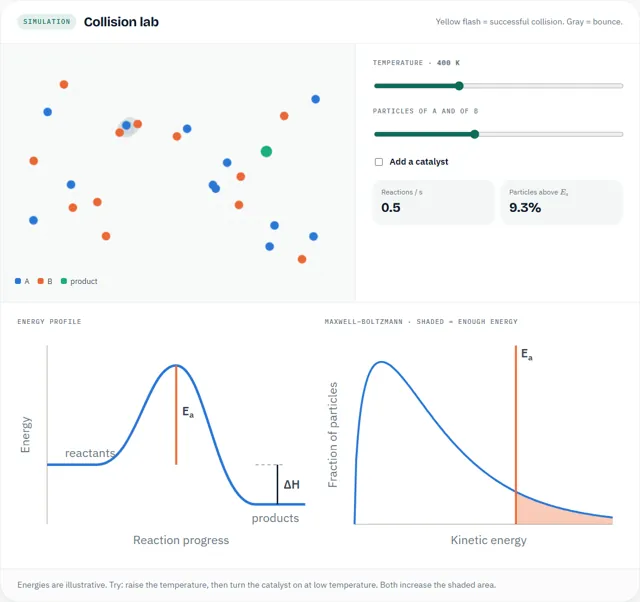
A collision only reacts if the particles have enough energy to break bonds (at least the activation energy, ) and the right orientation. Three particles meeting at once with both is so unlikely that elementary steps almost never involve more than two.
Why heat and catalysts work.
Higher temperature shifts the Maxwell–Boltzmann curve right: more particles clear . A catalyst gives a new pathway with a lower , so more particles clear it at the same temperature. doesn't change.
Collision lab
A catalyst is used, then given back.
Contact-lens cleaner: a platinum (or palladium) disc makes decompose fast, fizzing . The metal isn't used up. In a mechanism, a catalyst appears as a reactant first and a product later; an intermediate is the opposite.
One hump per step.
A two-step mechanism has two peaks on its energy profile. The step with the highest barrier is the slow, rate-determining step.
Study notes
Key concepts
What a catalyst does (ENE-1.A.1). A catalyst speeds up a reaction without being used up overall. To increase the rate, it must increase the number of effective collisions and/or give the reaction a new pathway with a lower activation energy. With a lower Ea, a much larger fraction of collisions (the area beyond Ea on the Maxwell–Boltzmann curve) has enough energy, so k increases.
Catalysts in mechanisms (ENE-1.A.2). The net amount of a catalyst stays constant. But a catalyst is often consumed in the rate-determining step and regenerated in a later step. Because of this, the catalyst's concentration often appears in the rate law. Example: decomposition of H₂O₂ catalyzed by I⁻:
Step 1: H₂O₂ + I⁻ → H₂O + IO⁻ (slow)
Step 2: H₂O₂ + IO⁻ → H₂O + O₂ + I⁻ (fast)
Overall: 2 H₂O₂ → 2 H₂O + O₂. I⁻ is the catalyst, IO⁻ the intermediate. Rate = k[H₂O₂][I⁻]: more catalyst, faster reaction.
Three types of catalysis in the CED.
| Type | How it works | Example |
|---|---|---|
| Binding catalysis, incl. enzymes (ENE-1.A.3) | Catalyst binds reactant(s), holding them in a favorable orientation and/or letting them react with lower Ea. A new intermediate forms in which the catalyst is bound to the reactant. | Enzyme + substrate → enzyme–substrate complex → enzyme + product. Catalase speeds up H₂O₂ decomposition. |
| Acid–base catalysis (ENE-1.A.4) | A reactant or intermediate gains or loses a proton (H⁺). This makes a new intermediate and new elementary steps with lower Ea. | Acid-catalyzed hydrolysis of sucrose or esters: S + H⁺ ⇌ SH⁺ (fast); SH⁺ → products + H⁺. |
| Surface (heterogeneous) catalysis (ENE-1.A.5) | A reactant or intermediate binds to (adsorbs onto), or forms covalent bonds with, a solid surface. New steps involve these surface-bound intermediates. | H₂ + C₂H₄ → C₂H₆ on Ni or Pt; catalytic converters (Pt, Pd, Rh); Haber process on Fe. |
Homogeneous vs. heterogeneous. A homogeneous catalyst is in the same phase as the reactants (I⁻(aq) with H₂O₂(aq); Cl atoms in the gas phase with O₃). A heterogeneous catalyst is in a different phase, usually a solid with gas or liquid reactants.
Surface catalysis step by step (hydrogenation of ethene on Ni). (1) H₂ adsorbs on the metal and its H–H bond breaks, giving H atoms bonded to the surface. (2) C₂H₄ adsorbs nearby. (3) H atoms add to the C atoms one at a time (surface-bound intermediates). (4) C₂H₆ leaves (desorbs), freeing the surface. The surface makes H–H bond breaking much easier and holds the reactants close together with good orientation.
Saturation and zero order. When all the surface sites (or all the enzyme molecules) are occupied, adding more reactant cannot make the reaction go faster. The rate then becomes constant: zero order in the reactant (compare Worked example 5.3-D). At low reactant concentration the rate is first order in reactant.
What a catalyst does NOT do.
- It does not change ΔH, ΔG° or K. The start and end of the energy profile are unchanged.
- It does not shift an equilibrium. It lowers Ea for the forward and the reverse reaction by the same amount, so both speed up, and equilibrium is reached sooner.
- It is not "used up" overall, though it takes part in the steps.
- It does not supply energy to the molecules or raise the temperature.
Catalysts on energy profiles. The catalyzed path starts and ends at the same levels as the uncatalyzed path but has lower peaks. It often has more humps than the uncatalyzed path, because the catalyst introduces new elementary steps and new intermediates (catalyst–reactant species).
Is it a catalyst or an intermediate? Catalyst: added at the start, used, then regenerated. Intermediate: made, then used. Example: in the ozone-destroying cycle Cl + O₃ → ClO + O₂; ClO + O → Cl + O₂, Cl is the catalyst and ClO is the intermediate.
Worked examples
Worked example 5.11-A (acid catalysis rate law). A reaction S → P is catalyzed by H⁺ through: S + H⁺ ⇌ SH⁺ (fast equilibrium); SH⁺ → P + H⁺ (slow).
Overall: S → P (H⁺ cancels). Slow step: rate = k₂[SH⁺]. From the equilibrium, [SH⁺] = K₁[S][H⁺]. So rate = k[S][H⁺]. The rate depends on [H⁺] (lower pH, faster), even though H⁺ is not consumed. SH⁺ is the new intermediate; the protonated form reacts with a lower Ea than S itself.
Worked example 5.11-B (comparing catalysts from data). 10.0 mL of 3% H₂O₂ is mixed with different catalysts at 25 °C, and the volume of O₂ collected in the first 60 s is measured.
| Trial | Catalyst | O₂ in 60 s (mL) |
|---|---|---|
| 1 | None | 0.5 |
| 2 | 0.10 g MnO₂(s) powder | 38 |
| 3 | 1.0 mL 0.10 M KI(aq) | 22 |
| 4 | 1.0 mL 0.20 M KI(aq) | 44 |
| 5 | 0.10 g MnO₂(s) lumps | 9 |
Analysis: Every catalyst greatly increases the rate compared with trial 1, because it provides a pathway with lower Ea. Trials 3 and 4: doubling [I⁻] doubles the rate (22 → 44 mL), which agrees with rate = k[H₂O₂][I⁻]: the catalyst is in the rate law because it is in the slow step. Trials 2 and 5: MnO₂ is a surface (heterogeneous) catalyst; powder has more surface area, so more active sites and a faster rate than lumps. If the reaction were left to finish, the total volume of O₂ would be the same in every trial, because a catalyst does not change how much product forms.
Unit 5 study guide: exam-style free-response set, worksheet and answers.
Worked example
- Add the steps and cancel and : .
- is used in step 1 and regenerated in step 2: catalyst.
- is formed in step 1 and consumed in step 2: intermediate.
- Answer: ; catalyst ; intermediate
Free-response practice
Write your answer first, then open the solution and mark yourself against it.
FRQ 5.11-1. The decomposition of ozone in the stratosphere, O₃(g) + O(g) → 2 O₂(g), is catalyzed by Cl atoms:
Step 1: Cl + O₃ → ClO + O₂ (slow)
Step 2: ClO + O → Cl + O₂ (fast)
(a) Identify the catalyst and the intermediate. Justify.
(b) Write the rate law for the catalyzed reaction.
(c) Is this homogeneous or heterogeneous catalysis? Explain.
(d) Explain, in terms of activation energy and collisions, why the catalyzed reaction is faster than the uncatalyzed reaction O₃ + O → 2 O₂.
(e) Describe how the energy profile of the catalyzed reaction differs from that of the uncatalyzed reaction.
Show the solution
(a) Cl is the catalyst: it is used in step 1 and regenerated in step 2. ClO is the intermediate: it is made in step 1 and used in step 2.
(b) Rate = k[Cl][O₃] (from the slow, bimolecular first step).
(c) Homogeneous: the catalyst (Cl atoms) and reactants are all in the gas phase.
(d) The Cl pathway has a lower activation energy. At the same temperature, a much larger fraction of collisions have energy ≥ Ea, so more collisions per second are effective and the rate constant is larger.
(e) Same reactant and product levels (same ΔH). The catalyzed profile has two humps (two steps), with ClO + O₂ in the valley, and its highest peak is lower than the single peak of the uncatalyzed reaction.
FRQ 5.11-2. An enzyme E converts substrate S to product P: E + S ⇌ ES (fast equilibrium); ES → E + P (slow).
(a) Identify the catalyst and the intermediate.
(b) Explain, using ENE-1.A.3 ideas, how the enzyme increases the rate.
(c) At very high [S], doubling [S] does not change the rate. Explain.
Show the solution
(a) E is the catalyst (used in step 1, regenerated in step 2). ES, the enzyme–substrate complex, is the intermediate.
(b) The enzyme binds the substrate in its active site. This holds the substrate in an orientation suited to reaction and stabilizes the transition state, giving a pathway with a lower activation energy than the uncatalyzed reaction.
(c) At high [S] nearly all enzyme molecules are already in the ES form. The rate = k₂[ES] cannot rise further because [ES] cannot exceed the total enzyme concentration. The reaction is zero order in S under these conditions.
Common mistake
Students say a catalyst shifts equilibrium toward products. A catalyst lowers the barrier for both directions equally, so equilibrium is reached faster but and the equilibrium amounts are unchanged.
Frequently asked questions
?Does a catalyst change the equilibrium constant?
No. It speeds up the forward and reverse reactions equally, so is unchanged; equilibrium is just reached sooner.
?Is a catalyst used up in a reaction?
No. It takes part in the mechanism but is regenerated, so the same amount is present at the end.
Practice questions on 5.11
- Q1How does a catalyst increase the rate of a reaction?
- Q2In a mechanism, species X is a reactant in step 1 and a product in step 2, and it does not appear in the overall equation. X is
- Q3Which best describes a catalyst?
- Q4Adding a catalyst to H₂(g) + I₂(g) ⇌ 2 HI(g) (exothermic) would
- Q5Which change would alter the value of the equilibrium constant for an exothermic gas reaction?
- Q6A small amount of solid catalyst is added to a solution, and the reaction runs for several minutes. What happens to the amount of catalyst?
- Q7In acid–base catalysis,
- Q8For the I⁻-catalyzed decomposition of H₂O₂ (rate = k[H₂O₂][I⁻]), doubling [I⁻] at constant [H₂O₂] will
- Q9On a metal surface, a gas reaction is zero order at high pressure but first order at low pressure. The best explanation is
- Q10Which statement about the catalyzed pathway on an energy profile is correct?
- Q11Which statement describes a catalyst?
- Q12How does a catalyst affect a reaction?
- Q13Four catalysts are tested at the same temperature. The reaction reaches completion in 12, 3, 25 and 8 min. Which catalyst is most effective?
- Q14The same reaction is run with and without a catalyst. Which is true?
- Q15How does a solid surface catalyst work?
- Q16Solid platinum catalyzes a reaction between two gases. What type of catalyst is it?
- Q17How does an acid catalyst usually work?
Terms used in this topic
Stuck on a unit? Let us fix it this week.
Book a 30-minute one-to-one session for $20. Bring a test, a homework set or the topic that is not clicking.
Book a session