 AP Chemistry Tutoring
5.9 Steady-state approximation
AP Chemistry Unit 5: Kinetics · 1 simulation · 7 practice questions
Updated · Aligned to the AP Chemistry Course and Exam Description
When a fast reversible first step is followed by a slow step, the rate law from the slow step contains an intermediate, which must be replaced. Because the fast step reaches equilibrium, forward and reverse rates are equal, so the intermediate's concentration can be expressed with reactant concentrations. For (fast) then (slow), , giving .
Reaction mechanisms
The recipe behind the equation.
A balanced equation is an ingredients list. A mechanism is the recipe: a series of elementary steps that add up to the overall equation.
For an elementary step (and only then) the coefficients are the orders.
The slowest step sets the pace.
Mixing pizza dough takes minutes; letting it rise takes hours. The slowest step is the rate-determining step, and its reactants give the rate law.
A valid mechanism must (1) add up to the overall equation and (2) give the experimental rate law.
Mechanism checker
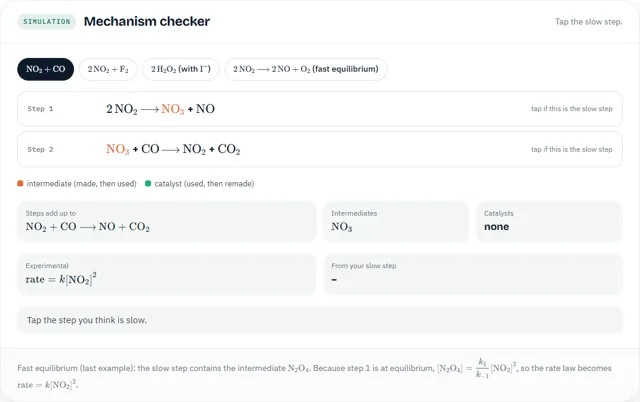
- Step 1 = overall − step 2. Move step 2's species to the opposite side and cancel.
- Step 1: ( is an intermediate).
- Slow step 1 has as reactants: . doesn't appear at all: zero order in .
Study notes
Key concepts
When the first step is not rate limiting (TRA-5.C.1). If a fast step comes before the slow step, the slow step usually contains an intermediate. Its concentration cannot be measured or controlled, so it must not be in the final rate law. An approximation is needed to write the intermediate's concentration in terms of reactants. Two related approximations are used.
1. Fast pre-equilibrium (the method used on most AP questions). If step 1 is a fast, reversible step that reaches equilibrium, and step 2 is slow, then step 1 stays essentially at equilibrium. Its forward and reverse rates are equal:
Substitute this into the slow step's rate law. All the constants combine into one observed k.
2. Steady-state approximation. After a very short start-up time, a reactive intermediate is used up about as fast as it is formed, so its concentration stays small and nearly constant:
For A + B ⇌ I (k₁, k₋₁) followed by I + C → P (k₂):
If k₋₁ ≫ k₂[C] (I goes back to A + B much faster than it goes on to P), this becomes rate = (k₁k₂/k₋₁)[A][B][C], the same answer as the pre-equilibrium method. If k₂[C] ≫ k₋₁, it becomes rate = k₁[A][B]: the first step is effectively rate limiting. You will not be asked to do this general algebra on the AP exam, but it shows where the shortcut comes from.
Short-cut rule. For a fast equilibrium before a slow step, the rate law contains all the reactant species that go into the slow step and into the steps before it, with intermediates replaced. Species produced in the fast equilibrium can appear in the denominator.
Recipe.
- Write the rate law for the slow step.
- If it contains an intermediate, use the fast equilibrium before it to write [intermediate] in terms of reactants (and possibly products).
- Substitute and combine constants into one k.
- Check the final rate law has no intermediates.
Worked examples
Worked example 5.9-A (2 NO + O₂). Mechanism:
Step 1: 2 NO ⇌ N₂O₂ (fast equilibrium)
Step 2: N₂O₂ + O₂ → 2 NO₂ (slow)
Slow step: rate = k₂[N₂O₂][O₂]. N₂O₂ is an intermediate. From step 1: k₁[NO]² = k₋₁[N₂O₂], so [N₂O₂] = (k₁/k₋₁)[NO]². Substitute: rate = (k₂k₁/k₋₁)[NO]²[O₂] = k[NO]²[O₂]. This is the experimental rate law, obtained without any termolecular step.
Worked example 5.9-B (explains Worked example 5.2-A). For 2 NO + 2 H₂ → N₂ + 2 H₂O (experimental rate = k[NO]²[H₂]):
Step 1: 2 NO ⇌ N₂O₂ (fast equilibrium)
Step 2: N₂O₂ + H₂ → N₂O + H₂O (slow)
Step 3: N₂O + H₂ → N₂ + H₂O (fast)
Slow step: rate = k₂[N₂O₂][H₂] = k₂K₁[NO]²[H₂] = k[NO]²[H₂]. The second H₂ enters after the slow step, which is why the reaction is first order in H₂ even though H₂ has coefficient 2.
Worked example 5.9-C (product in the rate law). For 2 O₃ → 3 O₂ under some conditions:
Step 1: O₃ ⇌ O₂ + O (fast equilibrium)
Step 2: O + O₃ → 2 O₂ (slow)
From step 1: [O] = K₁[O₃]/[O₂]. Rate = k₂[O][O₃] = k₂K₁[O₃]²/[O₂]. The rate is second order in O₃ and order −1 in O₂: adding product O₂ slows the reaction, because it pushes the fast equilibrium back and lowers [O].
Worked example 5.9-D (2019 AP FRQ Q6(c) style; consistency check). For 2 NO₂ → 2 NO + O₂ (experimental rate = k[NO₂]²), the mechanism 2 NO₂ ⇌ N₂O₄ (fast equilibrium); N₂O₄ → 2 NO + O₂ (slow) gives rate = k₂[N₂O₄] = k₂K₁[NO₂]². It is consistent with the rate law.
Unit 5 study guide: exam-style free-response set, worksheet and answers.
Worked example
- Slow step: .
- Fast equilibrium: , so .
- Substitute: .
- Answer: , with
Free-response practice
Write your answer first, then open the solution and mark yourself against it.
FRQ 5.9-1 (modelled on 2019 AP FRQ Q6(c)). The decomposition 2 NO₂(g) → 2 NO(g) + O₂(g) is second order in NO₂.
(a) Write the rate law.
(b) Mechanism I: NO₂ + NO₂ → NO + NO₃ (slow); NO₃ → NO + O₂ (fast). Is it consistent with the rate law? Justify.
(c) Mechanism II: NO₂ + NO₂ ⇌ N₂O₄ (fast equilibrium); N₂O₄ → 2 NO + O₂ (slow). Is it consistent? Justify.
(d) Can the rate law alone decide between mechanisms I and II? What other evidence could help?
Show the solution
(a) Rate = k[NO₂]².
(b) Yes. The slow step is bimolecular with two NO₂, giving rate = k[NO₂]². The steps add to 2 NO₂ → 2 NO + O₂.
(c) Yes. Slow step: rate = k₂[N₂O₄]. From the fast equilibrium, [N₂O₄] = K₁[NO₂]². So rate = k₂K₁[NO₂]² = k[NO₂]². The steps also add to the overall equation.
(d) No; both give the same rate law. Detecting the intermediate (NO₃ for mechanism I, N₂O₄ for mechanism II) during the reaction would support one over the other.
FRQ 5.9-2. For 2 NO(g) + Br₂(g) → 2 NOBr(g), rate = k[NO]²[Br₂]. Propose a two-step mechanism with a fast first step that is consistent with this rate law. Show that it gives the rate law.
Show the solution
Step 1: NO + Br₂ ⇌ NOBr₂ (fast equilibrium). Step 2: NOBr₂ + NO → 2 NOBr (slow).
The steps add to 2 NO + Br₂ → 2 NOBr. Slow step: rate = k₂[NOBr₂][NO]. From step 1, [NOBr₂] = K₁[NO][Br₂]. So rate = k₂K₁[NO]²[Br₂] = k[NO]²[Br₂]. Both steps are bimolecular, which is realistic.
Common mistake
Students stop at . is an intermediate, so it must be replaced using the fast equilibrium: .
Frequently asked questions
?Why can't an intermediate appear in a rate law?
Its concentration is not set by the experimenter and is usually too small or short-lived to measure, so the rate law is written in terms of reactants.
?Is the steady-state approximation the same as a fast equilibrium?
They are related ways to handle intermediates; on the AP exam the usual case is a fast reversible first step followed by a slow step, solved by setting forward and reverse rates equal.
Practice questions on 5.9
- Q1Mechanism: X + Y ⇌ Z (fast equilibrium); Z + A → B + C (slow). Which rate law is consistent?
- Q2The first step of a two-step mechanism is 2 NO(g) ⇌ N₂O₂(g) (fast). The experimental rate law is rate = k[NO]²[H₂]. Which is the slow second step?
- Q3Which statement describes the steady-state approximation?
- Q4Mechanism: Cl₂ ⇌ 2 Cl (fast equilibrium); Cl + CHCl₃ → HCl + CCl₃ (slow); CCl₃ + Cl → CCl₄ (fast). What is the rate law for Cl₂ + CHCl₃ → HCl + CCl₄?
- Q5Mechanism: A ⇌ B + I (fast equilibrium); I + C → D (slow). How does adding more B affect the rate?
- Q6Mechanism: (fast equilibrium), then (slow). What is the rate law?
- Q7Mechanism: (fast equilibrium), then (slow). What is the rate law?
Terms used in this topic
Stuck on a unit? Let us fix it this week.
Book a 30-minute one-to-one session for $20. Bring a test, a homework set or the topic that is not clicking.
Book a session