 AP Chemistry Tutoring
6.1 Endothermic and exothermic processes
AP Chemistry Unit 6: Thermochemistry · 1 simulation · 18 practice questions
Updated · Aligned to the AP Chemistry Course and Exam Description
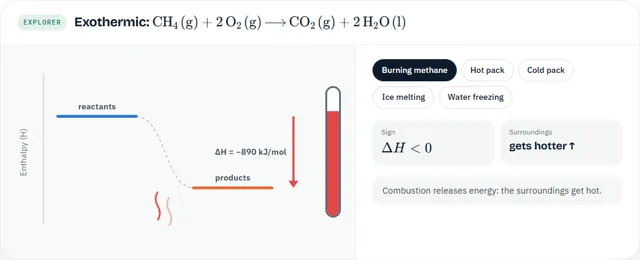
An exothermic process releases energy from the system to the surroundings, so and the surroundings warm up; an endothermic process absorbs energy from the surroundings, so and the surroundings cool. Energy is conserved, so the heat gained or lost by the system equals the heat lost or gained by the surroundings: .
Endothermic & exothermic
Exo: energy exits.
Like people moving out of California: the system loses energy, the surroundings gain it and get hotter. Products end lower than reactants: . Burning is the classic example.
Endo: energy enters.
Like money arriving in your bank account: it came from someone else. The system takes energy from the surroundings, which get colder. Products end higher: .
:
Breaking bonds always takes energy (endothermic). Forming bonds always releases it (exothermic). A reaction is exothermic overall when forming the new bonds releases more than breaking the old ones took.
Study notes
Key concepts
Energy, system and surroundings. Energy is the capacity to do work or to produce heat. It is measured in joules (J) or kilojoules (kJ); 1 kJ = 1000 J. The system is the part of the universe we are studying (usually the reacting chemicals). The surroundings are everything else (the water in which the reaction happens, the beaker, the air, your hand).
First law of thermodynamics. Energy is conserved. It is never created or destroyed, only transferred or changed in form. So any energy lost by the system is gained by the surroundings, and any energy gained by the system comes from the surroundings.
Temperature changes signal energy changes (ENE-2.A.1). In the lab you cannot see energy, but you can measure temperature. If a reaction happens in water and the water gets warmer, energy has moved from the reacting system into the water. If the water gets colder, energy has moved from the water into the reacting system.
Endothermic and exothermic (ENE-2.A.2, ENE-2.A.3).
| Exothermic | Endothermic | |
|---|---|---|
| Energy flow | System releases energy to surroundings | System absorbs energy from surroundings |
| Energy of system | Decreases | Increases |
| Sign of ΔH | Negative (ΔH < 0) | Positive (ΔH > 0) |
| Temperature of surroundings (e.g. water in a beaker) | Rises | Falls |
| Energy written in the equation | As a product | As a reactant |
| Phase-change examples | Freezing, condensation, deposition | Melting, boiling (vaporization), sublimation |
| Reaction examples | Combustion, neutralization (HCl + NaOH), rusting of iron | Decomposition of CaCO₃, photosynthesis, dissolving NH₄NO₃ |
Energy changes happen in three kinds of process (ENE-2.D.6): heating or cooling a substance, phase changes, and chemical reactions. All three can be described as endothermic or exothermic.
Examples written with energy as a term:
-
Exothermic: 2 H₂(g) + O₂(g) → 2 H₂O(l) + energy
-
Endothermic: energy + 2 HgO(s) → 2 Hg(l) + O₂(g)
-
Endothermic phase change: energy + H₂O(s) → H₂O(l)
Heat and work. The energy of the system can change in two ways: by heat transfer (q) or by work (w). For an exothermic reaction, the energy lost by the system goes to the surroundings as heat transferred from the system or as work done by the system (for example, a gas produced in a cylinder pushes a piston up). For an endothermic reaction, the system gains energy by heat transferred to it or work done on it. The sign convention used in chemistry is ΔE = q + w, where q > 0 means heat flows into the system and w > 0 means work is done on the system (compression). The technical difference between enthalpy and internal energy is not tested on the AP exam; at constant pressure we treat the enthalpy change ΔH as the heat of the process.
Solution formation can be either (ENE-2.A.4). Dissolving involves three steps:
-
Separating solute particles from each other (breaking solute–solute attractions): endothermic.
-
Separating solvent particles to make room (breaking some solvent–solvent attractions): endothermic.
-
Forming solute–solvent attractions (for ions in water, ion–dipole attractions; this step is often called hydration): exothermic.
If the energy released in step 3 is greater than the energy absorbed in steps 1 and 2, dissolving is exothermic and the solution warms (NaOH, KOH, CaCl₂, anhydrous CuSO₄). If it is smaller, dissolving is endothermic and the solution cools (NH₄NO₃, NH₄Cl, KNO₃ — the basis of instant cold packs).
Common misconceptions.
-
"Combustion needs a flame, so it is endothermic." No. A small amount of energy starts the reaction (activation energy), but much more energy is released overall. Combustion is exothermic.
-
"If the thermometer reading goes down, the reaction gave off cold." Cold is not a substance. A falling temperature means the reaction (system) absorbed energy from the water (surroundings): endothermic.
-
"Breaking bonds releases energy." Breaking a bond always requires energy (endothermic). Forming a bond always releases energy (exothermic). A reaction is exothermic only when the bonds formed release more energy than the bonds broken need.
Key equations
Worked examples
Example 1. A student dissolves solid ammonium nitrate, NH₄NO₃, in water in a polystyrene cup. The temperature falls from 22.0 °C to 16.5 °C. Classify the process and explain the direction of energy flow.
Solution. The water (surroundings) got colder, so energy flowed out of the water and into the dissolving NH₄NO₃ (system). The system gained energy, so the process is endothermic and ΔHsoln > 0. In particle terms, the energy needed to separate the NH₄⁺ and NO₃⁻ ions from the crystal and to separate water molecules is greater than the energy released when ion–dipole attractions form.
Example 2. A system absorbs 1.00 kJ of heat while its internal energy decreases by 5.00 kJ. Find the work and state who does it.
Solution. ΔE = q + w, so w = ΔE − q = (−5.00 kJ) − (+1.00 kJ) = −6.00 kJ. The negative sign means the system does 6.00 kJ of work on the surroundings.
Unit 6 study guide: exam-style free-response set, worksheet and answers.
Worked example
- The water (surroundings) loses energy, so .
- : the dissolving process absorbs heat.
- Answer: Endothermic; .
Free-response practice
Write your answer first, then open the solution and mark yourself against it.
FRQ 6.1-1. A student adds 5.0 g of solid calcium chloride, CaCl₂, to 50.0 mL of water in a polystyrene cup. The temperature rises from 21.0 °C to 35.5 °C. In a second experiment, 5.0 g of potassium nitrate, KNO₃, is added to 50.0 mL of water and the temperature falls from 21.0 °C to 14.2 °C.
(a) Classify each dissolution as endothermic or exothermic. Justify your answer using the direction of energy transfer.
(b) Explain, in terms of the attractions broken and formed, why dissolving CaCl₂ is exothermic.
(c) A third student says: "When KNO₃ dissolves, cold is released into the water." Correct this statement.
Show the solution
(a) CaCl₂: exothermic. The water temperature increased, so energy was transferred from the dissolving CaCl₂ (system) to the water (surroundings). KNO₃: endothermic. The water temperature decreased, so energy was transferred from the water to the dissolving KNO₃.
(b) Energy is absorbed to separate Ca²⁺ and Cl⁻ ions from the lattice and to separate some water molecules. Energy is released when ion–dipole attractions form between the ions and polar water molecules. For CaCl₂, the small, highly charged Ca²⁺ ion forms very strong ion–dipole attractions, so the energy released is greater than the energy absorbed, and the overall process is exothermic.
(c) No "cold" is transferred. Energy (heat) moves from the warmer water into the dissolving KNO₃ because the process is endothermic. The water loses thermal energy, so its temperature drops.
FRQ 6.1-2. A gas inside a cylinder with a movable piston absorbs 15.6 kJ of heat, while the surroundings do 1.4 kJ of work on the gas.
(a) Calculate ΔE for the gas.
(b) Did the piston move in or out? Explain.
Show the solution
(a) q = +15.6 kJ (heat absorbed) and w = +1.4 kJ (work done on the system). ΔE = q + w = 15.6 + 1.4 = +17.0 kJ.
(b) Work was done on the gas, so the gas was compressed: the piston moved in (the volume decreased).
Common mistake
Students say a reaction that makes its container cold has released cold. The reaction (system) absorbed heat from the surroundings, so it is endothermic and the surroundings' temperature drops.
Frequently asked questions
?Is melting ice endothermic or exothermic?
Endothermic: energy must be absorbed to overcome the hydrogen bonds holding water molecules in the solid.
?Does an exothermic reaction feel hot?
Yes. Energy flows from the reacting system into the surroundings, including your hand or the solution, so they warm up.
Practice questions on 6.1
- Q1When solid dissolves in water, the solution gets colder. Which statement is correct?
- Q2When solid dissolves in water in a cold pack, the pack gets cold. The dissolving process is
- Q3When a salt dissolves in water, which of the following steps is exothermic?
- Q4A few drops of water are added to white anhydrous copper(II) sulfate, CuSO₄(s), and the mixture becomes warm. Which statement best explains this observation?
- Q5Which process is endothermic?
- Q6HCl(aq) and NaOH(aq) are mixed in an insulated cup. The temperature of the mixture rises from 27.0 °C to 33.0 °C. Which statement is correct?
- Q7For an exothermic reaction A + B → C, which statement about chemical potential energy is correct?
- Q8Water is boiled inside a cylinder fitted with a movable, frictionless piston at constant pressure. Which statement is correct?
- Q9Dissolving a solute takes three steps. Which step is exothermic?
- Q10NaOH pellets dissolving in water make the solution hot. Why?
- Q11Which process is endothermic?
- Q12Solid dissolves, and the solution becomes colder. Which is true?
- Q13Which process is endothermic?
- Q14In an endothermic reaction, how does the chemical potential energy of the products compare with that of the reactants?
- Q15An energy diagram shows the products higher in energy than the reactants. What happens to the surroundings?
- Q16A cold metal is placed in hot water. The metal's energy changes by +45 J. Assuming no losses, what is the water's energy change?
- Q17A gas in a cylinder with a movable piston is cooled at constant pressure. What happens?
- Q18A gas is heated at constant pressure. What happens to its volume?
Terms used in this topic
Stuck on a unit? Let us fix it this week.
Book a 30-minute one-to-one session for $20. Bring a test, a homework set or the topic that is not clicking.
Book a session