 AP Chemistry Tutoring
5.3 Concentration changes over time
AP Chemistry Unit 5: Kinetics · 1 simulation · 24 practice questions
Updated · Aligned to the AP Chemistry Course and Exam Description
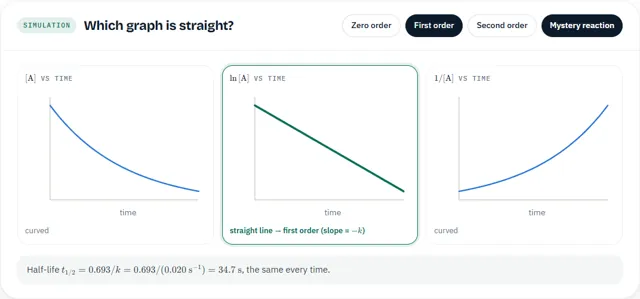
Integrated rate laws describe how concentration changes with time, and the order is identified by which plot is linear: vs. for zero order, vs. for first order, and vs. for second order. For a first-order reaction and the half-life is constant, as in radioactive decay.
Concentration over time
Find the straight line.
One experiment, three graphs. Whichever one is a straight line tells you the order.
| vs straight | zero order | |
| vs straight | first order | |
| vs straight | second order |
Which graph is straight?
A first-order reaction: falls 0.160 → 0.080 → 0.040 M, every 1.67 hours. Find .
- Concentration halves in equal times: constant half-life, so first order. .
- (on the formula sheet), so .
- . Always give units.
? at equal time steps gives = 2.00, 2.75, 3.50, 4.25 . What is the order?Think, then tap to check
Second order. rises by the same 0.75 each step: a straight line of against time.
Study notes
Key concepts
Why we need integrated rate laws. A rate law tells you the rate at one set of concentrations. An integrated rate law tells you the concentration at any time. It comes from the rate law by calculus, but you only need to use the results. They are on the AP equation sheet.
Finding the order from a concentration–time graph (TRA-3.C.1 to TRA-3.C.3). Make three plots from the same data. Whichever one is a straight line tells you the order with respect to the reactant you are watching.
| Zero order | First order | Second order | |
|---|---|---|---|
| Rate law | rate = k | rate = k[A] | rate = k[A]² |
| Integrated rate law | [A]ₜ − [A]₀ = −kt | ln[A]ₜ − ln[A]₀ = −kt | 1/[A]ₜ − 1/[A]₀ = kt |
| Straight-line plot | [A] vs. t | ln[A] vs. t | 1/[A] vs. t |
| Slope of the straight line (TRA-3.C.4) | −k | −k | +k |
| Units of k | M s⁻¹ | s⁻¹ | M⁻¹ s⁻¹ |
| Half-life | [A]₀/(2k), gets shorter as [A] falls | 0.693/k, constant | 1/(k[A]₀), gets longer as [A] falls |
Only the first-order half-life is required by the CED, but knowing how the half-life behaves in the other two cases is a fast way to recognize the order from a table.
Reading the graphs.
- Zero order: [A] falls in a straight line. The rate does not slow down until A runs out. Common for reactions on a saturated catalyst surface or a saturated enzyme.
- First order: [A] vs. t is a curve that keeps halving in equal time intervals. ln[A] vs. t is a straight line with slope −k.
- Second order: [A] vs. t curves more sharply at first and then flattens out more than first order does. 1/[A] vs. t is a straight line with positive slope +k.
- If ln[A] vs. t curves upward (gets less steep) and 1/[A] vs. t is straight, it is second order. If 1/[A] vs. t curves and ln[A] is straight, it is first order.
Half-life (TRA-3.C.5). The half-life t½ is the time for the reactant concentration to fall to half its value. For a first-order reaction it does not depend on concentration:
So a first-order reaction takes the same time to go from 100% to 50% as from 50% to 25%, and from 25% to 12.5%. Constant half-life is a quick test for first order. After n half-lives the fraction left is (½)ⁿ.
| Half-lives passed | 1 | 2 | 3 | 4 | 5 | 6 | 7 | 8 | 10 |
|---|---|---|---|---|---|---|---|---|---|
| Fraction remaining | 1/2 | 1/4 | 1/8 | 1/16 | 1/32 | 1/64 | 1/128 | 1/256 | 1/1024 |
| Percent remaining | 50 | 25 | 12.5 | 6.25 | 3.13 | 1.56 | 0.78 | 0.39 | 0.098 |
Radioactive decay (TRA-3.C.6). Every radioactive decay is first order. Each nucleus has a fixed chance of decaying per second, no matter how many others are around, and decay is not affected by temperature, pressure or chemical bonding. So a radioactive isotope has a constant half-life, and number of atoms or activity can be used in place of concentration in ln N = ln N₀ − kt.
Pseudo-first-order conditions (lab skill). If rate = k[A][B] and B is in large excess, [B] hardly changes. Then rate ≈ k′[A] with k′ = k[B]. The reaction behaves like first order in A, and you can find the order in A from a ln[A] plot. Changing [B] (still in excess) and seeing how k′ changes gives the order in B. This is how the crystal violet and food-dye bleaching labs work.
Useful forms of the first-order equation.
"x% complete" means (100 − x)% remains. Always put the fraction remaining into the equation.
Common mistakes.
- Using log (base 10) instead of ln.
- Putting "percent reacted" into the equation instead of "percent remaining".
- Mixing time units (k in min⁻¹ with t in s).
- Forgetting that the slope of a ln[A] plot is −k, so k is positive.
- Saying the half-life of a first-order reaction depends on the starting amount. It does not.
Key equations
Worked examples
Worked example 5.3-A (first-order calculations). SO₂Cl₂(g) → SO₂(g) + Cl₂(g) is first order with k = 2.2 × 10⁻⁵ s⁻¹ at 593 K. [SO₂Cl₂]₀ = 0.0500 M.
(a) [SO₂Cl₂] after 1.00 h: t = 3600 s. ln[A] = ln(0.0500) − (2.2 × 10⁻⁵)(3600) = −2.9957 − 0.0792 = −3.0749, so [A] = e^(−3.0749) = 0.0462 M.
(b) Half-life: t½ = 0.693 ÷ 2.2 × 10⁻⁵ s⁻¹ = 3.15 × 10⁴ s (8.75 h).
(c) Time to fall to 0.0100 M: ln(0.0100/0.0500) = −kt, so t = ln 5 ÷ 2.2 × 10⁻⁵ = 1.609 ÷ 2.2 × 10⁻⁵ = 7.3 × 10⁴ s (about 20.3 h).
Worked example 5.3-B (choosing the order from data; modelled on 2016 AP FRQ Q5 and 2019 AP FRQ Q6(a)). For the gas-phase dimerization 2 C₄H₆ → C₈H₁₂ at a fixed temperature:
| t (s) | [C₄H₆] (M) | ln[C₄H₆] | 1/[C₄H₆] (M⁻¹) |
|---|---|---|---|
| 0 | 0.0200 | −3.912 | 50.0 |
| 100 | 0.0133 | −4.318 | 75.0 |
| 200 | 0.0100 | −4.605 | 100.0 |
| 300 | 0.00800 | −4.828 | 125.0 |
| 400 | 0.00667 | −5.011 | 150.0 |
[A] vs. t is not linear (it drops by 0.0067, then 0.0033, then 0.0020 per 100 s). ln[A] vs. t is not linear (changes of −0.406, −0.287, −0.223, −0.183). 1/[A] vs. t rises by exactly 25.0 M⁻¹ every 100 s, so it is linear. The reaction is second order in C₄H₆: rate = k[C₄H₆]².
k = slope = 25.0 M⁻¹ ÷ 100 s = 0.250 M⁻¹ s⁻¹.
Half-life check: 0.0200 → 0.0100 M took 200 s. The next halving (0.0100 → 0.0050 M) needs 1/0.0050 = 200 M⁻¹, reached at t = (200 − 50)/0.250 = 600 s, so it takes 400 s. The half-life doubles: a fingerprint of second order.
Worked example 5.3-C (counting half-lives; modelled on 1999 released MC Q48 and 2018 AP FRQ Q7(b)–(c)). A radioactive isotope has t½ = 15.0 min.
k = 0.693 ÷ 15.0 min = 0.0462 min⁻¹.
A sample starts with 128 atoms. 128 → 64 → 32 → 16 → 8 → 4 → 2 → 1 is 7 half-lives, so the expected time is 7 × 15.0 = 105 min.
If 93.75% of another isotope decays in 36 h, then 6.25% = 1/16 = (½)⁴ remains, which is 4 half-lives, so t½ = 36 ÷ 4 = 9.0 h.
Worked example 5.3-D (zero order). On a hot platinum wire, N₂O decomposes with [N₂O] values of 0.0100, 0.00750, 0.00500 and 0.00250 M at t = 0, 100, 200 and 300 s. The concentration falls by the same amount (0.00250 M) every 100 s, so [N₂O] vs. t is linear: zero order. Rate = k, with k = −slope = 0.00250 M ÷ 100 s = 2.50 × 10⁻⁵ M s⁻¹. (The rate is constant because the Pt surface is fully covered; adding more N₂O cannot make the surface react faster. See 5.11.)
Unit 5 study guide: exam-style free-response set, worksheet and answers.
Worked example
- Half-life: .
- 90.0 min is 3 half-lives: .
- Check: .
- Answer: 10.0 g
Free-response practice
Write your answer first, then open the solution and mark yourself against it.
FRQ 5.3-1 (modelled on 2015 AP FRQ Q5 and the CED crystal violet investigation). Crystal violet (CV⁺, purple) reacts with OH⁻ to give a colorless product: CV⁺(aq) + OH⁻(aq) → CVOH(aq). A student mixes CV⁺ with a large excess of OH⁻ ([OH⁻] = 0.010 M, essentially constant) and records absorbance at 590 nm.
| t (s) | 0 | 100 | 200 | 300 | 400 |
|---|---|---|---|---|---|
| Absorbance | 0.800 | 0.566 | 0.400 | 0.283 | 0.200 |
(a) Explain why absorbance can be used in place of [CV⁺].
(b) Determine the order with respect to CV⁺. Justify your answer using the data.
(c) Calculate the observed rate constant k′.
(d) The reaction is first order in OH⁻. Calculate k in rate = k[CV⁺][OH⁻].
(e) In a second run, the color disappears too quickly to measure. Propose one change to the reaction mixture that would slow the reaction, and explain.
Show the solution
(a) By Beer's law, A = εbc. With the same wavelength and cuvette, A is directly proportional to [CV⁺].
(b) The absorbance halves every 200 s (0.800 → 0.400 → 0.200), so the half-life is constant. That means first order in CV⁺. (Equivalently, ln A vs. t is linear: −0.223, −0.570, −0.916, −1.263, −1.609, falling by 0.347 every 100 s.)
(c) k′ = 0.693 ÷ 200 s = 3.47 × 10⁻³ s⁻¹ (also = −slope of ln A vs. t = 0.347 ÷ 100 s).
(d) k′ = k[OH⁻], so k = 3.47 × 10⁻³ s⁻¹ ÷ 0.010 M = 0.35 M⁻¹ s⁻¹.
(e) Use a lower [OH⁻] (still in large excess over CV⁺). Since k′ = k[OH⁻], a smaller [OH⁻] gives a smaller k′ and a longer half-life, because there are fewer OH⁻ ions to collide with CV⁺ each second. (Lowering the temperature would also work by lowering k.)
FRQ 5.3-2 (modelled on 2011 AP FRQ Q6(c)–(d), ethanol decomposing on a Cu catalyst). On a hot platinum surface, 2 N₂O(g) → 2 N₂(g) + O₂(g). In a rigid 1.0 L flask at constant temperature, the initial [N₂O] is 0.0100 M and the initial pressure is 0.40 atm. [N₂O] falls in a straight line, reaching 0.00500 M at 200 s.
(a) What is the order of the reaction with respect to N₂O? Justify.
(b) Write the rate law and calculate k with units.
(c) Calculate the total pressure in the flask after all of the N₂O has decomposed.
(d) Would a plot of ln[N₂O] vs. t be linear? Explain.
Show the solution
(a) Zero order. A straight-line [N₂O] vs. t plot means the rate is constant and does not depend on [N₂O].
(b) Rate = k. k = (0.0100 − 0.00500) M ÷ 200 s = 2.50 × 10⁻⁵ M s⁻¹.
(c) 2 mol gas → 3 mol gas. At constant V and T, P is proportional to moles of gas: P = 0.40 atm × 3/2 = 0.60 atm.
(d) No. ln[N₂O] vs. t is linear only for first order. For zero order, [N₂O] vs. t is linear, so ln[N₂O] vs. t curves downward (gets steeper with time).
Common mistake
Students use the first-order half-life formula for any reaction. Only first-order reactions have a constant half-life independent of concentration.
Frequently asked questions
?How do you tell if a reaction is first order from a graph?
Plot against time; if the plot is a straight line, the reaction is first order and the slope is .
?Is the half-life formula on the AP equation sheet?
Yes. The sheet gives the integrated rate laws and for first-order reactions.
Practice questions on 5.3
- Q1A graph of against time is a straight line. What is the order of the reaction with respect to A?
- Q2A first-order reaction has . What is its half-life?
- Q3A first-order reaction has a half-life of 10 minutes. What fraction of the reactant remains after 30 minutes?
- Q4Plots of , and against time are made. Only vs time is a straight line. What is the rate law?
- Q5A first-order reactant falls from 0.160 M to 0.080 M in 1.67 h. What is ?
- Q6A first-order reaction has a half-life of 4.0 h. What is k?
- Q7The half-life of a first-order reaction A → products depends on
- Q8After 150 s of a first-order reaction, 12.5% of reactant A remains. What is the half-life?
- Q9The percent of a reactant remaining was recorded: Time (min): 0, 2, 4, 6, 8, 12, 16 % remaining: 100, 71, 50, 35, 25, 12.5, 6.3 Which describes the order and half-life?
- Q10Which plot is linear for a reaction that is second order in A?
- Q11A → B + C is first order with k = 0.20 s⁻¹. How long does it take for the reaction to be 35% complete?
- Q12X reacts with a large excess of Y. Data show that [X] falls in a straight line with time until X is gone, while [Y] barely changes. What can be concluded?
- Q13For a first-order reaction with t½ = 100 s, about what percent of the reactant remains after 305 s?
- Q14Which statement about radioactive decay is true?
- Q15A first-order reaction has a half-life of 6.93 min. What is ?
- Q16A first-order reaction has . What is its half-life?
- Q17Two first-order reactions have half-lives of 10 min and 10 s. Which has the larger rate constant?
- Q18What does the half-life of a first-order reaction depend on?
- Q19In a first-order reaction, 87.5% of the reactant is consumed in 90 s. What is the half-life?
- Q20What is the order of radioactive decay?
- Q21A first-order reaction has s. Approximately what percentage remains after 162 s?
- Q22 is 0.800, 0.400, 0.200 and 0.100 M at 0, 10, 20 and 30 s. What is the order in A?
- Q23For a first-order reaction with , how long does it take for 60% of the reactant to be consumed?
- Q24Which plot gives a straight line whose slope is used to find the activation energy?
Stuck on a unit? Let us fix it this week.
Book a 30-minute one-to-one session for $20. Bring a test, a homework set or the topic that is not clicking.
Book a session