 AP Chemistry Tutoring
5.4 Elementary reactions
AP Chemistry Unit 5: Kinetics · 1 simulation · 11 practice questions
Updated · Aligned to the AP Chemistry Course and Exam Description
An elementary reaction is a single step that occurs exactly as written in one collision or event. Its molecularity is the number of reactant particles involved (unimolecular, bimolecular, rarely termolecular), and its rate law can be written directly from its coefficients: for the elementary step , . This shortcut applies only to elementary steps, not to overall reactions.
Reaction mechanisms
The recipe behind the equation.
A balanced equation is an ingredients list. A mechanism is the recipe: a series of elementary steps that add up to the overall equation.
For an elementary step (and only then) the coefficients are the orders.
The slowest step sets the pace.
Mixing pizza dough takes minutes; letting it rise takes hours. The slowest step is the rate-determining step, and its reactants give the rate law.
A valid mechanism must (1) add up to the overall equation and (2) give the experimental rate law.
Mechanism checker
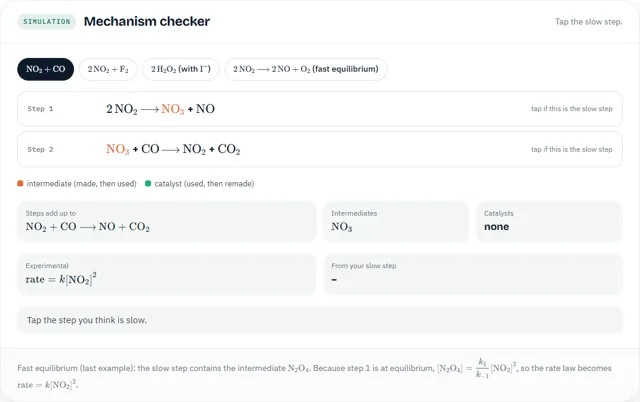
- Step 1 = overall − step 2. Move step 2's species to the opposite side and cancel.
- Step 1: ( is an intermediate).
- Slow step 1 has as reactants: . doesn't appear at all: zero order in .
Study notes
Key concepts
What an elementary reaction is. An elementary reaction (elementary step) is a single event at the molecular level: one molecule falling apart, or two (rarely three) particles colliding and changing bonds in one go. It describes exactly which particles meet. Most overall reactions are not elementary; they happen through a series of elementary steps (a mechanism, 5.7).
Molecularity. The number of reactant particles in an elementary step is its molecularity.
| Molecularity | Elementary step | Rate law | Order |
|---|---|---|---|
| Unimolecular | A → products | rate = k[A] | 1 |
| Bimolecular | A + B → products | rate = k[A][B] | 2 |
| Bimolecular | 2 A → products | rate = k[A]² | 2 |
| Termolecular | A + B + C → products | rate = k[A][B][C] | 3 |
| Termolecular | 2 A + B → products | rate = k[A]²[B] | 3 |
| Termolecular | 3 A → products | rate = k[A]³ | 3 |
Rate law of an elementary step (TRA-4.A.1). For an elementary step, and only for an elementary step, the rate law can be written straight from the equation: each reactant's coefficient becomes its order. This works because the rate of a single-collision event is proportional to how often those particular particles meet, and the chance of meeting is proportional to each concentration. Doubling [A] doubles the number of A–B collisions per second; doubling both [A] and [B] quadruples them.
Three-body collisions are rare (TRA-4.A.2). For three particles to hit the same place at the same instant with the right energy and orientation is very unlikely. So termolecular steps are uncommon and steps with four or more particles essentially never happen. If a balanced equation has many reactant particles (for example 2 MnO₄⁻ + 5 H₂C₂O₄ + 6 H⁺), it cannot be one elementary step.
Elementary vs. overall. You are usually told whether an equation is elementary. If you are not told, do not assume it.
Common mistakes.
- Writing rate laws from coefficients of an overall reaction. (Only allowed for elementary steps.)
- Thinking molecularity can be zero or a fraction. Molecularity is always a whole number 1, 2 or (rarely) 3; reaction orders of overall reactions can be 0 or fractions.
Worked examples
Worked example 5.4-A. Write the rate law and molecularity for each elementary step.
(a) O₃(g) → O₂(g) + O(g): unimolecular; rate = k[O₃].
(b) NO(g) + O₃(g) → NO₂(g) + O₂(g): bimolecular; rate = k[NO][O₃].
(c) 2 NO(g) + Br₂(g) → 2 NOBr(g), if it were elementary: termolecular; rate = k[NO]²[Br₂].
Worked example 5.4-B. The elementary step 2 NO₂ → NO₃ + NO occurs with rate = k[NO₂]². If [NO₂] is cut to one third, the rate becomes (⅓)² = 1/9 of its value, because the number of NO₂–NO₂ collisions per second falls by a factor of 9.
Unit 5 study guide: exam-style free-response set, worksheet and answers.
Worked example
- The step is elementary, so the exponents equal the coefficients: 1 for and 1 for .
- Two reactant particles collide, so it is bimolecular.
- Answer: ; bimolecular
Free-response practice
Write your answer first, then open the solution and mark yourself against it.
FRQ 5.4-1. Consider the elementary step 2 NO(g) + O₂(g) → 2 NO₂(g).
(a) Write the rate law for this step and state its molecularity.
(b) If the volume of the container is halved at constant temperature, by what factor does the rate change? Explain using particles.
(c) A student says this step is unlikely to be a real elementary step. Give one reason the student could use.
Show the solution
(a) Rate = k[NO]²[O₂]; termolecular.
(b) Halving the volume doubles every concentration. Rate factor = (2)² × (2) = 8. With the particles packed twice as closely, collisions involving the required particles happen much more often.
(c) Termolecular steps need three particles to collide at the same instant with suitable energy and orientation. That is rare, so a two-step mechanism (for example a fast 2 NO ⇌ N₂O₂ equilibrium followed by N₂O₂ + O₂ → 2 NO₂) is more likely. (See 5.9.)
Common mistake
Students write rate laws for overall reactions from coefficients. Only an elementary step's rate law follows from its coefficients; an overall reaction's rate law must be determined by experiment or from a mechanism.
Frequently asked questions
?What does molecularity mean?
The number of reactant particles that collide in a single elementary step: one (unimolecular), two (bimolecular) or three (termolecular).
?Can you use coefficients for a rate law?
Only for elementary steps. For an overall reaction the orders must come from experimental data.
Practice questions on 5.4
- Q1Which is the rate law for the elementary step A + B → C + D?
- Q2An elementary step has the rate law rate = k[A]³[B]². What are the reactants in the step, and is it likely?
- Q3The equation 3 A + 3 B → C is an overall reaction (not stated to be elementary). What does it tell you about the order and molecularity?
- Q4Assuming each is a single elementary step with similar energy requirements, which kind of step is most likely to happen at the highest rate at equal concentrations?
- Q5For the elementary step NO(g) + NO₃(g) → 2 NO₂(g), what is the overall order?
- Q6What is the rate law for the elementary step ?
- Q7The overall reaction is not known to be elementary. What can be concluded about its rate law?
- Q8A mechanism has steps (slow) and (fast). What is the rate law, and what is the molecularity of the slow step?
- Q9A mechanism has steps (slow) and (fast). What is the rate law?
- Q10Other factors being equal, which type of elementary step tends to be fastest?
- Q11If rate and [B] is held constant, how does the rate change as [A] increases?
Terms used in this topic
Stuck on a unit? Let us fix it this week.
Book a 30-minute one-to-one session for $20. Bring a test, a homework set or the topic that is not clicking.
Book a session