 AP Chemistry Tutoring
5.5 Collision model
AP Chemistry Unit 5: Kinetics · 1 simulation · 16 practice questions
Updated · Aligned to the AP Chemistry Course and Exam Description
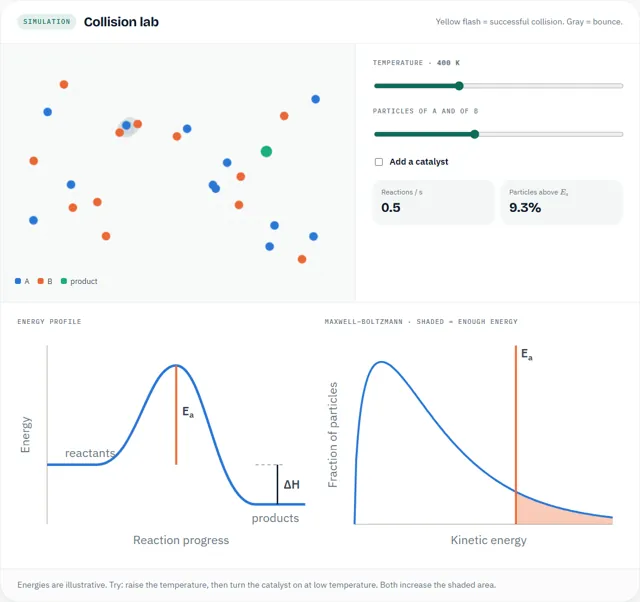
The collision model states that a reaction occurs only when particles collide with enough energy to reach the activation energy, , and with an orientation that allows bonds to break and form. Raising the temperature increases the rate mainly because a larger fraction of collisions have energy at least , as shown by the Maxwell-Boltzmann distribution; higher concentration increases the frequency of collisions.
Collisions & energy
Most collisions bounce off.
A collision only reacts if the particles have enough energy to break bonds (at least the activation energy, ) and the right orientation. Three particles meeting at once with both is so unlikely that elementary steps almost never involve more than two.
Why heat and catalysts work.
Higher temperature shifts the Maxwell–Boltzmann curve right: more particles clear . A catalyst gives a new pathway with a lower , so more particles clear it at the same temperature. doesn't change.
Collision lab
A catalyst is used, then given back.
Contact-lens cleaner: a platinum (or palladium) disc makes decompose fast, fizzing . The metal isn't used up. In a mechanism, a catalyst appears as a reactant first and a product later; an intermediate is the opposite.
One hump per step.
A two-step mechanism has two peaks on its energy profile. The step with the highest barrier is the slow, rate-determining step.
Study notes
Key concepts
Collisions start reactions (TRA-4.B.1). In an elementary reaction, reactant particles must collide so that old bonds can start to break and new bonds can start to form.
Most collisions do nothing (TRA-4.B.2). In a gas at room temperature each molecule collides billions of times per second, yet most reactions are far slower than that. Only a small fraction of collisions are effective (successful). An effective collision needs both:
- Enough energy. The colliding particles must have a combined kinetic energy at least equal to the activation energy Ea, the energy needed to reach the transition state.
- The right orientation. The atoms that must bond have to meet each other. For example, in NO + O₃ → NO₂ + O₂, the N atom of NO must hit an end O atom of O₃. If the O end of NO hits O₃, nothing happens no matter how hard the collision.
So:
Maxwell–Boltzmann distribution (TRA-4.B.3). In any sample, particles have a range of kinetic energies. A Maxwell–Boltzmann curve plots fraction of particles (y-axis) against kinetic energy (x-axis). Features to know:
- It starts at zero (no particle has zero energy), rises to a peak (the most probable energy) and has a long tail to the right.
- It is not symmetrical; the tail to the high-energy side is long.
- The area under the curve is the total number of particles, so it is the same at every temperature for the same sample.
- Mark Ea as a vertical line on the energy axis. The area under the curve to the right of Ea is the fraction of particles with enough energy to react.
What happens when T increases. The curve flattens and spreads to the right. The peak moves to higher energy and gets lower (total area is unchanged). The area to the right of Ea gets much bigger. For many reactions a 10 °C rise roughly doubles the rate, because the fraction of particles above Ea roughly doubles, while the collision frequency rises by only a few percent. So the main reason temperature speeds reactions is energy, not collision frequency.
| Change | Collisions per second | Fraction with E ≥ Ea | Fraction with good orientation | k changes? |
|---|---|---|---|---|
| Increase [reactant] | Increases | Same | Same | No |
| Increase T | Increases a little | Increases a lot | Same | Yes, increases |
| Add catalyst | Same or more | Increases (Ea is lower) | May increase | Yes, increases |
| Grind solid finer | Increases | Same | Same | Rate rises (surface term) |
How the collision model explains the rate law. Collision frequency between A and B is proportional to [A][B], which is why an elementary bimolecular step has rate = k[A][B]. The energy and orientation fractions are inside k. That is why k depends on temperature and catalyst but not on concentration.
Common mistakes.
- "Higher temperature lowers Ea." It does not. Ea is a property of the pathway; temperature changes how many particles can get over it.
- "The rate increases with temperature mainly because collisions are more frequent." The bigger effect is the larger fraction of collisions with E ≥ Ea.
- Drawing the hot curve taller than the cold curve. The hot curve has a lower, broader peak.
Worked examples
Worked example 5.5-A (Maxwell–Boltzmann description). Describe how the Maxwell–Boltzmann curve at 350 K differs from the curve for the same gas sample at 300 K, and use it to explain why the reaction is faster at 350 K.
At 350 K the curve's peak is lower and further to the right, and the curve is wider with a larger high-energy tail. The total area under both curves is the same (same number of molecules). If a vertical line is drawn at Ea, the area to the right of that line is clearly larger for 350 K. So a larger fraction of collisions has enough energy to reach the transition state. With more effective collisions per second, the rate is higher, and this shows up as a larger rate constant k.
Worked example 5.5-B (orientation). In the reaction of a hydroxide ion with bromomethane, OH⁻ + CH₃Br → CH₃OH + Br⁻, the O of OH⁻ must hit the carbon atom on the side opposite to the Br atom. Collisions where OH⁻ hits the Br end or the H atoms do not lead to reaction even if they are energetic. This is why only a small fraction of collisions are effective, even above Ea.
Unit 5 study guide: exam-style free-response set, worksheet and answers.
Worked example
- At higher temperature the Maxwell-Boltzmann curve shifts to higher energies and flattens.
- The area under the curve beyond , the fraction of particles with enough energy, increases.
- More collisions have enough energy (and particles collide slightly more often), so more effective collisions occur per second.
- Answer: A larger fraction of collisions exceed , so the frequency of successful collisions and the rate increase.
Free-response practice
Write your answer first, then open the solution and mark yourself against it.
FRQ 5.5-1. For the elementary step NO(g) + O₃(g) → NO₂(g) + O₂(g):
(a) Explain why increasing [O₃] at constant temperature increases the rate. Refer to collisions.
(b) Explain why increasing the temperature increases the rate. Refer to the Maxwell–Boltzmann distribution.
(c) Only about 1 in 100 of the collisions that have energy ≥ Ea actually produce NO₂. Give a reason.
Show the solution
(a) More O₃ molecules per liter means NO molecules collide with O₃ more often each second. With the same fraction of collisions being effective, more effective collisions happen per second, so the rate is higher. (The step is first order in O₃.)
(b) At higher temperature the Maxwell–Boltzmann curve shifts to higher energies, and a larger fraction of molecules have kinetic energy ≥ Ea (larger area beyond Ea). So a larger fraction of collisions are energetic enough to reach the transition state, and the rate constant k increases.
(c) Orientation. The N atom of NO must strike a terminal O atom of O₃ so that the N–O bond can form while the O–O bond breaks. Energetic collisions with the wrong parts of the molecules do not react.
Common mistake
Students say higher temperature speeds up a reaction only because particles collide more often. The main reason is that a much greater fraction of collisions have energy at or above the activation energy.
Frequently asked questions
?Why don't all collisions result in a reaction?
Most collisions lack the activation energy or have the wrong orientation, so the particles simply bounce apart.
?Does the activation energy change with temperature?
No. is a property of the reaction pathway; temperature changes how many particles can reach it. Only a catalyst provides a pathway with lower .
Practice questions on 5.5
- Q1Raising the temperature increases the rate of a reaction mainly because
- Q2A Maxwell–Boltzmann distribution gives
- Q3For A + B → C, which collisions are effective?
- Q4A gas sample is warmed from 25 °C to 40 °C. How does its Maxwell–Boltzmann curve change?
- Q5In a gas, 80% of collisions between A molecules do not lead to product. The best explanation is that
- Q6Which statement best explains why raising the temperature by 10 °C often roughly doubles a reaction rate?
- Q7Two gas samples of the same substance at the same temperature have different numbers of moles in the same volume. Compared with the more dilute sample, the more concentrated sample has
- Q8What does a Maxwell–Boltzmann distribution describe?
- Q9Considering collision requirements, which reaction is likely to have the highest rate constant if it occurs in a single step?
- Q10What makes a collision effective?
- Q11Distribution curves for the same gas at four temperatures are compared. The highest fraction of collisions above belongs to the curve with:
- Q12What happens to the distribution curve as temperature rises?
- Q13A 10 °C rise often roughly doubles a reaction rate. What is the main reason?
- Q14Only 25% of the collisions in a gas sample produce product. Why?
- Q15A gas is warmed from 300 K to 320 K. How does its distribution curve change?
- Q16A gas is cooled from 300 K to 280 K. How does its distribution curve change?
Terms used in this topic
Stuck on a unit? Let us fix it this week.
Book a 30-minute one-to-one session for $20. Bring a test, a homework set or the topic that is not clicking.
Book a session