 AP Chemistry Tutoring
5.6 Reaction energy profile
AP Chemistry Unit 5: Kinetics · 1 simulation · 13 practice questions
Updated · Aligned to the AP Chemistry Course and Exam Description
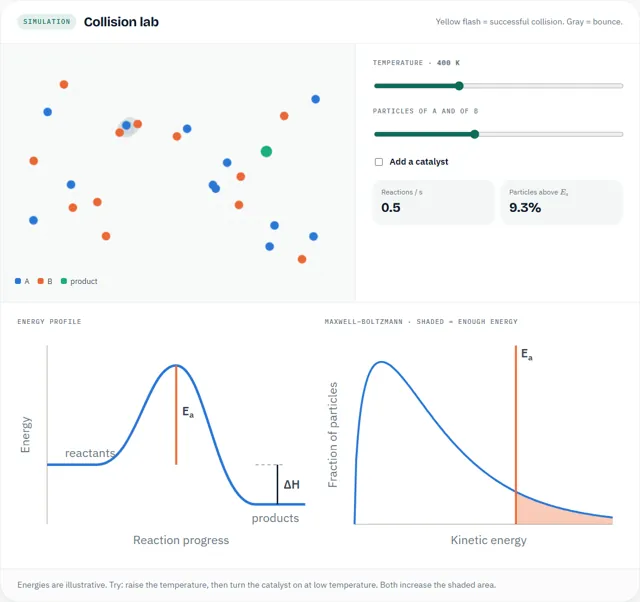
A reaction energy profile plots potential energy along the reaction pathway. The peak is the transition state (activated complex); the forward activation energy, , is the energy from reactants to the peak, and is the energy of products minus reactants. The reverse activation energy is , and the Arrhenius relationship shows that larger gives a smaller rate constant.
Collisions & energy
Most collisions bounce off.
A collision only reacts if the particles have enough energy to break bonds (at least the activation energy, ) and the right orientation. Three particles meeting at once with both is so unlikely that elementary steps almost never involve more than two.
Why heat and catalysts work.
Higher temperature shifts the Maxwell–Boltzmann curve right: more particles clear . A catalyst gives a new pathway with a lower , so more particles clear it at the same temperature. doesn't change.
Collision lab
A catalyst is used, then given back.
Contact-lens cleaner: a platinum (or palladium) disc makes decompose fast, fizzing . The metal isn't used up. In a mechanism, a catalyst appears as a reactant first and a product later; an intermediate is the opposite.
One hump per step.
A two-step mechanism has two peaks on its energy profile. The step with the highest barrier is the slow, rate-determining step.
Study notes
Key concepts
Bonds break and form (TRA-4.C.1). In an elementary step some bonds break (costs energy) and some new bonds form (releases energy). At the start, breaking dominates, so the energy goes up.
Reaction coordinate (TRA-4.C.2). The x-axis of an energy profile is the reaction coordinate. It is not time. It stands for the complicated set of atomic motions (bonds stretching, atoms moving) that carry reactants into products.
The energy profile (TRA-4.C.3). The y-axis is potential energy. For one elementary step the curve goes:
- a flat region for the reactants,
- up to a single peak, the transition state (also called the activated complex), where old bonds are partly broken and new bonds partly formed,
- down to a flat region for the products.
Key quantities:
| Quantity | How to read it from the profile |
|---|---|
| Ea (forward) | Energy of transition state − energy of reactants |
| Ea (reverse) | Energy of transition state − energy of products |
| ΔH | Energy of products − energy of reactants (= Ea,forward − Ea,reverse) |
| Exothermic | Products lower than reactants (ΔH < 0); Ea,reverse > Ea,forward |
| Endothermic | Products higher than reactants (ΔH > 0); Ea,forward > Ea,reverse, and Ea,forward ≥ ΔH |
The transition state is not a substance you can isolate. It lasts about one molecular vibration. An intermediate (5.10) is different: it sits in a valley and has a real, if short, lifetime.
Ea and rate. A larger Ea means a smaller fraction of collisions can reach the transition state, so a smaller k and a slower reaction (at the same temperature). ΔH does not decide the rate: a very exothermic reaction can be very slow (for example, wood and oxygen at room temperature) if Ea is large.
Arrhenius equation (TRA-4.C.4). The rate constant depends on temperature and Ea:
A is the frequency factor (related to collision frequency and orientation). The term e^(−Ea/RT) is the fraction of collisions with E ≥ Ea. Larger T makes this fraction bigger; larger Ea makes it smaller. A plot of ln k vs. 1/T is a straight line with slope −Ea/R. Calculations with the Arrhenius equation are not assessed on the AP exam, but you must be able to explain the relationship in words.
Changing temperature does not change the profile. Heating gives more particles enough energy to get over the barrier; it does not lower the barrier. Only a new pathway (a catalyst) changes Ea.
If Ea,forward = Ea,reverse, the reactants and products have the same energy, so ΔH = 0.
Key equations
(The last equation is enrichment only; it is not on the AP equation sheet.)
Worked examples
Worked example 5.6-A. An elementary step has Ea,forward = 75 kJ mol⁻¹ and ΔH = −40 kJ mol⁻¹. Describe its energy profile and find Ea,reverse.
Description: reactants at 0 kJ mol⁻¹; the curve rises to a single transition state at +75 kJ mol⁻¹; it then falls to products at −40 kJ mol⁻¹. Exothermic.
Ea,reverse = 75 − (−40) = 115 kJ mol⁻¹.
| Point on profile | Relative energy (kJ mol⁻¹) |
|---|---|
| Reactants | 0 |
| Transition state | +75 |
| Products | −40 |
Worked example 5.6-B (enrichment: Arrhenius calculation, not on the AP exam). A reaction has k = 3.7 × 10⁻³ s⁻¹ at 25 °C and Ea = 43.6 kJ mol⁻¹. Find k at 75 °C.
ln(k₂/k₁) = (43 600 / 8.314) × (1/298.15 − 1/348.15) = 5244 × 4.817 × 10⁻⁴ = 2.526. So k₂/k₁ = 12.5 and k₂ = 4.6 × 10⁻² s⁻¹. A 50 °C rise makes the reaction about 12 times faster.
Unit 5 study guide: exam-style free-response set, worksheet and answers.
Worked example
- The transition state is 50 kJ/mol above the reactants; products are 30 kJ/mol below the reactants.
- Reverse barrier: .
- Answer: 80 kJ/mol
Free-response practice
Write your answer first, then open the solution and mark yourself against it.
FRQ 5.6-1. Above about 500 K, the reaction NO₂(g) + CO(g) → NO(g) + CO₂(g) is thought to occur as a single elementary step. The step has Ea = 134 kJ mol⁻¹ and ΔH° = −226 kJ mol⁻¹.
(a) Describe the energy profile, giving the relative energies of reactants, transition state and products.
(b) Calculate the activation energy for the reverse step.
(c) Is the reverse reaction faster or slower than the forward reaction at the same temperature and concentrations? Justify.
(d) A student says that because the reaction is so exothermic it must be fast. Respond.
Show the solution
(a) Reactants at 0; a single peak (transition state) at +134 kJ mol⁻¹; products at −226 kJ mol⁻¹.
(b) Ea,reverse = 134 − (−226) = 360 kJ mol⁻¹.
(c) Slower. The reverse barrier (360 kJ mol⁻¹) is much higher than the forward barrier (134 kJ mol⁻¹), so a much smaller fraction of collisions in the reverse direction have enough energy.
(d) The rate depends on Ea, not ΔH. ΔH only tells how much energy is released overall. A reaction with a large Ea is slow even if it is very exothermic.
Common mistake
Students think an exothermic reaction must be fast. Speed depends on the activation energy, not on ; a very exothermic reaction can be extremely slow if is large.
Frequently asked questions
?What is the transition state?
The highest-energy arrangement of atoms along the reaction pathway, in which old bonds are partly broken and new bonds partly formed.
?Is the Arrhenius equation tested on AP Chemistry?
Calculations with it are not required, but you should explain qualitatively how temperature and activation energy affect the rate constant.
Practice questions on 5.6
- Q1A reaction has the same activation energy in the forward and reverse directions. Which must be true?
- Q2For an elementary step, the energy of the reactants is 20 kJ mol⁻¹, the transition state 95 kJ mol⁻¹, and the products 60 kJ mol⁻¹. What are Ea (forward) and ΔH?
- Q3What happens to the energy profile when the temperature is raised?
- Q4Gasoline vapor and air in an engine do not react until a spark passes. Which best describes the role of the spark?
- Q5At the highest point of a single-step energy profile is
- Q6Two elementary reactions at the same temperature have the same frequency factor. Reaction 1 has Ea = 50 kJ mol⁻¹ and ΔH = −200 kJ mol⁻¹. Reaction 2 has Ea = 30 kJ mol⁻¹ and ΔH = +20 kJ mol⁻¹. Which is faster at equal concentrations?
- Q7What does a point on the rising part of an energy profile, below the peak, represent?
- Q8If the forward and reverse activation energies of a reaction are equal, then:
- Q9A mechanism has steps with activation energies of 45, 60 and 38 kJ. Which step is most likely rate-determining?
- Q10What does raising the temperature do?
- Q11Where on the energy profile is the activated complex?
- Q12A reaction has kJ forward and kJ. What is for the reverse reaction?
- Q13How does increasing the temperature change the energy profile itself?
Terms used in this topic
Stuck on a unit? Let us fix it this week.
Book a 30-minute one-to-one session for $20. Bring a test, a homework set or the topic that is not clicking.
Book a session