 AP Chemistry Tutoring
5.7 Introduction to reaction mechanisms
AP Chemistry Unit 5: Kinetics · 1 simulation · 13 practice questions
Updated · Aligned to the AP Chemistry Course and Exam Description
A reaction mechanism is a sequence of elementary steps that add up to the overall balanced equation. A reaction intermediate is produced in one step and consumed in a later step, so it does not appear in the overall equation; a catalyst is consumed in an early step and regenerated later. For example, followed by sums to .
Reaction mechanisms
The recipe behind the equation.
A balanced equation is an ingredients list. A mechanism is the recipe: a series of elementary steps that add up to the overall equation.
For an elementary step (and only then) the coefficients are the orders.
The slowest step sets the pace.
Mixing pizza dough takes minutes; letting it rise takes hours. The slowest step is the rate-determining step, and its reactants give the rate law.
A valid mechanism must (1) add up to the overall equation and (2) give the experimental rate law.
Mechanism checker
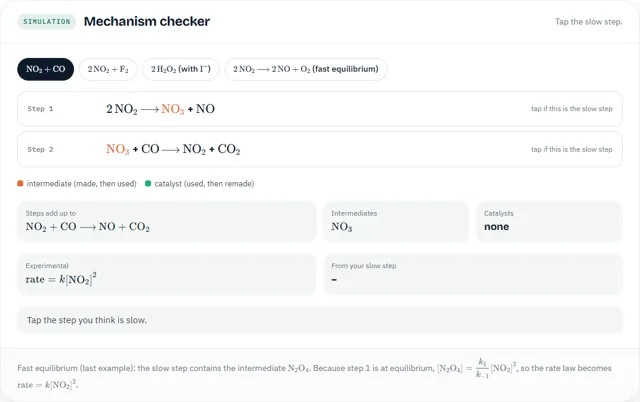
- Step 1 = overall − step 2. Move step 2's species to the opposite side and cancel.
- Step 1: ( is an intermediate).
- Slow step 1 has as reactants: . doesn't appear at all: zero order in .
Study notes
Key concepts
What a mechanism is (TRA-5.A.1). A reaction mechanism is the series of elementary steps, in order, by which reactants become products. Its components can include reactants, intermediates, products and catalysts.
The steps must add up to the overall equation (TRA-5.A.2). Add the steps like equations in Hess's law. Anything that appears on both sides cancels. What remains must be the balanced overall equation. If it is not, the mechanism is wrong.
Intermediates (TRA-5.A.3). An intermediate is made in one step and used up in a later step. It exists only while the reaction is happening and does not appear in the overall equation. Intermediates are often reactive species such as free atoms (O, Cl, H), radicals (NO₃), or unusual ions.
Catalysts in a mechanism. A catalyst is used up in an early step and made again (regenerated) in a later step. It also does not appear in the overall equation, but it is present at the start.
| First appears as | Last appears as | In overall equation? | Present before reaction starts? | |
|---|---|---|---|---|
| Intermediate | Product of an early step | Reactant of a later step | No | No |
| Catalyst | Reactant of an early step | Product of a later step | No | Yes |
A memory trick: an intermediate is "made, then used"; a catalyst is "used, then made".
Evidence for a mechanism (TRA-5.A.4). A mechanism cannot be proven, only supported. Detecting an intermediate (for example by its absorption spectrum) is strong evidence for a mechanism that contains it and against a mechanism that does not. A mechanism must also agree with the experimental rate law (5.8). (Designing experiments to detect intermediates is not assessed on the AP exam.)
Many mechanisms can fit one overall equation. The balanced equation alone cannot tell you the mechanism.
Worked examples
Worked example 5.7-A. A proposed mechanism for NO₂(g) + CO(g) → NO(g) + CO₂(g) at low temperature:
Step 1: NO₂ + NO₂ → NO₃ + NO
Step 2: NO₃ + CO → NO₂ + CO₂
Add: 2 NO₂ + NO₃ + CO → NO₃ + NO + NO₂ + CO₂. Cancel one NO₂ and the NO₃ from both sides: NO₂ + CO → NO + CO₂. The mechanism matches the overall equation. NO₃ is an intermediate (made in step 1, used in step 2). There is no catalyst.
Worked example 5.7-B (catalyst and intermediates). For 2 Ce⁴⁺ + Tl⁺ → 2 Ce³⁺ + Tl³⁺, a proposed mechanism is
Step 1: Ce⁴⁺ + Mn²⁺ → Ce³⁺ + Mn³⁺
Step 2: Ce⁴⁺ + Mn³⁺ → Ce³⁺ + Mn⁴⁺
Step 3: Tl⁺ + Mn⁴⁺ → Tl³⁺ + Mn²⁺
Sum: 2 Ce⁴⁺ + Tl⁺ → 2 Ce³⁺ + Tl³⁺. Mn²⁺ is used in step 1 and remade in step 3: it is the catalyst. Mn³⁺ and Mn⁴⁺ are made and then used: they are intermediates.
Unit 5 study guide: exam-style free-response set, worksheet and answers.
Worked example
- Add the steps: .
- Cancel and one from both sides.
- is made in step 1 and used in step 2, so it is an intermediate.
- Answer: ; intermediate:
Free-response practice
Write your answer first, then open the solution and mark yourself against it.
FRQ 5.7-1. A proposed mechanism for the oxidation of bromide by hydrogen peroxide in acid is:
Step 1: H⁺ + H₂O₂ ⇌ H₂O–OH⁺ (fast equilibrium)
Step 2: H₂O–OH⁺ + Br⁻ → HOBr + H₂O (slow)
Step 3: HOBr + H⁺ + Br⁻ → Br₂ + H₂O (fast)
(a) Write the overall balanced equation.
(b) Identify every intermediate.
(c) Is H⁺ a catalyst in this mechanism? Justify.
Show the solution
(a) Add the steps and cancel H₂O–OH⁺ and HOBr: 2 H⁺ + H₂O₂ + 2 Br⁻ → Br₂ + 2 H₂O.
(b) H₂O–OH⁺ (protonated hydrogen peroxide) and HOBr.
(c) No. H⁺ is used in steps 1 and 3 and is never regenerated, so it is consumed overall (it appears as a reactant in the overall equation). A catalyst must be regenerated.
Common mistake
Students confuse intermediates and catalysts. An intermediate appears first as a product, then as a reactant; a catalyst appears first as a reactant, then as a product.
Frequently asked questions
?What is the difference between an intermediate and a transition state?
An intermediate is a real species that sits in an energy valley between steps; a transition state is the unstable arrangement at an energy peak.
?Can a mechanism be proven correct?
No. Experimental data can only show that a mechanism is consistent with the rate law and overall equation.
Practice questions on 5.7
- Q1A reaction has this mechanism. Step 1 (slow): . Step 2 (fast): . What is the rate law?
- Q2In the mechanism Step 1: , Step 2: , what is ?
- Q3Step 1 (slow): . Step 2 (fast): . Which rate law does this mechanism predict?
- Q4For the steps O₂ → 2 O; O + SO₂ → SO₃ (this step occurs twice for each O₂), which species is an intermediate?
- Q5A mechanism is: A + F → B + C (slow); C + A → D + E (fast). What are the overall reaction and the intermediate?
- Q6A mechanism is: 2 A + F → B + C + G; C + A + G → D + E. What is the overall reaction?
- Q7Which statement about an intermediate is correct?
- Q8In the mechanism Cl + O₃ → ClO + O₂; ClO + O → Cl + O₂, Cl is
- Q9Which observation best supports a proposed mechanism?
- Q10What is the intermediate in followed by ?
- Q11Steps: and . What are the overall reaction and the intermediate?
- Q12Steps: and . What is the overall reaction?
- Q13What must be true of a valid mechanism?
Terms used in this topic
Stuck on a unit? Let us fix it this week.
Book a 30-minute one-to-one session for $20. Bring a test, a homework set or the topic that is not clicking.
Book a session