 AP Chemistry Tutoring
5.8 Reaction mechanism and rate law
AP Chemistry Unit 5: Kinetics · 1 simulation · 13 practice questions
Updated · Aligned to the AP Chemistry Course and Exam Description
The overall rate of a multistep reaction is limited by its slowest step, the rate-determining step. When the first step is slow, the rate law of the overall reaction is the rate law of that elementary step: for the slow step , . A mechanism is acceptable only if its steps add to the overall equation and its predicted rate law matches the experimental one.
Reaction mechanisms
The recipe behind the equation.
A balanced equation is an ingredients list. A mechanism is the recipe: a series of elementary steps that add up to the overall equation.
For an elementary step (and only then) the coefficients are the orders.
The slowest step sets the pace.
Mixing pizza dough takes minutes; letting it rise takes hours. The slowest step is the rate-determining step, and its reactants give the rate law.
A valid mechanism must (1) add up to the overall equation and (2) give the experimental rate law.
Mechanism checker
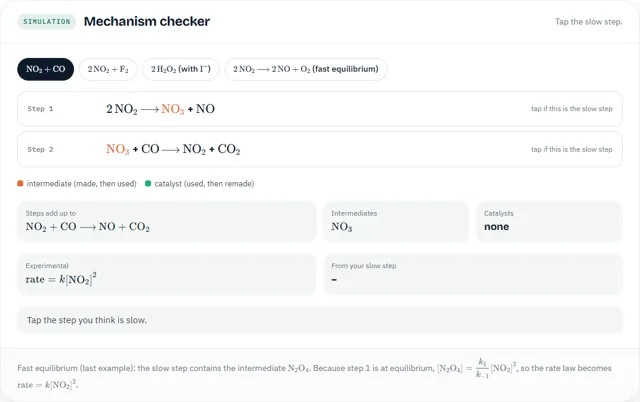
- Step 1 = overall − step 2. Move step 2's species to the opposite side and cancel.
- Step 1: ( is an intermediate).
- Slow step 1 has as reactants: . doesn't appear at all: zero order in .
Study notes
Key concepts
The slowest step controls the rate (TRA-5.B.1). In a mechanism, the slowest elementary step is the rate-determining step (rate-limiting step). The overall reaction cannot go faster than its slowest step, just as a factory line cannot run faster than its slowest station. Steps after the slow step are fast and do not affect the rate.
Rate law when the first step is slow (or all steps are irreversible and the first is slowest). The rate law of the overall reaction is simply the rate law of the slow step, written from its molecularity:
- Find the slow step.
- Write its rate law from its coefficients (it is elementary).
- Check that no intermediate is in it. If the slow step is the first step, its reactants are all real reactants, so this is automatic.
Matching a mechanism to experiment. A mechanism is acceptable only if (a) its steps add to the overall equation, (b) each step is a reasonable elementary step (uni- or bimolecular, rarely termolecular), and (c) the rate law it predicts matches the experimental rate law. Even then, it is only consistent with the data, not proven.
What the order tells you. The overall order tells you how many reactant particles are involved up to and including the rate-determining step. A reactant can be zero order if it enters only after the slow step.
If the slow step is not the first step, its rate law may contain an intermediate. You then need an approximation to replace the intermediate's concentration (5.9).
Common mistakes.
- Writing the rate law from the overall equation.
- Including a species from a fast step that comes after the slow step.
- Leaving an intermediate in a final rate law. Experimental rate laws only contain species you can control (reactants, sometimes products or catalysts).
Worked examples
Worked example 5.8-A. Two mechanisms are proposed for 2 O₃(g) → 3 O₂(g). The experimental rate law is rate = k[O₃].
Mechanism 1: O₃ → O₂ + O (slow); O + O₃ → 2 O₂ (fast).
Mechanism 2: O₃ + O₃ → O₂ + O₄ (slow); O₄ → 2 O₂ (fast).
Both add to 2 O₃ → 3 O₂. Intermediates: O in mechanism 1; O₄ in mechanism 2. Slow step of 1 is unimolecular, giving rate = k[O₃]. Slow step of 2 is bimolecular, giving rate = k[O₃]². Only mechanism 1 agrees with the experimental rate law.
Worked example 5.8-B. H₂(g) + 2 ICl(g) → 2 HCl(g) + I₂(g). Mechanism:
H₂ + ICl → HClI + H (slow)
H + ICl → HCl + I (fast)
HClI → HCl + I (fast)
I + I → I₂ (fast)
Rate = k[H₂][ICl]. It is first order in ICl, not second, because only one ICl molecule is in the slow step.
Worked example 5.8-C. The experimental rate law for 2 NO₂(g) + F₂(g) → 2 NO₂F(g) is rate = k[NO₂][F₂]. A consistent two-step mechanism with a slow first step:
NO₂ + F₂ → NO₂F + F (slow)
NO₂ + F → NO₂F (fast)
The steps add to the overall equation, F is the intermediate, and the slow step gives rate = k[NO₂][F₂].
Unit 5 study guide: exam-style free-response set, worksheet and answers.
Worked example
- The steps add to the overall equation ( cancels).
- The slow step is elementary, so the predicted rate law is .
- reacts only after the slow step, so it does not appear in the rate law, matching the data.
- Answer: Yes, the mechanism is consistent with the observed rate law.
Free-response practice
Write your answer first, then open the solution and mark yourself against it.
FRQ 5.8-1 (modelled on 2013 AP FRQ Q5(c)–(d)). HBr(g) adds to propene: C₃H₆(g) + HBr(g) → C₃H₇Br(g). A proposed mechanism is
Step 1: C₃H₆ + HBr → C₃H₇⁺ + Br⁻ (rate-determining)
Step 2: C₃H₇⁺ + Br⁻ → C₃H₇Br (fast)
(a) Show that the mechanism is consistent with the overall equation.
(b) Write the rate law predicted by the mechanism.
(c) Identify an intermediate.
(d) The concentrations of both reactants are doubled. By what factor does the rate change?
Show the solution
(a) Adding the steps, C₃H₇⁺ and Br⁻ appear on both sides and cancel, leaving C₃H₆ + HBr → C₃H₇Br.
(b) Rate = k[C₃H₆][HBr] (from the bimolecular rate-determining step).
(c) C₃H₇⁺ (or Br⁻).
(d) 2 × 2 = 4 times faster.
FRQ 5.8-2 (modelled on 1999 AP FRQ Q3(d)). For 2 NO(g) + Br₂(g) → 2 NOBr(g), experiments show rate = k[NO]²[Br₂]. A student proposes:
Step 1: NO + Br₂ → NOBr₂ (slow)
Step 2: NOBr₂ + NO → 2 NOBr (fast)
Is the mechanism consistent with the experimental rate law? Justify.
Show the solution
No. The slow first step is bimolecular, so the mechanism predicts rate = k[NO][Br₂], which is first order in NO. The experiment shows second order in NO. (The steps do add to the overall equation, but that is not enough.)
Common mistake
Students include an intermediate in the final rate law. Intermediate concentrations cannot be controlled or easily measured, so they must be eliminated; the rate law contains only reactants or catalysts.
Frequently asked questions
?What is a rate-determining step?
The slowest elementary step in a mechanism; it acts as a bottleneck that controls the overall rate.
?Why is CO not in the rate law even though it is a reactant?
It reacts only in a fast step after the rate-determining step, so its concentration does not affect the overall rate.
Practice questions on 5.8
- Q1For 2 NO(g) + O₂(g) → 2 NO₂(g), the proposed mechanism is NO + NO → N₂O₂ (slow); N₂O₂ + O₂ → 2 NO₂ (fast). Which rate law agrees with this mechanism?
- Q2A reaction occurs in two steps: A + B → C (slow); C + 2 B → AB₃ (fast). Which is correct?
- Q3The experimental rate law for 2 NO(g) + Cl₂(g) → 2 NOCl(g) at one temperature is rate = k[NO][Cl₂]. Which mechanism is consistent?
- Q4In which step does the species that controls the overall rate appear?
- Q5Reactant Z does not appear in the experimental rate law of a reaction, but it is in the overall equation. The best explanation is that
- Q6A mechanism predicts the experimental rate law. What can you conclude?
- Q7Which step in a mechanism is rate-determining?
- Q8The steps of a mechanism have activation energies of 25, 72, 40 and 18 kJ. Which step is likely slowest?
- Q9The observed rate law is rate . Which mechanism is consistent with it?
- Q10The slow first step of a mechanism is . What is the rate law?
- Q11Why do intermediates not appear in rate laws?
- Q12The volume of a gas-phase reaction mixture is decreased at constant temperature, increasing the pressure. What happens to the rate?
- Q13Why does powdered chalk react faster with acid than a single lump?
Terms used in this topic
Stuck on a unit? Let us fix it this week.
Book a 30-minute one-to-one session for $20. Bring a test, a homework set or the topic that is not clicking.
Book a session