 AP Chemistry Tutoring
6.3 Heat transfer and thermal equilibrium
AP Chemistry Unit 6: Thermochemistry · 1 simulation · 14 practice questions
Updated · Aligned to the AP Chemistry Course and Exam Description
Heat is energy transferred between objects at different temperatures, always from hotter to colder, through particle collisions. Transfer continues until thermal equilibrium, when both objects reach the same final temperature. Because energy is conserved, the heat lost by the hotter object equals the heat gained by the colder one: , with each .
Heat transfer & calorimetry
Heat flows from hot to cold, until equal.
When two objects reach the same temperature they're at thermal equilibrium: energy still moves both ways, but equally, so nothing changes. Heat lost by one = heat gained by the other.
= specific heat: J needed to warm 1 g by 1 °C. Water: .
Drop hot metal into water
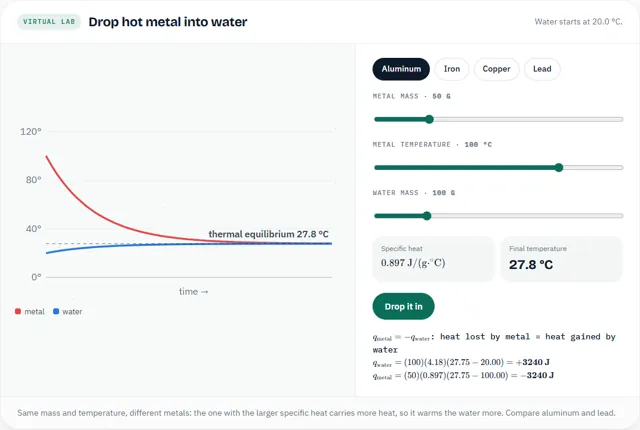
In a calorimeter, . Use the mass of the whole solution in , then divide by moles of the limiting reactant for in kJ/mol.
Study notes
Key concepts
Temperature and particle motion (ENE-2.C.1). Temperature is proportional to the average kinetic energy of the particles. The particles in a warmer object move (or vibrate) faster on average than the particles in a cooler object. Temperature is not the same as energy: a bathtub of warm water holds far more thermal energy than a cup of boiling water, but the cup has the higher temperature.
Heat is energy transferred by collisions (ENE-2.C.2). When two objects at different temperatures are in thermal contact, their particles collide at the boundary. In each collision, the faster particle tends to slow down and the slower particle tends to speed up. Over many collisions, energy moves from the warmer object to the cooler one. This is called heat transfer, heat exchange or transfer of energy as heat. The symbol is q. Heat always flows from higher temperature to lower temperature by itself, never the other way.
Thermal equilibrium (ENE-2.C.3). As collisions continue, the warmer object cools and the cooler object warms. Eventually the average kinetic energies, and so the temperatures, become equal. This is thermal equilibrium. Particles still collide at equilibrium, but there is no net transfer of energy. Any number of objects in contact will all end at the same final temperature.
Energy bookkeeping. In an isolated system (for example, a well-insulated calorimeter), energy lost by the warmer object = energy gained by the cooler object:
q(lost by hot) = −q(gained by cold)
Where the final temperature lands. The final temperature is always between the two starting temperatures. It is closer to the starting temperature of the object with the larger heat capacity (larger mass × specific heat). For example, if a large mass of water is mixed with a small mass of hot water, the final temperature stays close to the temperature of the large mass.
Common misconceptions.
-
"Cold flows into the warm object." Only energy flows, and it always flows from hot to cold.
-
"At thermal equilibrium the particles stop moving." They keep moving and colliding; only the net energy flow stops.
-
"Both objects lose and gain the same temperature change." Not true. They exchange the same amount of energy, but the temperature changes depend on mass and specific heat.
-
Phase does not decide kinetic energy: a gas at 20 °C and a solid at 20 °C have particles with the same average kinetic energy.
Key equations
Worked examples
Example. 1.50 L of water at 100.0 °C is mixed with 2.00 L of water at 80.0 °C in an insulated container. Find the final temperature. (Assume the density of water is 1.00 g/mL at both temperatures, and that specific heat is constant.)
Solution. Heat lost by the hot water = heat gained by the cool water. Because both are water, c cancels:
1500 g × (100.0 − Tf) = 2000 g × (Tf − 80.0)
150000 − 1500 Tf = 2000 Tf − 160000
3500 Tf = 310000, so Tf = 88.6 °C.
The answer is closer to 80.0 °C than to 100.0 °C, because there is more of the 80.0 °C water. The 1.50 L portion loses heat and the 2.00 L portion gains heat.
Unit 6 study guide: exam-style free-response set, worksheet and answers.
Worked example
- Set heat lost equal to heat gained: .
- Solve: .
- Check: water gains and copper loses the same amount.
- Answer:
Free-response practice
Write your answer first, then open the solution and mark yourself against it.
FRQ 6.3-1. A 50.0 g sample of copper at 95.0 °C is placed in 50.0 g of water at 20.0 °C in an insulated cup.
(a) Describe, at the particle level, how energy is transferred between the copper and the water.
(b) Explain how you would know from a temperature-versus-time graph that thermal equilibrium has been reached.
(c) Without calculating, predict whether the final temperature will be closer to 95.0 °C or to 20.0 °C. The specific heat of copper is 0.385 J/(g·°C) and of water is 4.18 J/(g·°C). Justify your answer.
Show the solution
(a) The copper atoms vibrate with a greater average kinetic energy than the water molecules move. When water molecules collide with copper atoms at the surface, energy is transferred from the copper atoms to the water molecules. The water molecules then pass energy to other water molecules by collisions. The copper atoms slow down (copper cools) and the water molecules speed up (water warms).
(b) The water temperature (and the copper temperature) stops changing: the graph becomes a flat line. At that point the average kinetic energies are equal, so there is no net energy transfer.
(c) Closer to 20.0 °C. The masses are equal, but water's specific heat is about 11 times larger than copper's, so the water needs much more energy for each degree of change. The same amount of energy causes a large drop in the copper temperature and only a small rise in the water temperature. (The calculated value is about 26.3 °C.)
Common mistake
Students assume the final temperature is the average of the two starting temperatures. That is true only when is the same for both objects; the object with the larger changes temperature less.
Frequently asked questions
?What is thermal equilibrium?
The state in which two objects in contact have the same temperature, so there is no net heat transfer between them.
?Why does the water temperature change so little?
Water has a large specific heat, , and here a larger mass, so it absorbs a lot of energy with a small temperature rise.
Practice questions on 6.3
- Q1Two metal blocks of equal mass are both at 100 °C. Metal A has a specific heat of 0.90 J/g·°C and metal B has 0.45 J/g·°C. Each is dropped into an identical cup of cool water. Which cup ends up warmer?
- Q2A hot piece of metal is placed in cool water in an insulated cup. What is true once thermal equilibrium is reached?
- Q3A small piece of hot aluminum is dropped into cold water in an insulated cup. After a few minutes the aluminum and the water have the same temperature. Which statement best explains this?
- Q4A student records the following data. A: Temperature (°C) = 12; Mass (g) = 5; Phase = liquid B: Temperature (°C) = 60; Mass (g) = 15; Phase = gas C: Temperature (°C) = 25; Mass (g) = 20; Phase = solid Which statement is correct?
- Q5A solid metal block is placed in a beaker of water that starts at 25.0 °C. The water temperature is recorded. Time (s): 0, 15, 30, 45, 60 Water temperature (°C): 25.0, 26.0, 27.1, 27.9, 28.4 Which conclusion is best supported by the data?
- Q6Three objects A, B and C, each at a different temperature, are placed in contact inside an insulated box and left for a long time. What happens?
- Q7Hot copper is placed in cool water, and both reach the same temperature. How was energy transferred?
- Q8How can you tell that two objects in contact have reached thermal equilibrium?
- Q9An ice cube is placed in warm lemonade. In which direction does energy flow?
- Q103.0 L of water at 20 °C is mixed with 1.0 L of water at 60 °C. What is the final temperature?
- Q11A 5 g piece of metal at 80 °C is placed in 50 g of water at 20 °C. Which statement is correct?
- Q12Which sample has the highest average kinetic energy: A (liquid, 15 °C), B (gas, 70 °C) or C (solid, 30 °C)?
- Q13A metal is added to water at 20.0 °C. The readings are 21.5, 23.0, 23.8 and 24.1 °C at 15-second intervals. What is the best conclusion?
- Q14Four objects at different temperatures are placed in contact and isolated. What eventually happens?
Stuck on a unit? Let us fix it this week.
Book a 30-minute one-to-one session for $20. Bring a test, a homework set or the topic that is not clicking.
Book a session