 AP Chemistry Tutoring
6.4 Heat capacity and calorimetry
AP Chemistry Unit 6: Thermochemistry · 1 simulation · 20 practice questions
Updated · Aligned to the AP Chemistry Course and Exam Description
Calorimetry measures the heat of a process from the temperature change of its surroundings, usually water, using . In a coffee-cup calorimeter the heat released or absorbed by the reaction is opposite in sign to the heat absorbed by the solution, , and dividing by moles of the limiting reactant gives the molar enthalpy change, .
Heat transfer & calorimetry
Heat flows from hot to cold, until equal.
When two objects reach the same temperature they're at thermal equilibrium: energy still moves both ways, but equally, so nothing changes. Heat lost by one = heat gained by the other.
= specific heat: J needed to warm 1 g by 1 °C. Water: .
Drop hot metal into water
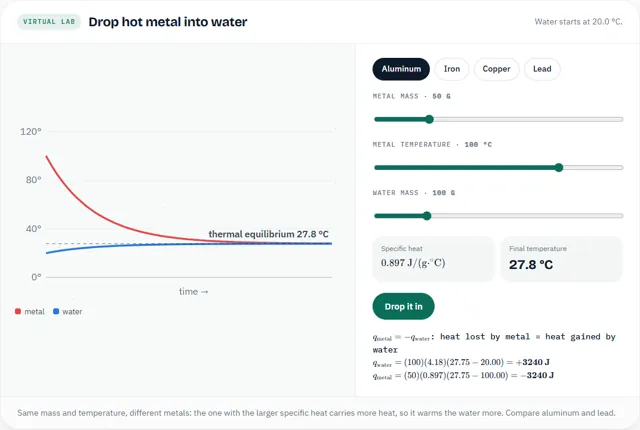
In a calorimeter, . Use the mass of the whole solution in , then divide by moles of the limiting reactant for in kJ/mol.
Study notes
Key concepts
Heating changes the energy of a system (ENE-2.D.4). Heating a system increases its energy; cooling a system decreases its energy. The heat transferred depends on three things: how much substance there is, what the substance is, and how much its temperature changes.
Specific heat capacity and molar heat capacity (ENE-2.D.5).
-
Specific heat capacity, c: the energy needed to raise the temperature of 1 g of a substance by 1 °C (or 1 K). Units: J/(g·°C) or J/(g·K). A change of 1 °C equals a change of 1 K, so either unit works for ΔT.
-
Molar heat capacity, Cm: the energy needed to raise the temperature of 1 mol of a substance by 1 °C. Units: J/(mol·°C). Molar heat capacity = specific heat × molar mass.
-
Heat capacity of an object, C: the energy needed to raise the temperature of the whole object (for example, a calorimeter) by 1 °C. Units: J/°C or kJ/°C. C = m × c.
The heat-transfer equation (ENE-2.D.1). q = mcΔT, where ΔT = Tfinal − Tinitial. If the temperature rises, ΔT and q are positive (the substance gained energy). If it falls, both are negative (the substance lost energy). This equation is used only while the substance stays in one phase.
Different substances, different temperature changes (ENE-2.D.3). The same amount of energy does not produce the same temperature change in equal masses of different substances. A substance with a low specific heat (most metals) heats up and cools down quickly. A substance with a high specific heat (water) changes temperature slowly. Water's very high specific heat, caused by its hydrogen bonding, is why oceans keep coastal climates mild and why water is used as a coolant.
| Substance | Specific heat, J/(g·°C) |
|---|---|
| H₂O(l) | 4.18 |
| H₂O(s), ice | 2.09 |
| H₂O(g), steam | 2.01 |
| Ethanol(l) | 2.44 |
| Aluminum | 0.897 |
| Iron | 0.449 |
| Copper | 0.385 |
| Silver | 0.235 |
| Lead | 0.129 |
| Gold | 0.129 |
On a graph of temperature against heat added for equal masses, the slope is 1/(mc). The steeper the line, the smaller the specific heat.
First law in calorimetry (ENE-2.D.2). Energy is conserved, so in an insulated calorimeter the energy released by a reaction (or a hot object) is absorbed by the water/solution (and calorimeter):
qreaction = −(qsolution + q_calorimeter)
If the calorimeter's own heat capacity is negligible (as for a polystyrene "coffee-cup" calorimeter), qreaction = −qsolution.
Coffee-cup calorimetry (constant pressure). Two nested polystyrene cups with a lid, a thermometer and a stirrer. It is used for reactions in solution (neutralization, dissolving, metal + acid). Because the pressure is atmospheric and constant, the heat measured equals ΔH. Usual assumptions: the solution has the density and specific heat of water (1.00 g/mL, 4.18 J/(g·°C)); the mass used in q = mcΔT is the total mass of the solution (water + dissolved solute); no heat is lost to the surroundings.
Bomb calorimetry (constant volume). The sample burns in pure O₂ inside a sealed steel "bomb" placed in a known mass of water. It is used for combustion reactions. The whole calorimeter has a known heat capacity Ccal, so qreaction = −Ccal × ΔT. (The small difference between ΔE and ΔH is not tested.)
Steps for a calorimetry problem that gives ΔH.
-
Find q for the surroundings: qsoln = msoln × c × ΔT.
-
Change the sign: qrxn = −qsoln.
-
Find moles of the limiting reactant (or the substance named in the question).
-
ΔH = qrxn / n, in kJ/mol. Check: if the temperature rose, ΔH must be negative.
Sources of error. Heat lost to the air or the cup makes the measured |ΔH| too small. Incomplete reaction, splashing of solution, or a thermometer read before the maximum temperature also make |ΔH| too small. Using only the mass of water (not the solution) gives a slightly smaller q.
Key equations
Worked examples
Example 1 (specific heat). 59.8 J raises the temperature of 25.0 g of ethylene glycol by 10.0 °C. Find its specific heat.
Solution. c = q/(mΔT) = 59.8 J / (25.0 g × 10.0 °C) = 0.239 J/(g·°C).
Example 2 (metal in water). A 26.47 g lead pellet at 89.98 °C is placed in a calorimeter containing 100.0 g of water. The water temperature rises from 22.50 °C to 23.17 °C. Find the specific heat of lead.
Solution. qwater = (100.0 g)(4.184 J/(g·°C))(23.17 − 22.50) °C = +280.3 J. Heat lost by lead = −280.3 J. ΔTPb = 23.17 − 89.98 = −66.81 °C. cPb = (−280.3 J) / (26.47 g × −66.81 °C) = 0.158 J/(g·°C).
Example 3 (ΔH of dissolving). 8.00 g of NaOH (molar mass 40.00 g/mol) is dissolved in 100.0 g of water in a coffee-cup calorimeter. The temperature rises from 20.0 °C to 39.5 °C. Find ΔHsoln in kJ/mol.
Solution. Mass of solution = 108.0 g. qsoln = (108.0)(4.18)(19.5) = 8.80 × 10³ J. qrxn = −8.80 × 10³ J. n(NaOH) = 8.00/40.00 = 0.200 mol. ΔHsoln = −8.80 kJ / 0.200 mol = −44.0 kJ/mol. The sign is negative because the solution warmed.
Example 4 (bomb calorimeter). 0.600 g of graphite is burned in a bomb calorimeter with Ccal = 10.0 kJ/°C. The temperature rises by 1.97 °C. Find ΔH for C(s) + O₂(g) → CO₂(g) per mole of carbon.
Solution. qcal = (10.0 kJ/°C)(1.97 °C) = 19.7 kJ, so qrxn = −19.7 kJ. n(C) = 0.600/12.01 = 0.0500 mol. ΔH ≈ −19.7/0.0500 = −394 kJ/mol.
Unit 6 study guide: exam-style free-response set, worksheet and answers.
Worked example
- , so .
- Moles of water: .
- .
- Answer:
Free-response practice
Write your answer first, then open the solution and mark yourself against it.
FRQ 6.4-1. A student mixes 50.0 mL of 1.00 M HCl and 50.0 mL of 1.00 M NaOH, both at 21.0 °C, in a coffee-cup calorimeter. The highest temperature reached is 27.6 °C. Assume the solution has a density of 1.00 g/mL and c = 4.18 J/(g·°C), and the calorimeter absorbs no heat.
(a) Calculate the magnitude of the heat absorbed by the solution.
(b) Calculate ΔH for H⁺(aq) + OH⁻(aq) → H₂O(l), in kJ/molᵣₓₙ. Include the sign.
(c) The experiment is repeated with 100.0 mL of each solution. Will the temperature change be greater than, less than, or equal to the first experiment? Justify.
(d) The experiment is repeated with 50.0 mL of 2.00 M HCl and 50.0 mL of 2.00 M NaOH. Predict the temperature change.
Show the solution
(a) m = 100.0 g. ΔT = 27.6 − 21.0 = 6.6 °C. q = (100.0)(4.18)(6.6) = 2.8 × 10³ J (2759 J).
(b) n(H⁺) = n(OH⁻) = 0.0500 L × 1.00 M = 0.0500 mol (neither is in excess). ΔH = −2.76 kJ / 0.0500 mol = −55 kJ/molᵣₓₙ. Negative because the solution warmed (exothermic).
(c) Equal (about 6.6 °C). Twice as many moles react, releasing twice the heat, but that heat is spread over twice the mass of solution. q/(mc) stays the same.
(d) About 13 °C (twice as large). Twice as many moles react in the same 100.0 g of solution, so twice the heat raises the temperature twice as much.
FRQ 6.4-2. To identify a metal, a student heats a 25.0 g sample to 99.0 °C and drops it into 50.0 g of water at 21.0 °C in an insulated cup. The final temperature is 24.5 °C.
(a) Calculate the heat gained by the water.
(b) Calculate the specific heat of the metal.
(c) The possible metals are Al (0.897), Fe (0.449), Cu (0.385) and Pb (0.129), all in J/(g·°C). Identify the metal and calculate its molar heat capacity.
(d) Some hot water drips off the metal into the cup when it is transferred, and some heat escapes through the open top. Explain the effect of the heat loss on the calculated specific heat.
Show the solution
(a) qwater = (50.0)(4.18)(24.5 − 21.0) = 732 J (731.5 J).
(b) qmetal = −731.5 J. ΔTmetal = 24.5 − 99.0 = −74.5 °C. c = −731.5 / (25.0 × −74.5) = 0.393 J/(g·°C).
(c) Copper (0.385 is closest). Molar heat capacity = 0.385 J/(g·°C) × 63.55 g/mol = 24.5 J/(mol·°C). (Using the experimental value gives 25.0 J/(mol·°C).)
(d) Heat lost to the air means the water gains less energy than the metal actually released. The measured qwater is too small, so the calculated specific heat is too small.
Common mistake
Students report the heat absorbed by the water as without changing the sign. If the solution warms, is positive and the reaction's is negative.
Frequently asked questions
?What is the difference between specific heat and heat capacity?
Specific heat is the energy needed to raise 1 g of a substance by 1 C; heat capacity is the energy needed to raise a whole object by 1 C.
?How does heat loss from a coffee-cup calorimeter affect the result?
For an exothermic reaction, lost heat makes the measured temperature rise too small, so the calculated magnitude of is too small.
Practice questions on 6.4
- Q1How much heat is needed to warm 50.0 g of water from 20.0 °C to 45.0 °C? (c = 4.18 J/g·°C)
- Q250.0 mL of 1.00 M HCl is mixed with 50.0 mL of 1.00 M NaOH in a calorimeter and the temperature rises by 6.70 °C. Taking the solution as 100. g with c = 4.18 J/g·°C, what is per mole of water formed?
- Q3Equal masses of four metals are heated to 85 °C and each is placed in a separate 100. mL sample of water at 20 °C. Which metal gives the lowest final water temperature?
- Q4A 15.0 g sample of copper (c = 0.385 J/(g·°C)) at 25.0 °C absorbs 100. J of heat. What is its final temperature?
- Q5Four identical cups of coffee at 95 °C are each stirred with a different spoon that starts at 20 °C. Assume no heat is lost to the surroundings. A: Spoon = Aluminum; Mass of spoon (g) = 15.0; Specific heat (J/(g·°C)) = 0.90 B: Spoon = Glass; Mass of spoon (g) = 20.0; Specific heat (J/(g·°C)) = 0.84 C: Spoon = Steel; Mass of spoon (g) = 25.0; Specific heat (J/(g·°C)) = 0.50 D: Spoon = Silver; Mass of spoon (g) = 60.0; Specific heat (J/(g·°C)) = 0.24 In which cup is the final coffee temperature highest?
- Q620.0 g of NaOH (ΔH_soln = −45 kJ/mol) is dissolved in 500. g of water at 25.0 °C. Assume the solution has c = 4.18 J/(g·°C). What is the approximate final temperature?
- Q7A 50.0 cm³ block of metal (c = 0.500 J/(g·°C)) absorbs 1.80 × 10³ J as its temperature rises from 20.0 °C to 29.0 °C. What is the density of the metal?
- Q8Equal masses of three metals receive heat at the same steady rate. After 100 J has been added, metal A has warmed by 20 °C, metal B by 10 °C and metal C by 5 °C. Which ranking of specific heat is correct?
- Q9In a coffee-cup calorimetry experiment the student forgets to put the lid on the cup during an exothermic reaction. How does this affect the calculated ΔH?
- Q10How much heat is needed to raise the temperature of 10.0 mL of liquid bromine (density 3.12 g/mL, c = 0.226 J/(g·°C)) from 25.00 °C to 27.30 °C?
- Q11Equal masses of four metals at 90 °C are each placed in identical cups of cool water. Which metal raises the water to the highest final temperature?
- Q12Which causes the largest increase in a system's internal energy?
- Q13A system's internal energy increases by 2.0 kJ while it absorbs 5.0 kJ of heat. What work is involved?
- Q14Equal masses of metals with specific heats of , and absorb the same amount of heat. Which has the largest temperature rise?
- Q15A 25.0 g piece of Al ( J/(g·°C)) at 20.0 °C absorbs 450 J. What is its final temperature?
- Q16How could a student identify an unknown metal using only basic lab equipment?
- Q17Equal masses of metals A, B and C absorb the same heat. Their temperatures rise by 30, 15 and 10 °C. Rank their specific heats.
- Q188.0 g of ( kJ/mol) dissolves in 100.0 g of water at 25.0 °C. What is the final temperature? (Use J/(g·°C) for the 108 g of solution.)
- Q19A 20.0 cm³ metal block ( J/(g·°C)) absorbs 693 J and warms by 10.0 °C. What is its density?
- Q20Equal masses of sand ( J/(kg·K)) and water ( J/(kg·K)) sit in the sun for the same time. Which becomes hotter?
Stuck on a unit? Let us fix it this week.
Book a 30-minute one-to-one session for $20. Bring a test, a homework set or the topic that is not clicking.
Book a session