 AP Chemistry Tutoring
6.5 Energy of phase changes
AP Chemistry Unit 6: Thermochemistry · 1 simulation · 16 practice questions
Updated · Aligned to the AP Chemistry Course and Exam Description
Phase changes absorb or release energy without changing temperature, because the energy goes into overcoming or forming intermolecular forces rather than changing kinetic energy. Melting and vaporization are endothermic, with and ; freezing and condensation release the same amounts. is larger than because vaporizing separates the particles completely.
Phase changes
Flat lines on a heating curve.
While ice melts or water boils, the temperature doesn't change. All the energy goes into overcoming intermolecular forces, not into speeding the molecules up.
Boiling takes far more energy than melting: every attraction must be broken, not just loosened.
| Temperature changing | |
| Melting / freezing | |
| Boiling / condensing |
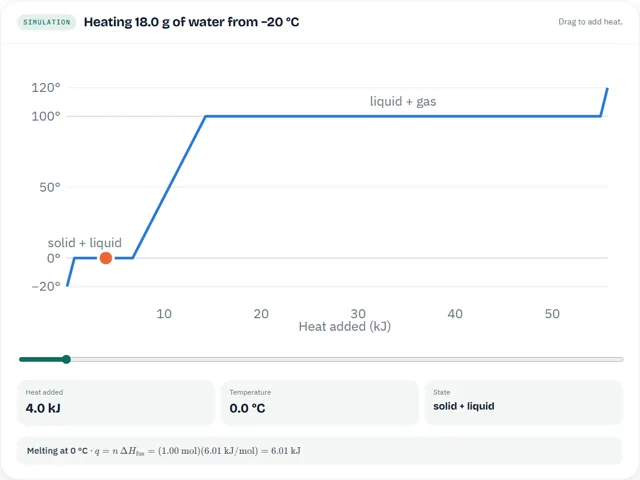
Heating 18.0 g of water from −20 °C
Study notes
Key concepts
Phase changes need or release energy (ENE-2.E.1). To melt a solid or boil a liquid, energy must be transferred into the system to overcome the attractions (intermolecular forces, or metallic/ionic bonds) between particles. So melting, vaporization and sublimation are endothermic, and the energy of the system increases. Freezing, condensation and deposition are exothermic: attractions form, and the system releases energy, so its energy decreases.
Temperature stays constant during a phase change. While a pure substance is melting or boiling, all the energy added goes into increasing the potential energy of the particles (moving them farther apart against their attractions), not into increasing their average kinetic energy. So the temperature stays at the melting point or boiling point until the phase change is complete.
Molar enthalpies of phase change.
-
ΔHfus (molar enthalpy, or heat, of fusion): energy to melt 1 mol of solid at its melting point. Water: +6.01 kJ/mol.
-
ΔHvap (molar enthalpy of vaporization): energy to vaporize 1 mol of liquid at its boiling point. Water: +40.7 kJ/mol at 100 °C (44.0 kJ/mol at 25 °C).
-
ΔHsub (sublimation) = ΔHfus + ΔHvap (Hess's law).
Opposite processes have opposite signs (ENE-2.E.2). The energy absorbed in a phase change equals the energy released in the reverse change. ΔHfreezing = −ΔHfus and ΔH_condensation = −ΔHvap. So condensing 1 mol of steam releases 40.7 kJ.
Why ΔHvap is much larger than ΔHfus. On melting, particles stay close together and only some attractions are disrupted. On boiling, the particles are separated almost completely, so nearly all attractions must be overcome. The change in potential energy is much larger. Water's ΔHvap (40.7 kJ/mol) is almost 7 times its ΔHfus (6.01 kJ/mol). Stronger intermolecular forces give larger ΔHvap (link to Unit 3).
Heating curve. A heating curve plots temperature against heat added (or time, at a steady heating rate). For water from ice to steam it has five segments:
| Segment | What is happening | Temperature | Equation |
|---|---|---|---|
| 1. Sloped | Ice warms | Rises to 0 °C | q = m cice ΔT |
| 2. Flat | Ice melts (solid and liquid coexist) | Constant at 0 °C | q = n ΔHfus |
| 3. Sloped | Liquid warms | Rises to 100 °C | q = m cwater ΔT |
| 4. Flat (longest) | Water boils (liquid and gas coexist) | Constant at 100 °C | q = n ΔHvap |
| 5. Sloped | Steam warms | Rises above 100 °C | q = m csteam ΔT |
The flat segment for boiling is much longer than the one for melting because ΔHvap > ΔHfus. The slope of each sloped segment depends on the specific heat of that phase: liquid water (c = 4.18) has a shallower slope than ice (2.09) or steam (2.01). A cooling curve is the same graph read backward, with energy released at each step.
Units warning. ΔHfus and ΔHvap are usually given per mole, so convert mass to moles first. Some worksheets give them per gram (J/g); then q = m × ΔH.
Key equations
Worked examples
Example. How much energy is needed to change 36.0 g of ice at −10.0 °C into steam at 110.0 °C? Use c(ice) = 2.09, c(water) = 4.18, c(steam) = 2.01 J/(g·°C); ΔHfus = 6.01 kJ/mol; ΔHvap = 40.7 kJ/mol.
Solution. n = 36.0/18.02 = 1.998 mol.
-
Warm ice: q₁ = (36.0)(2.09)(10.0) = 752 J = 0.752 kJ.
-
Melt: q₂ = (1.998)(6.01) = 12.0 kJ.
-
Warm water: q₃ = (36.0)(4.18)(100.0) = 15 048 J = 15.0 kJ.
-
Boil: q₄ = (1.998)(40.7) = 81.3 kJ.
-
Warm steam: q₅ = (36.0)(2.01)(10.0) = 724 J = 0.724 kJ.
Total q = 0.752 + 12.0 + 15.0 + 81.3 + 0.724 = 110 kJ (109.8 kJ). Notice that boiling alone needs about three-quarters of the energy.
Unit 6 study guide: exam-style free-response set, worksheet and answers.
Worked example
- Moles of water: .
- .
- Answer: 12.0 kJ
Free-response practice
Write your answer first, then open the solution and mark yourself against it.
FRQ 6.5-1. Modelled on 2015 AP FRQ Q7. Copper scrap can be recycled by melting it.
(a) Calculate the heat needed to melt 1.00 mol of Cu that starts at 298 K. The melting point of Cu is 1358 K, the molar heat capacity of Cu(s) is 24.4 J/(mol·K), and ΔHfus of Cu is 13.1 kJ/mol.
(b) Copper can also be produced from its oxide: CuO(s) → Cu(s) + ½ O₂(g), ΔH° = +157 kJ/molᵣₓₙ. Which needs less energy per mole of Cu, recycling (melting) or producing Cu from CuO? Justify with a calculation.
Show the solution
(a) Heat solid: q₁ = n × Cm × ΔT = (1.00)(24.4)(1358 − 298) = 25 900 J = 25.9 kJ. Melt: q₂ = (1.00)(13.1) = 13.1 kJ. Total = 39.0 kJ.
(b) Producing 1 mol Cu from CuO needs 157 kJ, compared with 39.0 kJ for recycling. Recycling needs less energy (about one-quarter as much).
FRQ 6.5-2. A 30.0 g ice cube at 0.0 °C is added to 250.0 g of water at 25.0 °C in an insulated cup. ΔHfus = 6.01 kJ/mol; c(water) = 4.18 J/(g·°C).
(a) Calculate the energy needed to melt the ice completely.
(b) Calculate the final temperature, assuming all the ice melts.
(c) Explain why the temperature of the ice–water mixture stays at 0.0 °C while ice is still melting.
Show the solution
(a) n = 30.0/18.02 = 1.665 mol. q = 1.665 × 6.01 = 10.0 kJ (1.00 × 10⁴ J).
(b) Heat lost by warm water = heat to melt ice + heat to warm melted ice water from 0.0 °C:
(250.0)(4.18)(25.0 − Tf) = 10 006 + (30.0)(4.18)(Tf − 0.0)
26 125 − 1045 Tf = 10 006 + 125.4 Tf
1170.4 Tf = 16 119, so Tf = 13.8 °C.
(c) While ice is melting, the energy taken in is used to overcome hydrogen bonds holding the solid together (raising potential energy), not to increase the average kinetic energy of the molecules, so the temperature stays at the melting point.
Common mistake
Students use across a phase change. During melting or boiling , so the energy must be calculated with the enthalpy of fusion or vaporization.
Frequently asked questions
?Why does the temperature stay constant while water boils?
The added energy is used to overcome intermolecular forces between molecules, not to increase their average kinetic energy.
?Why is the enthalpy of vaporization larger than the enthalpy of fusion?
Melting only loosens the particles, while vaporizing must separate them almost completely, which requires overcoming far more intermolecular attraction.
Practice questions on 6.5
- Q1Ice at 0 °C is heated at a steady rate. Why does its temperature stay at 0 °C until it has all melted?
- Q2How much heat is needed to melt 36.0 g of ice at 0 °C? (; molar mass of water = 18.0 g/mol)
- Q3The molar heat of fusion of NaCl is 28 kJ/mol. Which statement is correct?
- Q4Calcium has ΔH_vap = 154 kJ/mol. While liquid calcium is boiling at constant pressure, which is true?
- Q5A pure solid is heated at a steady rate at 1 atm. The data are shown. Time interval (min): 0–4, 4–9, 9–14, 14–30, 30–33 Temperature (°C): −20 → 5, 5 (constant), 5 → 80, 80 (constant), 80 → 95 Which statement is correct?
- Q6ΔH_vap of water is 40.7 kJ/mol. What is q when 9.0 g of steam condenses to liquid water at 100 °C?
- Q7Which is the best explanation for why the molar heat of vaporization of a substance is larger than its molar heat of fusion?
- Q8How much energy is released when 25.0 g of ethanol vapor (molar mass 46.07 g/mol, ΔH_vap = 38.6 kJ/mol) condenses at its boiling point?
- Q9The molar enthalpy of vaporization of ethanol is 38.6 kJ/mol. What does this mean?
- Q10Where does the energy go while water boils at constant temperature?
- Q11As liquid water freezes at 0 °C:
- Q12A solid is heated steadily. Its temperature rises from 0 to 4 s, stays constant from 4 to 8 s, then rises again. What happens between 4 and 8 s?
- Q13Water vapor condenses at constant pressure. Which description is correct?
- Q14 of water is 6.01 kJ/mol. How much energy is needed to melt 36.0 g of ice?
- Q15 of water is 40.7 kJ/mol. What is the enthalpy change when 27.0 g of steam condenses?
- Q16Why is larger than for most substances?
Terms used in this topic
Stuck on a unit? Let us fix it this week.
Book a 30-minute one-to-one session for $20. Bring a test, a homework set or the topic that is not clicking.
Book a session