 AP Chemistry Tutoring
6.6 Introduction to enthalpy of reaction
AP Chemistry Unit 6: Thermochemistry · 3 simulations · 10 practice questions
Updated · Aligned to the AP Chemistry Course and Exam Description
The enthalpy of reaction, , is the heat absorbed or released at constant pressure when a reaction occurs in the molar amounts shown by the balanced equation, e.g. with . The heat for any amount is proportional to moles reacted: per mole of the substance with the matching coefficient.
Enthalpy of reaction
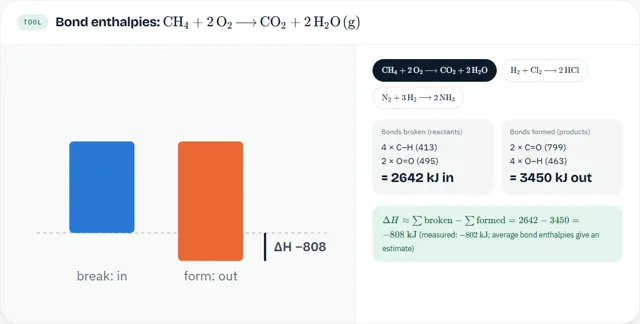
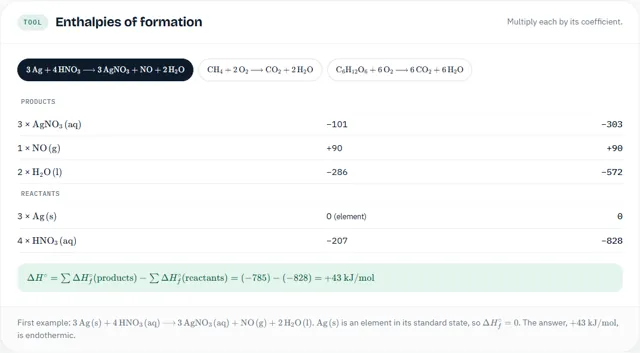
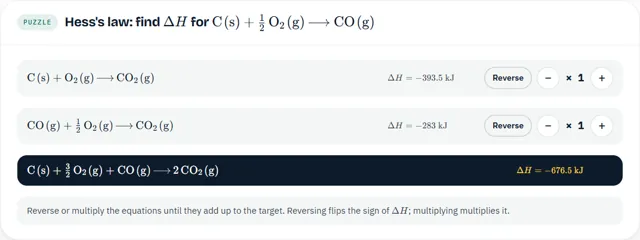
Three ways to calculate ΔH.
Reactant bonds in, product bonds out.
Elements in their standard state are 0.
Reverse: flip the sign. Multiply: multiply .
Bond enthalpies:
Enthalpies of formation
Hess's law: find for
?A catalyst () speeds up . What happens to and to ?Think, then tap to check
is lower (a lower hump on the energy diagram). is unchanged: the reactants and products sit at the same energies.
?Why is of , or zero?Think, then tap to check
They're elements already in their standard state. Forming them from themselves involves no change.
Study notes
Key concepts
Enthalpy of reaction (ENE-2.F.1). The enthalpy change of a reaction, ΔHrxn, is the heat released (ΔH negative) or absorbed (ΔH positive) by a reaction at constant pressure. On the AP exam, enthalpy change, heat of reaction and energy of reaction are treated as the same thing; the technical difference between enthalpy and internal energy is not tested.
Thermochemical equations. A thermochemical equation is a balanced equation with its ΔH, for example:
CH₄(g) + 2 O₂(g) → CO₂(g) + 2 H₂O(l) ΔH° = −890 kJ/molᵣₓₙ
The unit kJ/molᵣₓₙ means "per mole of reaction as written": 890 kJ is released when 1 mol CH₄ reacts with 2 mol O₂ to form 1 mol CO₂ and 2 mol H₂O(l). The coefficients act as conversion factors: −890 kJ per 1 mol CH₄, per 2 mol O₂, per 1 mol CO₂ and per 2 mol H₂O.
Rules for thermochemical equations.
-
Enthalpy is extensive: if the coefficients are multiplied by n, ΔH is multiplied by n.
-
If the equation is reversed, ΔH changes sign.
-
Physical states must always be shown, because changing a state changes ΔH. For example, forming H₂O(g) releases less energy than forming H₂O(l) by 44.0 kJ per mole of water at 25 °C.
-
The ° in ΔH° means standard conditions: 1 atm (or 1 bar) for gases, 1 M for solutions, usually 25 °C (298 K), and every substance in its standard state.
Calculating heat from amount of substance. q = n × ΔH, where n is the moles of reaction. In practice: convert the given mass to moles, then use the ratio of ΔH to the coefficient of that substance. If the amounts of two reactants are given, find the limiting reactant first; only the limiting reactant decides how much heat is released.
Sign language. "Heat released" or "heat evolved" is a positive amount of energy, and the matching ΔH is negative. In answers, either give a magnitude with the words "released/absorbed" or give a signed ΔH; do not mix them.
Common enthalpy names. ΔHcomb (combustion of 1 mol of a substance in O₂), ΔHsoln (dissolving), ΔHneut (neutralization), ΔHf (formation, topic 6.8), ΔHfus and ΔHvap (topic 6.5).
Key equations
Worked examples
Example 1. P₄(s) + 5 O₂(g) → P₄O₁₀(s), ΔH° = −3013 kJ/molᵣₓₙ. How much heat is released when 266 g of white phosphorus burns?
Solution. n(P₄) = 266 g / 123.88 g/mol = 2.147 mol. Heat released = 2.147 mol × 3013 kJ/mol = 6.47 × 10³ kJ (ΔH = −6.47 × 10³ kJ).
Example 2. 2 H₂(g) + O₂(g) → 2 H₂O(g), ΔH° = −483.6 kJ/molᵣₓₙ. What is ΔH when 178 g of H₂O(g) is produced?
Solution. n(H₂O) = 178/18.02 = 9.878 mol. ΔH = 9.878 mol H₂O × (−483.6 kJ / 2 mol H₂O) = −2.39 × 10³ kJ.
Example 3 (limiting reactant). 8.00 g of CH₄ and 16.0 g of O₂ react: CH₄(g) + 2 O₂(g) → CO₂(g) + 2 H₂O(l), ΔH° = −890 kJ/molᵣₓₙ. How much heat is released?
Solution. n(CH₄) = 8.00/16.04 = 0.499 mol; n(O₂) = 16.0/32.00 = 0.500 mol. O₂ needed for all the CH₄ = 0.998 mol, but only 0.500 mol is present, so O₂ is limiting. Moles of reaction = 0.500/2 = 0.250 mol. Heat released = 0.250 × 890 = 223 kJ.
Unit 6 study guide: exam-style free-response set, worksheet and answers.
Worked example
- Moles of : .
- One mole of corresponds to one mole of reaction: .
- Answer: 444 kJ released ()
Free-response practice
Write your answer first, then open the solution and mark yourself against it.
FRQ 6.6-1. Modelled on 2011 AP FRQ Q3(b). Methane burns: CH₄(g) + 2 O₂(g) → CO₂(g) + 2 H₂O(l), ΔH° = −890. kJ/molᵣₓₙ.
(a) Calculate the heat released when 10.0 g of CH₄ burns in excess oxygen.
(b) What mass of CH₄ must burn to heat 1.00 kg of water from 20.0 °C to 100.0 °C, assuming all the heat goes into the water? (c = 4.18 J/(g·°C))
(c) Would more, less, or the same amount of heat be released if the water were produced as H₂O(g)? Explain.
Show the solution
(a) n = 10.0/16.04 = 0.623 mol. Heat released = 0.623 × 890. = 555 kJ.
(b) qwater = (1000. g)(4.18)(80.0) = 334 400 J = 334 kJ. n(CH₄) = 334.4/890. = 0.376 mol. Mass = 0.376 × 16.04 = 6.03 g.
(c) Less. Forming H₂O(g) instead of H₂O(l) leaves out the condensation step, which is exothermic. The products are higher in enthalpy, so less energy is released (ΔH = −802 kJ/molᵣₓₙ instead of −890).
FRQ 6.6-2. The thermite reaction is Fe₂O₃(s) + 2 Al(s) → Al₂O₃(s) + 2 Fe(s), ΔH° = −852 kJ/molᵣₓₙ.
(a) Calculate the heat released when 10.0 g of Al reacts with excess Fe₂O₃.
(b) Is the reaction endothermic or exothermic? What would you observe?
Show the solution
(a) n(Al) = 10.0/26.98 = 0.371 mol. Heat = 0.371 × (852/2) = 158 kJ.
(b) Exothermic (ΔH < 0). So much heat is released that the iron produced is molten and glows; the surroundings become very hot.
Common mistake
Students apply the full to any amount of reactant. applies to the moles in the balanced equation, so the heat must be scaled by the actual moles reacted.
Frequently asked questions
?What does kJ per mole of reaction mean?
It is the enthalpy change when the reaction occurs once in the molar amounts given by the coefficients of the balanced equation.
?What happens to delta H if you double the equation?
It doubles. Enthalpy change is proportional to the amount of reaction.
Practice questions on 6.6
- Q1C₃H₈(g) + 5 O₂(g) → 3 CO₂(g) + 4 H₂O(l), ΔH° = −2220 kJ/molᵣₓₙ. About how much energy is released when 44 g of propane burns completely?
- Q22 Na₂O₂(s) + 2 H₂O(l) → 4 NaOH(s) + O₂(g), ΔH° = −126 kJ/molᵣₓₙ. How much heat is released when 2.00 mol of NaOH forms?
- Q32 S(s) + 3 O₂(g) → 2 SO₃(g), ΔH° = −790 kJ/molᵣₓₙ. What is ΔH when 0.95 g of sulfur reacts?
- Q4CH₄(g) + 3 Cl₂(g) → CHCl₃(l) + 3 HCl(g), ΔH° = −336 kJ/molᵣₓₙ. How much heat is released when 23.0 g of HCl forms?
- Q5A solid B dissolves in water and the temperature of the solution slowly decreases. Which statement is correct?
- Q6For N₂(g) + 3 H₂(g) → 2 NH₃(g), ΔH° = −92 kJ/molᵣₓₙ. What is ΔH° for NH₃(g) → ½ N₂(g) + 3/2 H₂(g)?
- Q7The combustion of has kJ/mol. How much heat is released when 32.0 g of burns?
- Q8 dissolves in water, and the temperature drops. Which is correct?
- Q9What is the sign of for breaking the bond in ?
- Q10Ethanol burns in oxygen. Which describes this reaction?
Terms used in this topic
Stuck on a unit? Let us fix it this week.
Book a 30-minute one-to-one session for $20. Bring a test, a homework set or the topic that is not clicking.
Book a session