 AP Chemistry Tutoring
6.7 Bond enthalpies
AP Chemistry Unit 6: Thermochemistry · 3 simulations · 8 practice questions
Updated · Aligned to the AP Chemistry Course and Exam Description
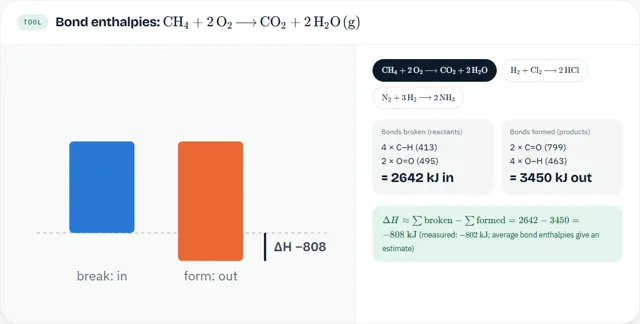
Bond enthalpy is the energy required to break one mole of a particular bond in the gas phase. Breaking bonds absorbs energy and forming bonds releases energy, so the enthalpy of reaction can be estimated as . A reaction is exothermic when the bonds formed in the products are stronger overall than the bonds broken in the reactants.
Enthalpy of reaction
Three ways to calculate ΔH.
Reactant bonds in, product bonds out.
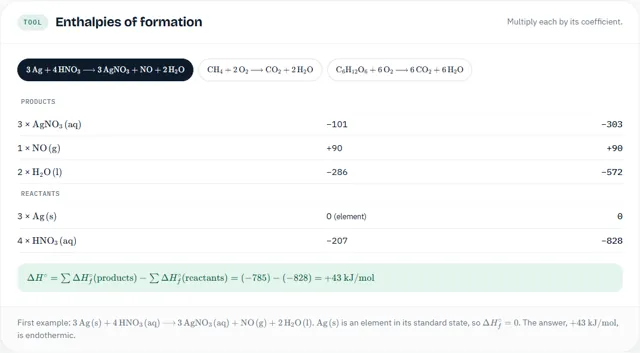
Elements in their standard state are 0.
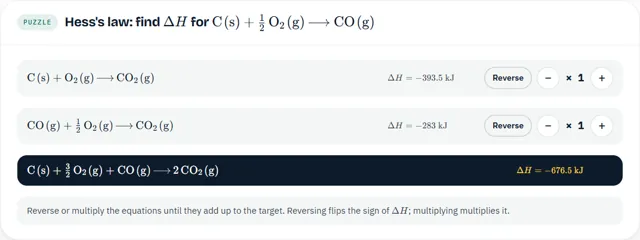
Reverse: flip the sign. Multiply: multiply .
Bond enthalpies:
Enthalpies of formation
Hess's law: find for
?A catalyst () speeds up . What happens to and to ?Think, then tap to check
is lower (a lower hump on the energy diagram). is unchanged: the reactants and products sit at the same energies.
?Why is of , or zero?Think, then tap to check
They're elements already in their standard state. Forming them from themselves involves no change.
Study notes
Key concepts
Bonds and potential energy (ENE-3.A.1). During a reaction, bonds in the reactants are broken and new bonds in the products are formed. Both events change the potential energy of the system.
-
Breaking a bond always requires energy (endothermic, +). Energy is needed to pull the bonded atoms apart against the attraction between the nuclei and the shared electrons.
-
Forming a bond always releases energy (exothermic, −). When atoms come together, their attraction lowers the potential energy.
This is one of the most common misconceptions on the exam: no bond releases energy when it breaks.
Bond enthalpy (bond energy). The bond enthalpy is the energy needed to break 1 mol of a particular bond in gaseous molecules. Values in tables are averages over many different compounds, so ΔH calculated from them is an estimate. The AP exam uses "bond energy" and "bond enthalpy" to mean the same thing.
Estimating ΔH (ENE-3.A.2). Add up the bond enthalpies of all bonds broken in the reactants, and subtract the bond enthalpies of all bonds formed in the products:
-
If energy released by forming bonds > energy needed to break bonds, the reaction is exothermic (ΔH < 0).
-
If energy needed to break bonds > energy released by forming bonds, the reaction is endothermic (ΔH > 0).
Note the order: it is "broken minus formed", which is the opposite of "products minus reactants" used with enthalpies of formation.
Counting bonds correctly. Students often lose points by miscounting. Always:
-
Draw the Lewis structure of every molecule.
-
Count every bond, multiplied by the coefficient. CH₄ has 4 C–H bonds; 2 O₂ has 2 O=O bonds; 2 H₂O has 4 O–H bonds.
-
Use the right bond order: C=O is different from C–O; a double bond is one entry (not two single bonds).
-
Shortcut: bonds that appear unchanged on both sides can be cancelled (only the bonds that actually change need to be counted).
Bond enthalpy and bond strength (link to Unit 2). Higher bond order means a shorter, stronger bond with larger bond enthalpy (C–C 348 < C=C 614 < C≡C 839 kJ/mol). Bond enthalpy also decreases as the bonded atoms get larger (H–F > H–Cl > H–Br).
Limits of the method. Bond enthalpies apply to gases. If a reactant or product is liquid or solid, the bond-enthalpy estimate ignores the energy of the intermolecular forces, so it differs more from the true value. Values calculated from enthalpies of formation (6.8) are more accurate.
Average bond enthalpies used in this unit (kJ/mol).
| Bond | Enthalpy | Bond | Enthalpy | Bond | Enthalpy |
|---|---|---|---|---|---|
| H–H | 436 | C–C | 348 | O–H | 463 |
| C–H | 413 | C=C | 614 | O=O | 498 |
| N–H | 391 | C≡C | 839 | C–O | 358 |
| H–F | 567 | C–N | 293 | C=O (in CO₂) | 799 |
| H–Cl | 431 | C≡N | 891 | N≡N | 941 |
| H–Br | 366 | C–Cl | 328 | F–F | 155 |
| Cl–Cl | 242 | Br–Br | 193 | I–I | 151 |
Key equations
Worked examples
Example 1. Estimate ΔH for CH₄(g) + 2 O₂(g) → CO₂(g) + 2 H₂O(g).
Solution. Lewis structures: CH₄ has 4 C–H; O₂ has O=O; CO₂ is O=C=O (2 C=O); H₂O has 2 O–H.
Bonds broken: 4 C–H + 2 O=O = 4(413) + 2(498) = 1652 + 996 = 2648 kJ.
Bonds formed: 2 C=O + 4 O–H = 2(799) + 4(463) = 1598 + 1852 = 3450 kJ.
ΔH ≈ 2648 − 3450 = −802 kJ/molᵣₓₙ. More energy is released forming bonds than is used breaking them, so the reaction is exothermic.
Example 2 (cancel unchanged bonds). Estimate ΔH for the hydrogenation of ethene, H₂C=CH₂(g) + H₂(g) → H₃C–CH₃(g).
Solution. The four C–H bonds of ethene are still there in ethane, so cancel them. Broken: C=C + H–H = 614 + 436 = 1050 kJ. Formed: C–C + 2 C–H = 348 + 2(413) = 1174 kJ. ΔH ≈ 1050 − 1174 = −124 kJ/molᵣₓₙ.
Unit 6 study guide: exam-style free-response set, worksheet and answers.
Worked example
- Bonds broken: .
- Bonds formed: .
- .
- Answer:
Free-response practice
Write your answer first, then open the solution and mark yourself against it.
FRQ 6.7-1. Modelled on 2019 AP FRQ Q2(g). Iodine monochloride decomposes: 2 ICl(g) → I₂(g) + Cl₂(g), ΔH° = +29 kJ/molᵣₓₙ. The bond enthalpies are I–I 151 kJ/mol and Cl–Cl 242 kJ/mol.
(a) Calculate the bond enthalpy of the I–Cl bond.
(b) Is the I–Cl bond stronger or weaker than the I–I bond? Give one reason based on atomic structure.
Show the solution
(a) ΔH = (bonds broken) − (bonds formed) = 2(I–Cl) − [151 + 242].
29 = 2(I–Cl) − 393, so 2(I–Cl) = 422 and I–Cl = 211 kJ/mol.
(b) Stronger (211 > 151 kJ/mol). Cl is smaller than I, so the I–Cl bond is shorter; the shared electrons are closer to the Cl nucleus and the Coulombic attraction is greater. The bond is also polar, which adds extra attraction.
FRQ 6.7-2. Ethanol vapor burns: C₂H₅OH(g) + 3 O₂(g) → 2 CO₂(g) + 3 H₂O(g).
(a) Draw (or describe) the Lewis structure of ethanol and list every bond in it.
(b) Using the bond-enthalpy table, estimate ΔH for the reaction.
(c) The accepted value is −1277 kJ/molᵣₓₙ. Give one reason for the difference.
Show the solution
(a) CH₃–CH₂–O–H: the first C has 3 H, the second C has 2 H and is bonded to O, and O is bonded to H. Bonds: 5 C–H, 1 C–C, 1 C–O, 1 O–H.
(b) Broken: 5(413) + 348 + 358 + 463 + 3(498) = 2065 + 348 + 358 + 463 + 1494 = 4728 kJ. Formed: 4 C=O + 6 O–H = 4(799) + 6(463) = 3196 + 2778 = 5974 kJ. ΔH ≈ 4728 − 5974 = −1246 kJ/molᵣₓₙ.
(c) Bond enthalpies are average values from many different compounds; the actual C–H, C–O and O–H bond energies in ethanol and water differ slightly from these averages.
Common mistake
Students compute bonds formed minus bonds broken, or say breaking bonds releases energy. Breaking any bond always requires energy, so the formula is broken minus formed.
Frequently asked questions
?Does breaking a bond release energy?
No. Breaking a bond always absorbs energy; energy is released when new bonds form.
?Why are bond enthalpy calculations only estimates?
Tabulated bond enthalpies are averages over many compounds and apply to gases, so they do not exactly match a specific molecule.
Practice questions on 6.7
- Q1Using bond enthalpies of 436 kJ/mol for H–H, 243 kJ/mol for Cl–Cl and 431 kJ/mol for H–Cl, estimate for .
- Q2Using bond enthalpies H–H 436, Cl–Cl 242 and H–Cl 431 kJ/mol, estimate for .
- Q3Which statement about the reaction AB(g) → A(g) + B(g) is correct?
- Q4Using average bond enthalpies H–H 436, F–F 155 and H–F 567 kJ/mol, estimate ΔH for H₂(g) + F₂(g) → 2 HF(g).
- Q5Using average bond enthalpies N≡N 941, H–H 436 and N–H 391 kJ/mol, estimate ΔH for N₂(g) + 3 H₂(g) → 2 NH₃(g).
- Q6Hydrogen cyanide can rearrange to hydrogen isocyanide: H–C≡N(g) → H–N≡C(g). Average bond enthalpies: C–H 413 and N–H 391 kJ/mol; treat the C≡N triple bond as the same on both sides. Estimate ΔH.
- Q7Why does ΔH calculated from average bond enthalpies usually differ slightly from ΔH calculated from standard enthalpies of formation?
- Q8Which list is in order of increasing bond enthalpy?
Terms used in this topic
Stuck on a unit? Let us fix it this week.
Book a 30-minute one-to-one session for $20. Bring a test, a homework set or the topic that is not clicking.
Book a session