 AP Chemistry Tutoring
6.8 Enthalpy of formation
AP Chemistry Unit 6: Thermochemistry · 3 simulations · 9 practice questions
Updated · Aligned to the AP Chemistry Course and Exam Description
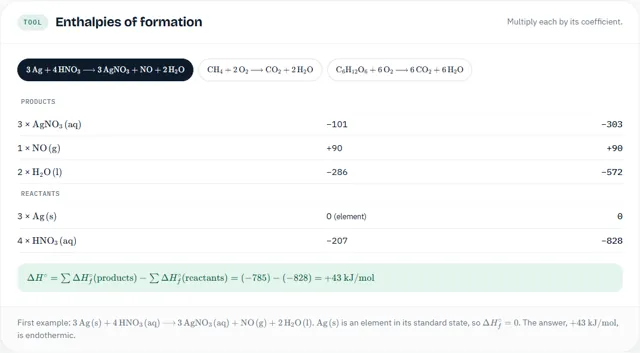
The standard enthalpy of formation, , is the enthalpy change when one mole of a compound forms from its elements in their standard states; for an element in its standard state, such as , it is zero. The standard enthalpy of any reaction is .
Enthalpy of reaction
Three ways to calculate ΔH.
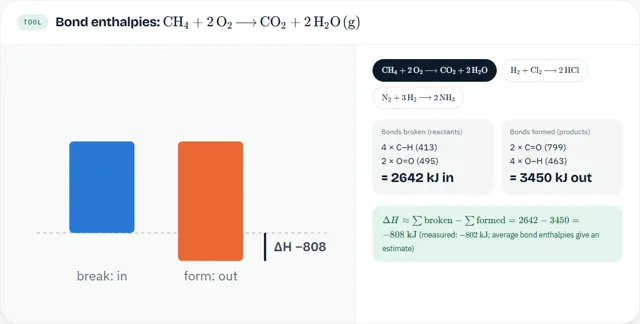
Reactant bonds in, product bonds out.
Elements in their standard state are 0.
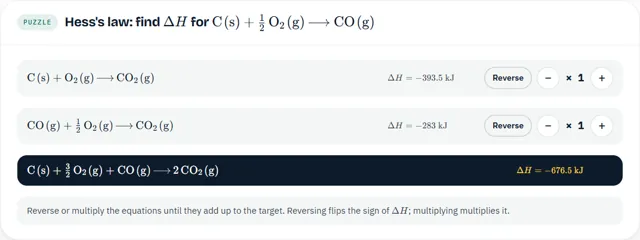
Reverse: flip the sign. Multiply: multiply .
Bond enthalpies:
Enthalpies of formation
Hess's law: find for
?A catalyst () speeds up . What happens to and to ?Think, then tap to check
is lower (a lower hump on the energy diagram). is unchanged: the reactants and products sit at the same energies.
?Why is of , or zero?Think, then tap to check
They're elements already in their standard state. Forming them from themselves involves no change.
Study notes
Key concepts
Standard enthalpy of formation, ΔH°f. The enthalpy change when exactly 1 mol of a compound is formed from its elements, with every substance in its standard state (the most stable form of the substance at 1 atm and the stated temperature, usually 25 °C). Units: kJ/mol.
Elements in their standard states have ΔH°f = 0. Examples: O₂(g), H₂(g), N₂(g), Cl₂(g), Br₂(l), I₂(s), C(s, graphite), Na(s), Fe(s), Hg(l). Other forms of an element are not zero: C(s, diamond) +1.9 kJ/mol, O₃(g) +142.7 kJ/mol, Br₂(g) +30.9 kJ/mol, I₂(g) +62.4 kJ/mol. Ions in solution are measured relative to H⁺(aq), which is set to 0.
Writing a formation equation. Exactly 1 mol of product, made only from elements in their standard states. Fractional coefficients are allowed:
-
H₂O(l): H₂(g) + ½ O₂(g) → H₂O(l) ΔH°f = −285.8 kJ/mol
-
C₂H₅OH(l): 2 C(s, graphite) + 3 H₂(g) + ½ O₂(g) → C₂H₅OH(l) ΔH°f = −277.7 kJ/mol
Calculating ΔH°rxn from ΔH°f values (ENE-3.B.1). Tables of ΔH°f let you calculate the standard enthalpy change of any reaction, chemical or physical:
ΔH°rxn = ΣnΔH°f(products) − ΣmΔH°f(reactants)
where n and m are the coefficients. This works because of Hess's law (6.9): imagine breaking every reactant down into its elements (the reverse of formation, −ΔH°f), then building the products from those elements (+ΔH°f).
Tips.
-
Multiply each ΔH°f by its coefficient.
-
Include elements, but their value is 0.
-
Use the value for the right phase: H₂O(l) −285.8 and H₂O(g) −241.8 kJ/mol differ by ΔHvap at 25 °C (44.0 kJ/mol).
-
The equation can be rearranged to find an unknown ΔH°f when ΔH°rxn is known (for example, from a combustion experiment).
-
A more negative ΔH°f means a compound is lower in enthalpy (more stable) relative to its elements.
Selected standard enthalpies of formation at 25 °C (kJ/mol).
| Substance | ΔH°f | Substance | ΔH°f |
|---|---|---|---|
| CO₂(g) | −393.5 | C₂H₂(g) | +226.7 |
| H₂O(l) | −285.8 | C₂H₄(g) | +52.3 |
| H₂O(g) | −241.8 | C₂H₆(g) | −84.7 |
| CO(g) | −110.5 | C₃H₈(g) | −103.8 |
| CH₄(g) | −74.8 | C₆H₆(l) | +49.0 |
| NH₃(g) | −46.1 | C₂H₅OH(l) | −277.7 |
| NO(g) | +90.3 | C₂H₅OH(g) | −234.8 |
| NO₂(g) | +33.2 | CaCO₃(s) | −1206.9 |
| HCl(g) | −92.3 | CaO(s) | −635.1 |
| SO₂(g) | −296.8 | Fe₂O₃(s) | −824.2 |
| SO₃(g) | −395.7 | Al₂O₃(s) | −1675.7 |
| ZnO(s) | −350.5 | Zn²⁺(aq) | −153.9 |
Key equations
Worked examples
Example 1. Calculate ΔH° for the combustion of propane: C₃H₈(g) + 5 O₂(g) → 3 CO₂(g) + 4 H₂O(l).
Solution. Products: 3(−393.5) + 4(−285.8) = −1180.5 + (−1143.2) = −2323.7 kJ. Reactants: (−103.8) + 5(0) = −103.8 kJ. ΔH° = −2323.7 − (−103.8) = −2219.9 kJ/molᵣₓₙ.
Example 2. Benzene burns: 2 C₆H₆(l) + 15 O₂(g) → 12 CO₂(g) + 6 H₂O(l). How much heat is released per mole of benzene? (ΔH°f of C₆H₆(l) = +49.04 kJ/mol.)
Solution. ΔH° = [12(−393.5) + 6(−285.8)] − [2(49.04) + 15(0)] = (−4722.0 − 1714.8) − 98.08 = −6534.9 kJ/molᵣₓₙ. This is for 2 mol of benzene, so heat released per mole = 6534.9/2 = 3267 kJ.
Example 3 (find an unknown ΔH°f). Glucose burns: C₆H₁₂O₆(s) + 6 O₂(g) → 6 CO₂(g) + 6 H₂O(l), ΔH° = −2800 kJ/molᵣₓₙ. Find ΔH°f of glucose.
Solution. −2800 = [6(−393.5) + 6(−285.8)] − [ΔH°f(glucose) + 0] = −4075.8 − ΔH°f(glucose). So ΔH°f(glucose) = −4075.8 + 2800 = −1276 kJ/mol.
Unit 6 study guide: exam-style free-response set, worksheet and answers.
Worked example
- Products: .
- Reactants: .
- .
- Answer:
Free-response practice
Write your answer first, then open the solution and mark yourself against it.
FRQ 6.8-1. Modelled on 2014 AP FRQ Q6(c). Ethene and ethane both burn to form CO₂(g) and H₂O(g):
C₂H₄(g) + 3 O₂(g) → 2 CO₂(g) + 2 H₂O(g)
C₂H₆(g) + 7/2 O₂(g) → 2 CO₂(g) + 3 H₂O(g)
(a) Use the ΔH°f table in this topic to calculate ΔH° for each reaction.
(b) Does the combustion of 1.00 mol of ethene release more, less, or the same energy as 1.00 mol of ethane? Justify with your answers to (a).
(c) Compare the heat released per gram of each fuel.
Show the solution
(a) Ethene: [2(−393.5) + 2(−241.8)] − [52.3 + 0] = −1270.6 − 52.3 = −1322.9 kJ/molᵣₓₙ. Ethane: [2(−393.5) + 3(−241.8)] − [−84.7 + 0] = −1512.4 + 84.7 = −1427.7 kJ/molᵣₓₙ.
(b) Less. 1.00 mol ethene releases 1322.9 kJ, which is less than the 1427.7 kJ released by 1.00 mol ethane.
(c) Ethene: 1322.9/28.05 = 47.2 kJ/g. Ethane: 1427.7/30.07 = 47.5 kJ/g. Per gram they are almost the same; ethane is very slightly higher.
FRQ 6.8-2. For C₂H₄(g) + 3 O₂(g) → 2 CO₂(g) + 2 H₂O(g), ΔH°rxn = −1322.9 kJ/molᵣₓₙ. ΔH°f of C₂H₄(g) is +52.3 kJ/mol and of H₂O(g) is −241.8 kJ/mol.
(a) Calculate ΔH°f of CO₂(g).
(b) How much heat is released when 140.0 g of C₂H₄ burns?
(c) How many moles of C₂H₄ must burn to release 2300 kJ? What volume is this at STP (22.4 L/mol)?
Show the solution
(a) −1322.9 = [2ΔH°f(CO₂) + 2(−241.8)] − [52.3]. 2ΔH°f(CO₂) = −1322.9 + 483.6 + 52.3 = −787.0. ΔH°f(CO₂) = −393.5 kJ/mol.
(b) n = 140.0/28.05 = 4.991 mol. Heat = 4.991 × 1322.9 = 6.603 × 10³ kJ.
(c) n = 2300/1322.9 = 1.739 mol. V = 1.739 × 22.4 = 39.0 L.
Common mistake
Students forget to multiply by coefficients or subtract in the wrong order. Use products minus reactants, each multiplied by its coefficient from the balanced equation.
Frequently asked questions
?Why is the enthalpy of formation of O2 zero?
is oxygen's standard state, and forming an element from itself involves no change.
?Is it products minus reactants for enthalpy of formation?
Yes: . For bond enthalpies it is the reverse, broken minus formed.
Practice questions on 6.8
- Q1Given values of −393.5 kJ/mol for , −285.8 kJ/mol for and −74.8 kJ/mol for , what is for ?
- Q2Using values −101, +90, −286 and −207 kJ/mol, what is for ?
- Q3Which equation represents the standard enthalpy of formation of liquid water?
- Q4Which substance has ΔH°f = 0 at 25 °C?
- Q5What is ΔH° for 3 C₂H₂(g) → C₆H₆(l)? (ΔH°f of C₂H₂(g) = +227 kJ/mol; C₆H₆(l) = +49 kJ/mol.)
- Q6Using the data, find ΔH° for Ca(OH)₂ + 2 H₃AsO₄ → Ca(H₂AsO₄)₂ + 2 H₂O. Ca(OH)₂: ΔH°f (kJ/mol) = −986.6 H₃AsO₄: ΔH°f (kJ/mol) = −900.4 Ca(H₂AsO₄)₂: ΔH°f (kJ/mol) = −2346.0 H₂O: ΔH°f (kJ/mol) = −285.9
- Q7A student wants ΔH° for IF₇(g) + I₂(g) → IF₅(g) + 2 IF(g) and has ΔH°f values for IF(g), IF₅(g) and IF₇(g) only. What else is needed?
- Q8For 4 Al(s) + 3 O₂(g) → 2 Al₂O₃(s), ΔH° = −3351 kJ/molᵣₓₙ. What is ΔH°f of Al₂O₃(s)?
- Q9Using ΔH°f values of CaCO₃(s) −1206.9, CaO(s) −635.1 and CO₂(g) −393.5 kJ/mol, calculate ΔH° for CaCO₃(s) → CaO(s) + CO₂(g).
Terms used in this topic
Stuck on a unit? Let us fix it this week.
Book a 30-minute one-to-one session for $20. Bring a test, a homework set or the topic that is not clicking.
Book a session