 AP Chemistry Tutoring
8.2 pH and pOH of strong acids and bases
AP Chemistry Unit 8: Acids and Bases · 3 simulations · 18 practice questions
Updated · Aligned to the AP Chemistry Course and Exam Description
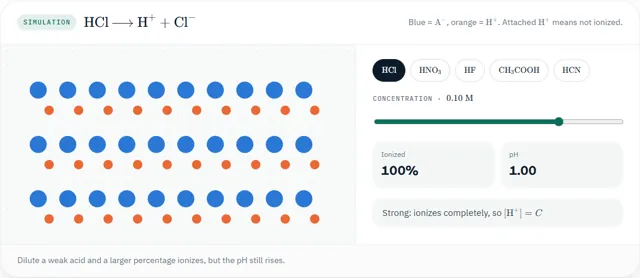
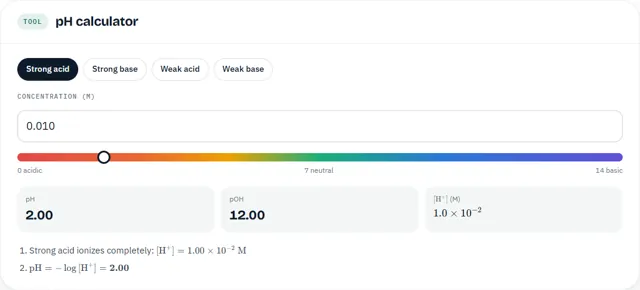
Strong acids and strong bases ionize completely in water, so the concentration of or comes directly from the stoichiometry of the solute. For a strong acid such as , equals the acid concentration; for , is twice the base concentration. Then and .
pH, strong and weak
Water always holds a little and : at 25 °C. Take of both sides and you get the rule you'll use constantly:
On the AP exam you may write in place of .
Ionize completely. Mnemonic: "SoCal HELL NO".
Dissociate completely into .
, , , , any … Small .
Take from water. Small .
pH calculator
Reactions & salts
Mixing acids and bases.
If either one is strong, the reaction goes to completion: find the limiting reactant with a table of moles, then see what's left over.
| Strong + strong | · neutral at equivalence |
| Strong acid + weak base | makes · acidic |
| Weak acid + strong base | makes · basic |
| Weak + weak | depends on vs |
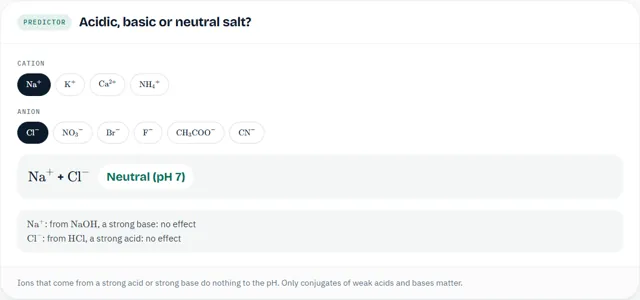
Acidic, basic or neutral salt?
500 mL of 1.0 M KOH is mixed with 300 mL of 2.0 M HBr. What is the pH?
- : . : .
- They react 1 : 1 to completion. is limiting: 0.10 mol is left.
- Total volume 0.800 L: .
? and are each dissolved in water. Which gives a slightly acidic solution, and why?Think, then tap to check
: . (from strong ) does nothing. is actually slightly basic: is the conjugate base of the weak acid .
Study notes
Key concepts
Strong acids ionize completely (SAP-9.B.1). The strong acids you must know are HCl, HBr, HI, HClO₄, HNO₃ and H₂SO₄. In water their molecules transfer their proton to water essentially 100%:
HNO₃(aq) + H₂O(l) → H₃O⁺(aq) + NO₃⁻(aq)
A single arrow is used because there is no significant reverse reaction. A solution labelled "0.10 M HNO₃" contains essentially no HNO₃ molecules; it contains 0.10 M H₃O⁺ and 0.10 M NO₃⁻. So for a strong monoprotic acid, [H₃O⁺] = initial concentration of the acid, and pH = −log(cacid).
A note on H₂SO₄. Only the first proton of sulfuric acid is strong: H₂SO₄ → H₃O⁺ + HSO₄⁻. HSO₄⁻ is a weak acid (Ka₂ ≈ 1.0 × 10⁻²), so the second proton is only partly removed. On the AP Exam you will usually only need to recognise H₂SO₄ as a strong acid; if a calculation is asked, it will tell you how to treat the second proton.
Strong bases dissociate completely (SAP-9.B.2). The strong bases are the hydroxides of group 1 (LiOH, NaOH, KOH, RbOH, CsOH) and the heavier group 2 metals (Ca(OH)₂, Sr(OH)₂, Ba(OH)₂). They are ionic solids that break apart completely into ions when they dissolve:
Ba(OH)₂(s) → Ba²⁺(aq) + 2 OH⁻(aq)
Watch the subscript: each formula unit of a group 2 hydroxide gives two OH⁻ ions, so [OH⁻] = 2 × c(base). Mg(OH)₂ and Ca(OH)₂ are only slightly soluble, but the part that dissolves is fully dissociated.
Recipe for strong acid / strong base pH.
- Find [H₃O⁺] (strong acid) or [OH⁻] (strong base) directly from the concentration and the formula.
- Take −log to get pH (or pOH).
- Use pH + pOH = 14.00 (at 25 °C) to get the other one.
Strong is not the same as concentrated. "Strong" describes the extent of ionization (complete), not the amount dissolved. 0.0010 M HCl is a dilute strong acid; 10 M CH₃COOH is a concentrated weak acid. Concentrated strong acids can even have pH < 0 (2.0 M HCl has pH −0.30).
Mixing two strong acids or two strong bases. Add up the moles of H₃O⁺ (or OH⁻) contributed by each, then divide by the total volume.
Diluting a strong acid or base. Diluting by a factor of 10 changes [H₃O⁺] by a factor of 10 and the pH by exactly one unit (towards 7). Diluting a strong acid can never make it basic: as c(acid) approaches zero the pH approaches 7, because water's own autoionization then dominates. (For example, 2.0 × 10⁻⁷ M HCl has a pH of 6.62, not 6.70; this level of detail is beyond the AP Exam but explains why pH never "crosses" 7 on dilution.)
Common misconceptions.
- Forgetting the factor of 2 for Ba(OH)₂, Sr(OH)₂ and Ca(OH)₂.
- Calculating "pH = −log[OH⁻]" for a base. That gives pOH; subtract from 14.
- Thinking a strong acid solution contains HA molecules. It contains only ions (and water).
Key equations
Worked examples
Worked example 8.2-A. Calculate the pH of 0.025 M HNO₃.
HNO₃ is a strong acid, so [H₃O⁺] = 0.025 M. pH = −log(0.025) = 1.60.
Worked example 8.2-B. Calculate the pOH and pH of 0.015 M Ba(OH)₂.
[OH⁻] = 2 × 0.015 = 0.030 M. pOH = −log(0.030) = 1.52. pH = 14.00 − 1.52 = 12.48.
Worked example 8.2-C. 0.40 g of NaOH (molar mass 40.00 g/mol) is dissolved to make 250. mL of solution. Find the pH.
n(NaOH) = 0.40 / 40.00 = 0.010 mol; [OH⁻] = 0.010 mol / 0.250 L = 0.040 M; pOH = 1.40; pH = 12.60.
Worked example 8.2-D (mixing two bases; modelled on 1999 released exam MC Q59). 30.0 mL of 0.20 M KOH is mixed with 20.0 mL of 0.10 M Ba(OH)₂. Find [OH⁻] and pH. Assume volumes are additive.
n(OH⁻) from KOH = 0.0300 L × 0.20 M = 0.0060 mol. n(OH⁻) from Ba(OH)₂ = 0.0200 L × 0.10 M × 2 = 0.0040 mol. Total = 0.0100 mol in 0.0500 L, so [OH⁻] = 0.20 M. pOH = 0.70 and pH = 13.30.
Unit 8 study guide: exam-style free-response set, worksheet and answers.
Worked example
- , so .
- .
- .
- Answer: pH = 12.60
Free-response practice
Write your answer first, then open the solution and mark yourself against it.
FRQ 8.2-1. A student dissolves 3.65 g of HCl(g) (molar mass 36.46 g/mol) in enough water to make 2.00 L of solution.
(a) Write the equation for the reaction of HCl with water and explain why a single arrow is appropriate.
(b) Calculate the pH of the solution.
(c) Calculate [OH⁻] in the solution.
(d) The student takes 25.0 mL of this solution and dilutes it to 250. mL. Predict the pH of the diluted solution without a full calculation. Justify your answer.
Show the solution
(a) HCl(aq) + H₂O(l) → H₃O⁺(aq) + Cl⁻(aq). HCl is a strong acid: essentially every molecule transfers its proton to water and the reverse reaction is negligible. (1 point)
(b) n(HCl) = 3.65 / 36.46 = 0.100 mol; [H₃O⁺] = 0.100 / 2.00 = 0.0500 M; pH = −log(0.0500) = 1.30. (1 point)
(c) [OH⁻] = 1.0 × 10⁻¹⁴ / 0.0500 = 2.0 × 10⁻¹³ M. (1 point)
(d) pH = 2.30. The dilution is 10-fold, so [H₃O⁺] falls by a factor of 10 to 0.00500 M and the pH rises by exactly 1 unit. (1 point)
FRQ 8.2-2. A 0.0050 M solution of Sr(OH)₂ is prepared at 25 °C.
(a) Write the dissociation equation for Sr(OH)₂ in water.
(b) Calculate the pH.
(c) A second student says the pH should be 11.70 because "[OH⁻] = 0.0050 M". Identify the error.
Show the solution
(a) Sr(OH)₂(s) → Sr²⁺(aq) + 2 OH⁻(aq). (1 point)
(b) [OH⁻] = 2 × 0.0050 = 0.010 M; pOH = 2.00; pH = 12.00. (1 point)
(c) The student ignored the 1: 2 mole ratio between Sr(OH)₂ and OH⁻. Each formula unit releases two hydroxide ions. (1 point)
Common mistake
Students forget that and release two hydroxide ions per formula unit. For 0.020 M , .
Frequently asked questions
?What are the strong acids for AP Chemistry?
, , , , and (first proton).
?Is a strong acid the same as a concentrated acid?
No. Strong describes complete ionization; concentrated describes how much acid is dissolved. A dilute solution of a strong acid is still a strong acid.
Practice questions on 8.2
- Q1What is the pH of 0.010 M HCl?
- Q2What is the pH of 0.0010 M NaOH at 25 °C?
- Q3What is the pH of 2.00 × 10⁻⁴ M NaOH at 25 °C?
- Q46.00 × 10⁻⁴ mol of HCl is added to 1.0 L of 2.0 × 10⁻⁴ M HCl. Assuming no volume change, what is the new pH?
- Q5A 50.0 mL sample of NaOH solution has pH 12.50. Which procedure would give a NaOH solution with pH 11.50?
- Q6A student measures four 0.10 M solutions with a pH meter. Which reading is consistent with the identity of the solution at 25 °C?
- Q7Which of the following 0.010 M solutions has the highest pH?
- Q810.0 mL of 0.10 M HCl is diluted with water to a final volume of 1.00 L. What is the pH of the diluted solution?
- Q950.0 mL of 0.020 M HNO₃ is mixed with 50.0 mL of distilled water. What is the pH of the result?
- Q10Three 0.0010 M solutions are tested: HCl, H₂SO₄ and CH₃COOH. Which ranking of pH, lowest to highest, is correct?
- Q11What is the pH of M ?
- Q12What is the pH of M HCl?
- Q13A student measures four solutions with pH probes, and only one probe reads correctly. Which?
- Q14 mol of is added to 0.50 L of M (no volume change). What is the new pH?
- Q15What is the pH of M HBr?
- Q16What is the pOH of M KOH?
- Q17What is the pH of M KOH?
- Q18What does a 0.1 M solution of the strong acid contain?
Terms used in this topic
Stuck on a unit? Let us fix it this week.
Book a 30-minute one-to-one session for $20. Bring a test, a homework set or the topic that is not clicking.
Book a session