 AP Chemistry Tutoring
8.3 Weak acid and base equilibria
AP Chemistry Unit 8: Acids and Bases · 2 simulations · 24 practice questions
Updated · Aligned to the AP Chemistry Course and Exam Description
Weak acids and bases ionize only partially, and the extent is described by or . For a weak acid , , and when ionization is small . For a conjugate acid-base pair , so a weaker acid has a stronger conjugate base.
pH, strong and weak
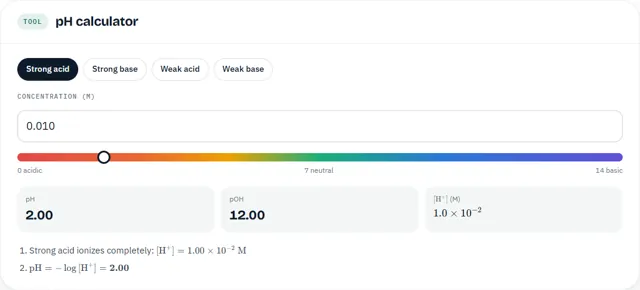
Water always holds a little and : at 25 °C. Take of both sides and you get the rule you'll use constantly:
On the AP exam you may write in place of .
Ionize completely. Mnemonic: "SoCal HELL NO".
Dissociate completely into .
, , , , any … Small .
Take from water. Small .
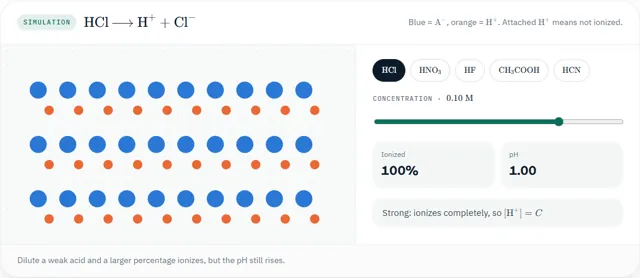
pH calculator
Study notes
Key concepts
Weak acids ionize only partially (SAP-9.C.1). A weak acid HA transfers its proton to water reversibly:
HA(aq) + H₂O(l) ⇌ H₃O⁺(aq) + A⁻(aq)
At equilibrium only a small percentage of HA molecules are ionized (usually well under 5%). So [H₃O⁺] is much less than the initial acid concentration, and the vast majority of the acid stays as HA molecules. The major species in 0.10 M CH₃COOH are H₂O and CH₃COOH; H₃O⁺ and CH₃COO⁻ are minor species. This is why a weak acid solution conducts electricity only weakly: there are few ions.
The acid ionization constant Ka (SAP-9.C.2). The equilibrium constant for the ionization of a weak acid is Ka, often reported as pKa = −log Ka. The larger Ka (the smaller pKa), the stronger the acid. Strong acids have Ka ≫ 1; typical weak acids have Ka between about 10⁻² and 10⁻¹⁰. The pH of a weak acid solution can be calculated from the initial concentration and Ka (or pKa).
Weak bases (SAP-9.C.3 and 9.C.4). A weak base B accepts a proton from water:
B(aq) + H₂O(l) ⇌ HB⁺(aq) + OH⁻(aq)
Only a small fraction of B molecules react, so [OH⁻] is much less than the initial base concentration. The equilibrium constant is Kb (pKb = −log Kb). Ammonia and amines (CH₃NH₂, C₅H₅N) and the anions of weak acids (F⁻, CH₃COO⁻, CO₃²⁻) are the common weak bases.
Ka × Kb = Kw for a conjugate pair. Adding the acid ionization of HA and the base reaction of A⁻ gives the autoionization of water, so Ka(HA) × Kb(A⁻) = Kw, and pKa + pKb = 14.00 at 25 °C. Consequence: the stronger the acid, the weaker its conjugate base, and vice versa. The conjugate bases of strong acids (Cl⁻, Br⁻, I⁻, NO₃⁻, ClO₄⁻) are so weak that they have no measurable effect on pH.
The ICE method for a weak acid. Let the initial concentration be c and let x mol/L ionize.
| HA | H₃O⁺ | A⁻ | |
|---|---|---|---|
| Initial | c | ≈ 0 | 0 |
| Change | −x | +x | +x |
| Equilibrium | c − x | x | x |
Then Ka = x² / (c − x). Because x is small compared with c, we approximate c − x ≈ c, giving x = √(Ka·c). Check the approximation afterwards: if x/c × 100% is below 5%, it is acceptable. If not, solve the quadratic x² + Ka·x − Ka·c = 0. Weak bases are handled in exactly the same way with Kb and [OH⁻].
Percent ionization (SAP-9.C.5). Percent ionization = [H₃O⁺]eq / c(HA) × 100% (or [OH⁻]eq / c(B) × 100% for a base). It can be calculated from the pKa and the initial concentration. Two trends to know:
- For the same concentration, a larger Ka gives a larger percent ionization.
- For the same acid, diluting the solution increases the percent ionization (but [H₃O⁺] still decreases, so pH rises). Using x = √(Ka·c), percent ionization = √(Ka/c) × 100%, which grows as c falls. Le Châtelier view: dilution reduces the total concentration of dissolved particles, and the equilibrium shifts to the side with more dissolved particles (H₃O⁺ + A⁻).
| Acetic acid, Ka = 1.8 × 10⁻⁵ | 0.10 M | 0.010 M |
|---|---|---|
| [H₃O⁺] | 1.3 × 10⁻³ M | 4.2 × 10⁻⁴ M |
| pH | 2.87 | 3.37 |
| Percent ionization | 1.3% | 4.2% |
Comparing a strong and a weak acid at the same pH. If HCl and CH₃COOH solutions have the same pH, they have the same [H₃O⁺], but the acetic acid must be much more concentrated, because only a small fraction of it ionizes (2014 FRQ Q2(c)(ii) idea).
Salts as acids and bases. A salt's ions can be weak acids or weak bases.
| Type of salt | Example | Ion that reacts with water | Solution |
|---|---|---|---|
| Cation of a strong base + anion of a strong acid | NaCl, KNO₃ | none | neutral, pH 7 |
| Cation of a strong base + anion of a weak acid | NaF, CH₃COONa, Na₂CO₃ | anion: A⁻ + H₂O ⇌ HA + OH⁻ | basic |
| Conjugate acid of a weak base + anion of a strong acid | NH₄Cl, CH₃NH₃Cl | cation: NH₄⁺ + H₂O ⇌ NH₃ + H₃O⁺ | acidic |
| Small, highly charged metal ion | AlCl₃, FeCl₃ | hydrated Al³⁺ / Fe³⁺ releases H⁺ | acidic |
| Weak acid cation + weak base anion | NH₄F, NH₄CN | both | compare Ka(cation) with Kb(anion) |
To calculate the pH of a salt solution, find Kb (or Ka) of the reacting ion from Kw / Ka (or Kw / Kb) and then treat it as an ordinary weak base (or acid).
Common misconceptions.
- Using the initial acid concentration as [H₃O⁺] for a weak acid. That is only true for strong acids.
- Thinking a more dilute weak acid has a lower pH because it is "more ionized". Percent ionization goes up, but [H₃O⁺] goes down.
- Writing [H₂O] in the Ka or Kb expression.
Key equations
Worked examples
Worked example 8.3-A (modelled on 2021 AP FRQ Q1(a)–(b)). Methanoic acid, HCOOH, has Ka = 1.8 × 10⁻⁴. (a) Write the Ka expression. (b) Calculate the pH of 0.40 M HCOOH and the percent ionization.
(a) Ka = [H₃O⁺][HCOO⁻] / [HCOOH]
(b) Let x = [H₃O⁺] = [HCOO⁻]. Then 1.8 × 10⁻⁴ = x² / (0.40 − x) ≈ x² / 0.40, so x = √(7.2 × 10⁻⁵) = 8.5 × 10⁻³ M.
pH = −log(8.5 × 10⁻³) = 2.07. Percent ionization = (8.5 × 10⁻³ / 0.40) × 100% = 2.1%. Because this is under 5%, the approximation is valid. (Solving the quadratic gives x = 8.4 × 10⁻³ M and pH 2.08, the same within rounding.)
Worked example 8.3-B. Calculate the pH of 0.15 M NH₃ (Kb = 1.8 × 10⁻⁵).
NH₃ + H₂O ⇌ NH₄⁺ + OH⁻. Kb = x² / (0.15 − x) ≈ x² / 0.15, so x = [OH⁻] = √(2.7 × 10⁻⁶) = 1.6 × 10⁻³ M.
pOH = 2.78, pH = 14.00 − 2.78 = 11.22. Percent ionization = 1.1%.
Worked example 8.3-C (finding Ka from pH; modelled on 2014 AP FRQ Q2(b)). The pH of 0.10 M propanoic acid, CH₃CH₂COOH, is 2.94 at 25 °C. Find Ka.
[H₃O⁺] = 10⁻²·⁹⁴ = 1.15 × 10⁻³ M = [CH₃CH₂COO⁻]. [CH₃CH₂COOH] = 0.10 − 0.00115 ≈ 0.099 M.
Ka = (1.15 × 10⁻³)² / 0.099 = 1.3 × 10⁻⁵.
Worked example 8.3-D (pH of a salt). Calculate the pH of 0.10 M sodium acetate, CH₃COONa. Ka(CH₃COOH) = 1.8 × 10⁻⁵.
Na⁺ is a spectator. Acetate is a weak base: CH₃COO⁻ + H₂O ⇌ CH₃COOH + OH⁻. Kb = Kw / Ka = 1.0 × 10⁻¹⁴ / 1.8 × 10⁻⁵ = 5.6 × 10⁻¹⁰.
[OH⁻] = √(5.6 × 10⁻¹⁰ × 0.10) = 7.5 × 10⁻⁶ M; pOH = 5.13; pH = 8.87. The solution is basic, as expected for the salt of a weak acid.
Worked example 8.3-E (when the 5% rule fails). Calculate the pH of 0.050 M methylamine, CH₃NH₂ (Kb = 4.4 × 10⁻⁴).
Approximation: x = √(4.4 × 10⁻⁴ × 0.050) = 4.7 × 10⁻³ M, which is 9.4% of 0.050 M, so the approximation is not good. Solve x² + 4.4 × 10⁻⁴ x − 2.2 × 10⁻⁵ = 0: x = 4.5 × 10⁻³ M. pOH = 2.35, pH = 11.65 (the approximation gives 11.67; on the AP Exam either method earns credit if the work is shown, but know why the quadratic is more accurate).
Unit 8 study guide: exam-style free-response set, worksheet and answers.
Worked example
- , so .
- .
- Percent ionization: , so the approximation is valid.
- Answer: pH 2.87; 1.3% ionized
Free-response practice
Write your answer first, then open the solution and mark yourself against it.
FRQ 8.3-1 (modelled on 2018 AP FRQ Q5). HF(aq) + H₂O(l) ⇌ F⁻(aq) + H₃O⁺(aq). In a 0.0500 M HF solution, HF is 11.0% ionized at 25 °C.
(a) A particulate diagram of this solution shows 20 HF-derived particles (water not shown). Describe how many should be intact HF molecules and how many should be F⁻ and H₃O⁺ ions for an accurate representation. Justify your answer.
(b) Calculate Ka for HF.
(c) If 50.0 mL of distilled water is added to 50.0 mL of the 0.0500 M HF, will the percent ionization increase, decrease or remain the same? Justify your answer.
Show the solution
(a) About 11% of 20 ≈ 2 molecules are ionized, so the diagram should show about 18 intact HF molecules plus about 2 F⁻ ions and 2 H₃O⁺ ions. HF is a weak acid, so most of it stays un-ionized; a drawing with mostly separated H₃O⁺ and F⁻ ions would represent a strong acid. (1 point)
(b) [H₃O⁺] = [F⁻] = 0.110 × 0.0500 = 5.50 × 10⁻³ M; [HF] = 0.0500 − 0.00550 = 0.0445 M. Ka = (5.50 × 10⁻³)² / 0.0445 = 6.80 × 10⁻⁴. (1 point for the equilibrium concentrations, 1 point for Ka)
(c) Increase. Immediately after dilution every concentration is halved, so Q = (½[H₃O⁺])(½[F⁻]) / (½[HF]) = ½Ka, which is less than Ka. The reaction shifts to the right, ionizing a larger fraction of the HF. (Check: solving Ka = x²/(0.0250 − x) gives x = 3.8 × 10⁻³ M, which is 15% ionization, larger than 11%.) (1 point)
FRQ 8.3-2 (modelled on 2011 AP FRQ Q1(b)–(c)). Two beakers each contain 25.0 mL of solution at 25 °C: beaker 1 contains 0.100 M NH₃ and beaker 2 contains 0.100 M NH₄Cl. Kb(NH₃) = 1.8 × 10⁻⁵.
(a) Write the Kb expression for NH₃ and calculate [OH⁻] in beaker 1.
(b) Calculate Ka for NH₄⁺ and the pH in beaker 2.
(c) Which beaker has the larger percent of its solute converted to ions by reaction with water? Justify your answer.
Show the solution
(a) Kb = [NH₄⁺][OH⁻] / [NH₃]. [OH⁻] = √(1.8 × 10⁻⁵ × 0.100) = 1.3 × 10⁻³ M. (2 points)
(b) Ka = Kw / Kb = 1.0 × 10⁻¹⁴ / 1.8 × 10⁻⁵ = 5.6 × 10⁻¹⁰. [H₃O⁺] = √(5.6 × 10⁻¹⁰ × 0.100) = 7.5 × 10⁻⁶ M; pH = 5.13. (2 points)
(c) Beaker 1. NH₃ is 1.3% ionized (1.3 × 10⁻³ / 0.100), whereas only 7.5 × 10⁻⁶ / 0.100 = 0.0075% of NH₄⁺ reacts with water, because Kb(NH₃) is much larger than Ka(NH₄⁺) at the same concentration. (1 point)
Common mistake
Students treat a weak acid as fully ionized and set equal to the acid concentration. For a weak acid only a small fraction ionizes, so must be found from .
Frequently asked questions
?How do you find the pH of a weak acid?
Set up an ICE table, write , approximate if is small, solve for , then take .
?Why does percent ionization increase when a weak acid is diluted?
Dilution lowers below , so the equilibrium shifts toward more ions, even though itself decreases.
Practice questions on 8.3
- Q1What is the pH of 0.10 M acetic acid? ()
- Q2Which salt gives a slightly acidic solution in water?
- Q3What is the approximate pH of 0.10 M HCN? ()
- Q4What is the pH of 0.50 M ethanoic (acetic) acid? Ka = 1.8 × 10⁻⁵.
- Q5What is [H₃O⁺] in 0.030 M HCN? Ka(HCN) = 3.0 × 10⁻¹⁰.
- Q6A weak acid has Ka = 1.0 × 10⁻⁸. What is its percent ionization in a 4.0 M solution?
- Q7A weak acid solution is diluted with water. By what factor must the acid concentration be reduced so that [H₃O⁺] falls to one-fourth of its original value? (Assume the approximation [H₃O⁺] = √(Ka·c) holds.)
- Q8Pyridine, C₅H₅N, is a weak base with Kb = 1.7 × 10⁻⁹. Which is closest to the pH of 0.20 M pyridine?
- Q9A solution of a weak acid HA (Ka = 4.0 × 10⁻⁹) has pH 5.50. What is the approximate percent ionization of HA?
- Q10Which 0.10 M aqueous solution has the highest pH?
- Q11When 0.10 M acetic acid is diluted to 0.010 M, which statement is correct?
- Q12A 0.050 M solution of a weak monoprotic acid has pH 3.00. What is the approximate Ka of the acid?
- Q13Which 0.10 M aqueous solution is acidic?
- Q14The Ka values are: HNO₂, 4.0 × 10⁻⁴; HCN, 6.2 × 10⁻¹⁰; HF, 6.8 × 10⁻⁴. Which list ranks the conjugate bases from strongest to weakest?
- Q15Equal concentrations (0.10 M) of HCl and CH₃COOH are tested for electrical conductivity. Which observation and explanation are correct?
- Q16What is the pH of 0.20 M ()?
- Q17Four 0.10 M weak acid solutions have values of 2.1, 4.8, 7.2 and 10.3. Which solution has the highest pH?
- Q18What is the percent ionization of a 1.0 M acid with ?
- Q19An HF solution conducts electricity only weakly. Why?
- Q20Given values: , , HCN , HOCl . Which is the weakest conjugate base?
- Q211 L of a weak acid solution is diluted to make one-third of its original value. To what volume must it be diluted?
- Q22Which is the closest pH for 0.10 M ()?
- Q23A weak acid () has pH 3.00 in 100 mL. How much water must be added to raise the pH to 4.00?
- Q24A weak acid solution has pH 4.00, and . What is the percent ionization?
Stuck on a unit? Let us fix it this week.
Book a 30-minute one-to-one session for $20. Bring a test, a homework set or the topic that is not clicking.
Book a session