 AP Chemistry Tutoring
9.1 Introduction to entropy
AP Chemistry Unit 9: Thermodynamics and Electrochemistry · 1 simulation · 16 practice questions
Updated · Aligned to the AP Chemistry Course and Exam Description
Entropy, , measures the dispersal of matter and energy in a system: the more ways particles and energy can be arranged, the greater the entropy. Entropy increases from solid to liquid to gas, when a reaction produces more moles of gas, when a solid dissolves, and when temperature rises. So has , since 3 mol of gas become a liquid.
Entropy
Entropy () measures dispersal.
More ways to arrange the particles and their energy means higher entropy. To predict the sign of , count moles of gas first. Gas beats everything else.
Units: . Divide by 1000 before combining with in kJ.
: 2 → 3 mol gas.
A solid spreads out into ions.
: 4 → 2 mol gas.
Faster particles, more energy states.
Sign of
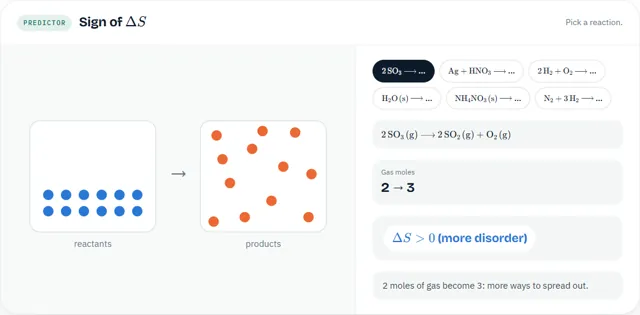
Study notes
Key concepts
What entropy is. Entropy (S) measures how spread out (dispersed) the matter and the energy of a system are. A useful particle-level picture uses microstates: a microstate is one particular arrangement of the positions and energies of all the particles. A state that can be achieved in more ways (more microstates) has higher entropy and is more probable. class notes contrast two views of a gas sample. Macroscopically, the gas is described by a few values (T, V, P). Microscopically, every molecule has its own position and speed, and an enormous number of different arrangements all look the same from outside. Entropy counts those hidden arrangements.
The old word "disorder" is a helpful shortcut, but "dispersal" is more accurate and is the word the AP exam uses.
Entropy increases when matter becomes more dispersed (ENE-4.A.1).
| Change | Sign of ΔS | Particle-level reason |
|---|---|---|
| Solid → liquid (melting) | + | Particles leave fixed lattice positions and move past each other. |
| Liquid → gas (vaporization) | + (large) | Particles become free and occupy a much larger volume. |
| Solid → gas (sublimation) | + (largest) | Combines both changes above. |
| Gas → liquid or solid (condensation, deposition) | − | Particles become confined and organised. |
| Gas expands into a larger volume at constant T | + | Each molecule has more positions available. |
| Two different gases mix | + | Each gas spreads into the whole volume. |
| Reaction makes more moles of gas than it uses | + | More gas particles means far more possible arrangements. |
| Reaction makes fewer moles of gas than it uses | − | Fewer gas particles. |
| Solid or liquid dissolves in water | usually + | Solute particles spread through the solution (some ions that strongly organise water are exceptions). |
| Gas dissolves in a liquid | − | Gas particles become confined in the liquid. |
The gas-moles rule. For a reaction with gases, count moles of gas on each side. If moles of gas increase, ΔS > 0. If they decrease, ΔS < 0. Gases have so much more entropy than solids and liquids that this usually decides the sign. Only when Δn(gas) = 0 do you need to look at other factors (phase of the other species, number of particles, complexity).
Entropy increases when energy is dispersed (ENE-4.A.2). As temperature rises, the Maxwell–Boltzmann distribution of molecular speeds (and kinetic energies) becomes lower and broader. The kinetic energy is spread over a wider range of values, so there are more ways to share it among the particles. Therefore the entropy of any substance increases as its temperature increases. Describe this in words on the exam: "At higher temperature the distribution of kinetic energies is broader, so there are more possible energy arrangements (microstates), so the entropy is greater."
Can entropy be zero? The slides pose this question. The answer is the third law of thermodynamics: a perfect crystal at 0 K has exactly one possible arrangement, so its entropy is zero. Every real substance above 0 K has S > 0. This is why tables list absolute entropies (Topic 9.2), and why S° for an element is not zero even though ΔH°f and ΔG°f for an element are zero.
The second law. For any thermodynamically favored process, the total entropy of the universe (system plus surroundings) increases: ΔS(universe) > 0. The system's own entropy can go down (for example, water freezing below 0 °C) as long as the surroundings gain more entropy from the heat released.
Common misconceptions.
- "Entropy always increases, so ΔS of a system can never be negative." Wrong. Only ΔS(universe) must increase for a favored process.
- "ΔS of reaction doubles if the Kelvin temperature doubles." Wrong. Absolute entropies increase with T, but ΔS° for a reaction changes only slightly with temperature. AP problems treat ΔS° and ΔH° as constant.
- "A larger number of moles of anything always means more entropy." The phase matters most. 2 mol of solid can have less entropy than 1 mol of gas.
Worked examples
Example 9.1-A. Predict the sign of ΔS for each process and justify it.
(a) I₂(g) → I₂(s)
(b) 2 H₂O₂(l) → 2 H₂O(l) + O₂(g)
(c) N₂(g) + 3 H₂(g) → 2 NH₃(g)
(d) Sugar dissolves in water.
(e) A sample of neon is heated from 300 K to 400 K at constant volume.
Solution.
(a) Negative. Gas particles become locked in a solid lattice, so matter is less dispersed.
(b) Positive. 0 mol of gas become 1 mol of gas.
(c) Negative. 4 mol of gas become 2 mol of gas, so there are fewer gas particles and fewer possible arrangements.
(d) Positive. Sugar molecules leave the ordered crystal and spread throughout the solution.
(e) Positive. At higher temperature the distribution of kinetic energies of the Ne atoms is broader, so energy is more dispersed.
Example 9.1-B (ranking). Rank in order of increasing standard molar entropy at 298 K: H₂O(s), H₂O(l), H₂O(g).
Solution. H₂O(s) < H₂O(l) < H₂O(g). Same substance, so phase decides: particles are least free in the solid and most dispersed in the gas.
Unit 9 study guide: exam-style free-response set, worksheet and answers.
Worked example
- Reactants: 0 mol of gas. Products: 1 mol of gas.
- Forming a gas greatly increases the dispersal of matter and energy.
- Answer:
Free-response practice
Write your answer first, then open the solution and mark yourself against it.
FRQ 9.1-1. Use particle-level reasoning in each part.
(a) Predict the sign of ΔS° for CaCO₃(s) → CaO(s) + CO₂(g). Justify your answer.
(b) A sealed rigid flask of N₂(g) is heated from 25 °C to 100 °C. Does the entropy of the N₂ increase, decrease or stay the same? Explain in terms of the distribution of molecular kinetic energies.
(c) A student says: "Water freezing at −5 °C has ΔS < 0, so it breaks the second law of thermodynamics." Explain why the student is wrong.
Show the solution
(a) ΔS° > 0 (1 point). The reactant is a solid with no gas; the products include 1 mol of gas. Gas particles are far more dispersed than particles in a solid, so the products have more microstates (1 point).
(b) It increases (1 point). At the higher temperature the distribution of kinetic energies of the N₂ molecules is broader (spread over a wider range of values), so the energy can be shared among the molecules in more ways (1 point). The volume is constant, so the increase comes from the energy dispersal.
(c) The second law requires ΔS of the universe to be positive, not ΔS of the system (1 point). Freezing releases heat to the colder surroundings, which increases the entropy of the surroundings by more than the entropy of the water decreases, so ΔS(universe) > 0 below 0 °C (1 point).
FRQ 9.1-2. A pure substance is cooled at a steady rate from 150 °C to 0 °C. The data are summarised below.
| Time interval (s) | Temperature behaviour | What is happening |
|---|---|---|
| 0–20 | Falls from 150 °C to 110 °C | Gas cools |
| 20–40 | Constant at 110 °C | ? |
| 40–70 | Falls from 110 °C to 60 °C | Liquid cools |
| 70–100 | Constant at 60 °C | ? |
| 100–120 | Falls from 60 °C to 0 °C | Solid cools |
(a) Identify the phase changes during 20–40 s and 70–100 s.
(b) In which constant-temperature interval does the entropy of the substance decrease more? Justify your answer.
(c) Is ΔS for the whole cooling process positive or negative? Explain.
Show the solution
(a) 20–40 s: condensation (gas → liquid) at the boiling point, 110 °C. 70–100 s: freezing (liquid → solid) at the melting point, 60 °C.
(b) The 20–40 s interval (condensation). A gas is far more dispersed than a liquid, while a liquid and a solid are both condensed phases with similar particle spacing. So the gas → liquid change removes much more entropy than liquid → solid.
(c) Negative. Every stage (cooling each phase, and both phase changes) makes matter less dispersed or narrows the kinetic energy distribution, so the entropy of the substance falls throughout.
Common mistake
Students count the total moles of all species, including solids and liquids, to predict . Gases have far higher entropy than condensed phases, so the change in moles of gas is what matters most.
Frequently asked questions
?How do you predict if entropy increases or decreases?
Compare moles of gas on each side first; more gas means higher entropy. Without gases, look at phase changes and dissolving.
?Is entropy the same as disorder?
Disorder is a rough picture. Entropy more precisely measures how dispersed matter and energy are, or how many microscopic arrangements are possible.
Practice questions on 9.1
- Q1Which process involves a decrease in the entropy of the system?
- Q2X is an unknown element. Which process has the most negative ΔS?
- Q3A balloon filled with helium is plunged into liquid nitrogen and shrinks. Which describes the helium (the system)?
- Q4H₂(g) + Cl₂(g) ⇌ 2 HCl(g) is at equilibrium in a closed container. Which change increases the entropy of the system?
- Q5Which process shows the largest increase in entropy?
- Q6Two flasks of equal volume are joined by a closed stopcock. One holds He(g), the other Ar(g), both at the same T and P. The stopcock is opened and the gases mix at constant temperature. Which statement is correct?
- Q7Which process decreases entropy?
- Q8Which process has the most negative ?
- Q9A hot iron bar is cooled in water. What are the signs of and for the iron?
- Q10For a gas mixture in a sealed container at constant temperature, which change increases the entropy of the system?
- Q11As a substance is heated from solid to gas, during which step does entropy increase the most?
- Q12Which sample has the highest molar entropy?
- Q13Which reaction decreases the entropy of the system?
- Q14Which reaction has a positive ?
- Q15Which change shows the largest increase in entropy?
- Q16Two different ideal gases are separated by a closed valve. When the valve opens, the gases mix. What happens to the entropy?
Terms used in this topic
Stuck on a unit? Let us fix it this week.
Book a 30-minute one-to-one session for $20. Bring a test, a homework set or the topic that is not clicking.
Book a session