 AP Chemistry Tutoring
9.2 Absolute entropy and entropy change
AP Chemistry Unit 9: Thermodynamics and Electrochemistry · 1 simulation · 12 practice questions
Updated · Aligned to the AP Chemistry Course and Exam Description
Every substance has a positive absolute standard molar entropy, , measured relative to a perfect crystal at 0 K, and unlike , of an element is not zero. The standard entropy change of a reaction is , in .
Entropy
Entropy () measures dispersal.
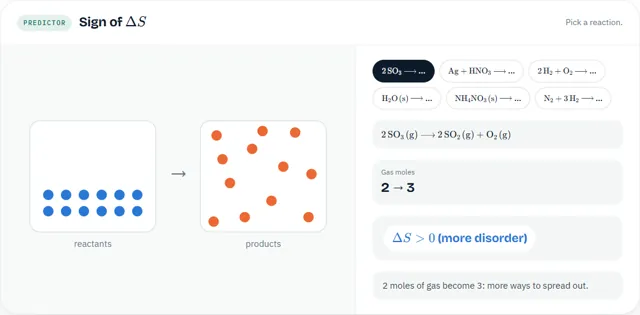
More ways to arrange the particles and their energy means higher entropy. To predict the sign of , count moles of gas first. Gas beats everything else.
Units: . Divide by 1000 before combining with in kJ.
: 2 → 3 mol gas.
A solid spreads out into ions.
: 4 → 2 mol gas.
Faster particles, more energy states.
Sign of
Study notes
Key concepts
Absolute (standard molar) entropy, S°. Because of the third law (S = 0 for a perfect crystal at 0 K), we can measure the total entropy of one mole of a substance at standard conditions (1 bar or 1 atm, 1 M for solutions, usually 298 K). This is the standard molar entropy S°, in J/(mol·K). Note the unit is joules, not kilojoules. This matters in Topic 9.3.
Key facts about S° values:
- S° is always positive for a substance (it is an absolute amount, not a change).
- S° of an element in its standard state is not zero (for example S° of O₂(g) is about 205 J/(mol·K)). Do not confuse this with ΔH°f = 0 and ΔG°f = 0 for elements.
- For the same substance: S°(gas) ≫ S°(liquid) > S°(solid).
- For similar substances in the same phase, S° increases with molar mass and with molecular complexity (more atoms, more ways to vibrate and rotate). Example: S°(F₂, g) < S°(Cl₂, g); S°(CH₄, g) < S°(C₂H₆, g).
- Hard, strongly bonded solids such as diamond have very low S° (about 2.4 J/(mol·K)), while soft solids with weaker bonding have higher S°.
Entropy change of a reaction (ENE-4.B.1). ΔS° for a process is found from the absolute entropies of products and reactants, each multiplied by its coefficient in the balanced equation.
Units and "per mole of reaction". ΔS°rxn has units J/(molrxn·K), meaning per mole of the reaction as written. If you double the equation, ΔS° doubles; if you reverse it, ΔS° changes sign.
Check your answer against Topic 9.1. Always predict the sign first (gas-moles rule). If your calculation disagrees with the prediction, look for an arithmetic error or a missed coefficient.
Key equations
Worked examples
Example 9.2-A. Calculate ΔS° at 298 K for 2 SO₂(g) + O₂(g) → 2 SO₃(g).
| Substance | S° (J/(mol·K)) |
|---|---|
| SO₂(g) | 248.2 |
| O₂(g) | 205.1 |
| SO₃(g) | 256.8 |
Solution.
Check: 3 mol of gas become 2 mol of gas, so a negative value is expected. It agrees.
Example 9.2-B. Calculate ΔS° for the Haber process, N₂(g) + 3 H₂(g) → 2 NH₃(g). S° values in J/(mol·K): N₂(g) 191.6, H₂(g) 130.7, NH₃(g) 192.5.
Solution. ΔS° = 2(192.5) − [191.6 + 3(130.7)] = 385.0 − 583.7 = −198.7 J/(molrxn·K). Negative, as expected for 4 mol gas → 2 mol gas.
Example 9.2-C (working backwards). For CaCO₃(s) → CaO(s) + CO₂(g), ΔS° = +160.6 J/(molrxn·K). S° of CaO(s) is 39.8 and S° of CO₂(g) is 213.7 J/(mol·K). Find S° of CaCO₃(s).
Solution. 160.6 = (39.8 + 213.7) − S°(CaCO₃), so S°(CaCO₃) = 253.5 − 160.6 = 92.9 J/(mol·K).
Unit 9 study guide: exam-style free-response set, worksheet and answers.
Worked example
- Products: .
- Reactants: .
- ; negative, as expected for 4 mol gas becoming 2 mol gas.
- Answer:
Free-response practice
Write your answer first, then open the solution and mark yourself against it.
FRQ 9.2-1. Methane burns: CH₄(g) + 2 O₂(g) → CO₂(g) + 2 H₂O(l).
| Substance | S° (J/(mol·K)) |
|---|---|
| CH₄(g) | 186.3 |
| O₂(g) | 205.1 |
| CO₂(g) | 213.7 |
| H₂O(l) | 69.9 |
(a) Predict the sign of ΔS° before calculating. Justify your prediction.
(b) Calculate ΔS°, including units.
(c) If the water were produced as H₂O(g) (S° = 188.8 J/(mol·K)) instead of H₂O(l), would ΔS° be more positive, more negative or the same? Explain without a full calculation.
Show the solution
(a) Negative (1 point). 3 mol of gas on the left become 1 mol of gas on the right; the water is a liquid.
(b) ΔS° = [213.7 + 2(69.9)] − [186.3 + 2(205.1)] = 353.5 − 596.5 = −243.0 J/(molrxn·K) (1 point for set-up with coefficients, 1 point for answer with units).
(c) More positive (1 point). H₂O(g) has a much larger S° than H₂O(l), so the products' total entropy is larger. (In fact ΔS° = −5.2 J/(molrxn·K), because gas moles stay at 3 → 3.)
FRQ 9.2-2. A student measures that dissolving potassium chloride, KCl(s) → K⁺(aq) + Cl⁻(aq), has ΔS° = +75.0 J/(mol·K). S° of KCl(s) is 82.6 J/(mol·K) and S° of K⁺(aq) is 102.5 J/(mol·K).
(a) Calculate S° for Cl⁻(aq).
(b) Explain, at the particle level, why ΔS° is positive for this dissolution.
Show the solution
(a) 75.0 = (102.5 + S°Cl⁻) − 82.6, so S°(Cl⁻, aq) = 75.0 + 82.6 − 102.5 = 55.1 J/(mol·K).
(b) In the solid, K⁺ and Cl⁻ ions are held in fixed positions in a lattice. In solution, the ions separate and move freely throughout the whole volume of the solution, so the matter is far more dispersed. This outweighs the small amount of ordering of water molecules around the ions.
Common mistake
Students set of elements such as to zero, as with enthalpy of formation. Absolute entropies of elements are positive and must be included.
Frequently asked questions
?Why isn't the standard entropy of an element zero?
Absolute entropy is measured from a perfect crystal at 0 K; at 298 K every substance, including elements, has some dispersal of energy, so .
?What are the units of entropy?
for molar entropy and for an entropy change of a reaction as written.
Practice questions on 9.2
- Q1Which process has a positive entropy change for the system?
- Q2Which reaction has the most negative ?
- Q3Which statement is a correct form of the second law of thermodynamics?
- Q4For P₄(s) + 5 O₂(g) → P₄O₁₀(s), the standard molar entropies are P₄(s) 165, O₂(g) 205 and P₄O₁₀(s) 230 J/(mol·K). What is ΔS°?
- Q5Sulfur reacts with fluorine: S(s) + 3 F₂(g) → SF₆(g). S° values: S(s) 32, F₂(g) 203, SF₆(g) 292 J/(mol·K). What is ΔS°?
- Q6S° values: O₃(g) 239, O₂(g) 205, O(g) 161 J/(mol·K). Which process has the largest positive ΔS°?
- Q7Which substance has the greatest standard molar entropy at 298 K?
- Q8Which statement expresses the second law of thermodynamics?
- Q9Using values of 191.6, 130.7 and 192.5 J/(mol·K), what is for ?
- Q10Using values of 130.7, 205.2 and 69.9 J/(mol·K), what is for ?
- Q11Using values of 304, 240, 191.5 and 205 J/(mol·K), which reaction has the largest positive ?
- Q12What does a reaction with and do?
Terms used in this topic
Stuck on a unit? Let us fix it this week.
Book a 30-minute one-to-one session for $20. Bring a test, a homework set or the topic that is not clicking.
Book a session