 AP Chemistry Tutoring
9.3 Gibbs free energy and thermodynamic favorability
AP Chemistry Unit 9: Thermodynamics and Electrochemistry · 1 simulation · 22 practice questions
Updated · Aligned to the AP Chemistry Course and Exam Description
Gibbs free energy determines whether a process is thermodynamically favorable at constant temperature and pressure: . A process with is thermodynamically favorable, and one with is not. The signs of and decide whether favorability depends on temperature.
Gibbs free energy
One number decides: .
means thermodynamically favorable. Temperature sets how much entropy counts.
in kelvin. in (divide J by 1000).
| favorable at all | |
| never favorable | |
| favorable at low | |
| favorable at high |
against temperature
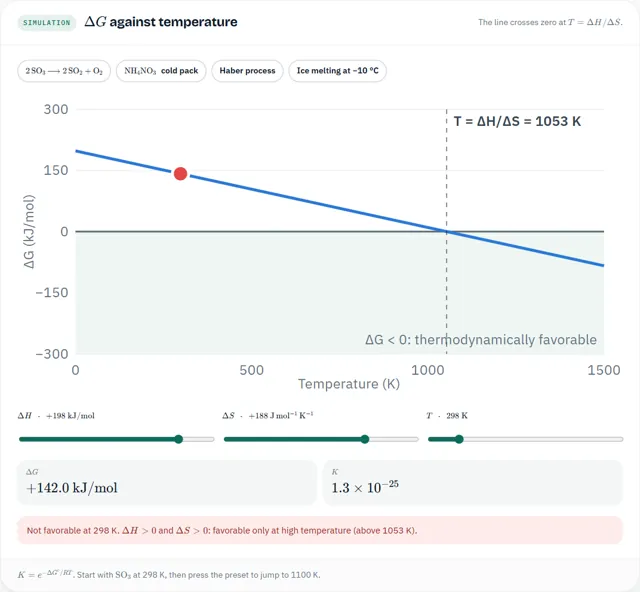
: , . Is it favorable at 25 °C? At what temperature does it become favorable?
- makes sense: 2 moles of gas become 3.
- At 298 K: . Not favorable.
- and : favorable only when outweighs .
has . Is it more favorable at 25 °C or at 95 °C?
- A gas () forms from no gas, so .
- and : the term is what makes negative.
- A larger makes more negative.
- More favorable at 95 °C.
Favorable ≠ fast.
has , yet diamonds last forever. The activation energy is enormous, so the reaction is under kinetic control: thermodynamics says it can happen, kinetics says not in your lifetime.
?A reaction has but no product forms after a week. Give one reason.Think, then tap to check
Study notes
Key concepts
Standard state and ΔG° (ENE-4.C.1). The Gibbs free energy change for a process in which every reactant and product is in its standard state is written ΔG° (said "delta G naught"). Standard state means: pure solids and liquids, solutions at 1.0 M, and gases at 1.0 atm (or 1.0 bar). The temperature is not part of the definition, but tables are almost always for 298 K.
ΔG° measures thermodynamic favorability (ENE-4.C.2). If ΔG° < 0, the process is thermodynamically favored: under standard conditions it can go forward without continuous outside help, and products are favored at equilibrium. Older books say "spontaneous". The AP exam prefers "thermodynamically favored", because "spontaneous" makes people think "fast" or "happens suddenly". Thermodynamics says nothing about speed (Topic 9.4). If ΔG° > 0, the process is thermodynamically unfavored; the reverse process is favored. If ΔG = 0, the system is at equilibrium.
ΔG° from free energies of formation (ENE-4.C.3). This works exactly like Hess's law for ΔH°. ΔG°f of an element in its standard state is zero.
ΔG° from ΔH° and ΔS° (ENE-4.C.5). At a given Kelvin temperature, ΔG° = ΔH° − TΔS°. Watch units: ΔH° is usually in kJ/molrxn and ΔS° in J/(molrxn·K). Convert ΔS° to kJ (divide by 1000) before combining. T must be in kelvin.
Enthalpy and entropy as "driving forces" (ENE-4.C.4). A negative ΔH (energy released, products have stronger bonds or attractions) favors a process. A positive ΔS (more dispersal) also favors a process, through the −TΔS term. Sometimes you must consider both. The CED gives two classic examples:
- Freezing of water. ΔH < 0 (favorable), ΔS < 0 (unfavorable). Below 0 °C the enthalpy term wins and ice forms; above 0 °C the entropy term wins and ice melts.
- Dissolving sodium nitrate. ΔH > 0 (endothermic, the solution gets cold, unfavorable), ΔS > 0 (favorable). At room temperature the −TΔS term is larger, so dissolution is favored. It is driven by entropy.
Predicting favorability from signs (ENE-4.C.6). Assume ΔH° and ΔS° do not change much with temperature.
| ΔH° | ΔS° | ΔG° = ΔH° − TΔS° | Favored (ΔG° < 0) at | Driven by |
|---|---|---|---|---|
| − | + | always negative | all T | both enthalpy and entropy |
| + | − | always positive | no T | neither |
| + | + | negative only when TΔS° > ΔH° | high T | entropy |
| − | − | negative only when ΔH° is larger in size than TΔS° | low T | enthalpy |
When ΔH° < 0 and ΔS° > 0, no calculation is needed: the process is favored. When ΔH° > 0 and ΔS° < 0, it is never favored.
The crossover temperature. For the two "it depends" rows, the switch from favored to unfavored happens where ΔG° = 0, that is at T = ΔH°/ΔS°. This is also the temperature at which K = 1 (Topic 9.5), and for a phase change it is the melting or boiling point.
How to answer "what drives the reaction?" on the exam. This is a common FRQ prompt, and the CED warns that students often say "both" automatically. Use the signs.
- ΔH < 0 and ΔS < 0, and the reaction is favored: driven by enthalpy only (the entropy change works against it).
- ΔH > 0 and ΔS > 0, and the reaction is favored: driven by entropy only (the enthalpy change works against it).
- ΔH < 0 and ΔS > 0: driven by both.
Macroscopic clues: a container that gets cold means ΔH > 0; a container that gets hot means ΔH < 0; gas bubbles or a solid dissolving usually mean ΔS > 0.
Key equations
Worked examples
Example 9.3-A (ΔG° from ΔG°f). Calculate ΔG° at 298 K for CaCO₃(s) → CaO(s) + CO₂(g). ΔG°f values (kJ/mol): CaCO₃(s) −1128.8, CaO(s) −604.0, CO₂(g) −394.4.
Solution. ΔG° = [(−604.0) + (−394.4)] − (−1128.8) = −998.4 + 1128.8 = +130.4 kJ/molrxn. Positive, so limestone does not decompose at 298 K under standard conditions.
Example 9.3-B (ΔG° from ΔH° and ΔS°, and the crossover temperature). For the same reaction ΔH° = +178.3 kJ/molrxn and ΔS° = +160.6 J/(molrxn·K).
(a) Confirm ΔG° at 298 K.
(b) Above what temperature is the decomposition thermodynamically favored?
Solution.
(a) Convert ΔS° to kJ: 0.1606 kJ/(molrxn·K).
This matches Example 9.3-A.
(b) ΔH° > 0 and ΔS° > 0, so the reaction is favored at high T. Set ΔG° = 0:
Above about 1110 K (about 840 °C), ΔG° < 0. This is why lime kilns run very hot. The reaction is entropy-driven (a gas is produced).
Example 9.3-C (which factor drives it?). For NaNO₃(s) → Na⁺(aq) + NO₃⁻(aq), ΔH° = +22.8 kJ/molrxn and ΔS° = +88.9 J/(molrxn·K). Calculate ΔG° at 298 K and state what drives the dissolution.
Solution. ΔG° = 22.8 − (298)(0.0889) = 22.8 − 26.5 = −3.7 kJ/molrxn, so dissolution is favored. ΔH° > 0 opposes it, so it is driven by entropy only: the −TΔS° term (−26.5 kJ) is larger in size than ΔH° (+22.8 kJ).
Example 9.3-D (freezing of water). For H₂O(l) → H₂O(s), ΔH = −6.01 kJ/mol and ΔS = −22.0 J/(mol·K). Find ΔG at 263 K and at 283 K.
Solution. At 263 K: ΔG = −6010 − (263)(−22.0) = −6010 + 5786 = −224 J/mol, so freezing is favored. At 283 K: ΔG = −6010 + 6226 = +216 J/mol, so freezing is not favored (ice melts). The crossover is T = 6010/22.0 = 273 K, the normal freezing point.
Unit 9 study guide: exam-style free-response set, worksheet and answers.
Worked example
- Convert: .
- .
- , so the reaction is favorable at 298 K.
- Answer: ; thermodynamically favorable
Free-response practice
Write your answer first, then open the solution and mark yourself against it.
FRQ 9.3-1. When solid barium hydroxide octahydrate is mixed with solid ammonium chloride in a flask, the mixture becomes a slushy liquid, smells of ammonia, and the flask becomes so cold that water vapour freezes on the outside.
Ba(OH)₂·8H₂O(s) + 2 NH₄Cl(s) → BaCl₂(aq) + 2 NH₃(g) + 10 H₂O(l)
(a) What is the sign of ΔH for the reaction? Justify using the observations.
(b) What is the sign of ΔS for the reaction? Justify.
(c) The reaction occurs readily at room temperature. Is it driven by enthalpy only, entropy only, or both? Justify in terms of ΔG.
Show the solution
(a) ΔH > 0 (1 point). The flask gets cold, so the reacting system absorbs thermal energy from the surroundings: the reaction is endothermic.
(b) ΔS > 0 (1 point). Two solids become a gas (2 mol NH₃), a liquid and dissolved ions, all far more dispersed than the solid reactants.
(c) Entropy only (1 point). The reaction occurs, so ΔG < 0. Since ΔH > 0 makes a positive contribution to ΔG = ΔH − TΔS, the only way ΔG can be negative is that −TΔS is negative and larger in size than ΔH. So the entropy increase drives the reaction (1 point).
FRQ 9.3-2. Consider 2 NO₂(g) ⇌ N₂O₄(g).
| Substance | ΔH°f (kJ/mol) | S° (J/(mol·K)) | ΔG°f (kJ/mol) |
|---|---|---|---|
| NO₂(g) | 33.2 | 240.1 | 51.3 |
| N₂O₄(g) | 9.2 | 304.4 | 97.8 |
(a) Calculate ΔH° and ΔS° for the reaction.
(b) Calculate ΔG° at 298 K using your answers to (a). Check it using the ΔG°f values.
(c) Is the formation of N₂O₄ favored at 350 K under standard conditions? Justify with a calculation.
(d) Explain in words why raising the temperature makes the formation of N₂O₄ less favorable.
Show the solution
(a) ΔH° = 9.2 − 2(33.2) = −57.2 kJ/molrxn. ΔS° = 304.4 − 2(240.1) = −175.8 J/(molrxn·K).
(b) ΔG° = −57.2 − (298)(−0.1758) = −57.2 + 52.4 = −4.8 kJ/molrxn. Check: ΔG° = 97.8 − 2(51.3) = −4.8 kJ/molrxn. They agree.
(c) ΔG° = −57.2 − (350)(−0.1758) = −57.2 + 61.5 = +4.3 kJ/molrxn. Positive, so not favored at 350 K.
(d) ΔS° is negative (2 mol gas → 1 mol gas), so the −TΔS° term is positive. As T rises, this unfavorable term becomes larger while ΔH° stays about the same, so ΔG° becomes less negative and then positive.
Common mistake
Students combine in kJ with in J/K without converting, giving a wildly wrong . Convert to kJ/K (divide by 1000) before using .
Frequently asked questions
?Is delta G negative for spontaneous reactions?
Yes. A negative means the process is thermodynamically favorable (the AP course uses favorable rather than spontaneous). It says nothing about how fast the reaction occurs.
?Above what temperature does the ammonia synthesis become unfavorable?
Both and are negative, so it is favorable only below under standard conditions.
?When is a reaction favorable at all temperatures?
When and : both terms make negative.
Practice questions on 9.3
- Q1A reaction has and . At which temperatures is it thermodynamically favorable?
- Q2A process has a positive and a positive . When is it thermodynamically favorable?
- Q3What is at 298 K for a reaction with and ?
- Q4For , and . Above about what temperature is the reaction thermodynamically favorable?
- Q5 has . Compared with 25 °C, the reaction at 95 °C is
- Q6Potassium reacts with water: 2 K(s) + 2 H₂O(l) → 2 KOH(aq) + H₂(g). ΔH° = −393 kJ/mol_rxn and ΔS° is positive. Which statement is correct?
- Q7A process has ΔH° = +150. kJ/mol_rxn. At 30 °C the process is at equilibrium under standard conditions (ΔG° = 0). What is ΔS°?
- Q8Solid ammonium nitrate dissolves readily in water at 25 °C, and the beaker feels cold. Which set of signs is correct for the dissolution?
- Q9A reaction has ΔH° < 0 and ΔS° < 0. At 25 °C, ΔG° = 0. How can the reaction be made thermodynamically favored?
- Q10A reversible reaction has ΔH° = +653 kJ/mol_rxn and ΔS° = +1.70 kJ/(mol_rxn·K). Above what temperature is the forward reaction thermodynamically favored?
- Q11Which statement best describes a process with ΔG° < 0?
- Q12For 2 NO₂(g) → N₂O₄(g), ΔH° = −57.2 kJ/mol_rxn and ΔS° = −175.8 J/(mol_rxn·K). Which is true?
- Q13A reaction has kJ and J/K. When is it thermodynamically favorable?
- Q14At 27 °C, a reaction has kJ and . What is ?
- Q15A reaction has . What can be concluded about its rate?
- Q16A strongly exothermic reaction has a small and is favorable at room temperature. What drives it?
- Q17 dissolves spontaneously in water, and the solution cools. Which is true?
- Q18What defines a thermodynamically favorable process?
- Q19At 298 K, a reaction has kJ and J/K. Which describes it?
- Q20A reaction with and has at 400 K. How can it be made favorable?
- Q21A reaction has a large negative but is extremely slow. What is the most likely reason?
- Q22For , kJ and J/K. Above what temperature is it favorable?
Stuck on a unit? Let us fix it this week.
Book a 30-minute one-to-one session for $20. Bring a test, a homework set or the topic that is not clicking.
Book a session