 AP Chemistry Tutoring
9.4 Thermodynamic and kinetic control
AP Chemistry Unit 9: Thermodynamics and Electrochemistry · 1 simulation · 10 practice questions
Updated · Aligned to the AP Chemistry Course and Exam Description
A thermodynamically favorable reaction () may still occur too slowly to observe if its activation energy is high; such a reaction is under kinetic control. Thermodynamics tells whether products are favored, while kinetics tells how fast they form. For example, has , but diamond does not noticeably change because the activation energy is very large.
Gibbs free energy
One number decides: .
means thermodynamically favorable. Temperature sets how much entropy counts.
in kelvin. in (divide J by 1000).
| favorable at all | |
| never favorable | |
| favorable at low | |
| favorable at high |
against temperature
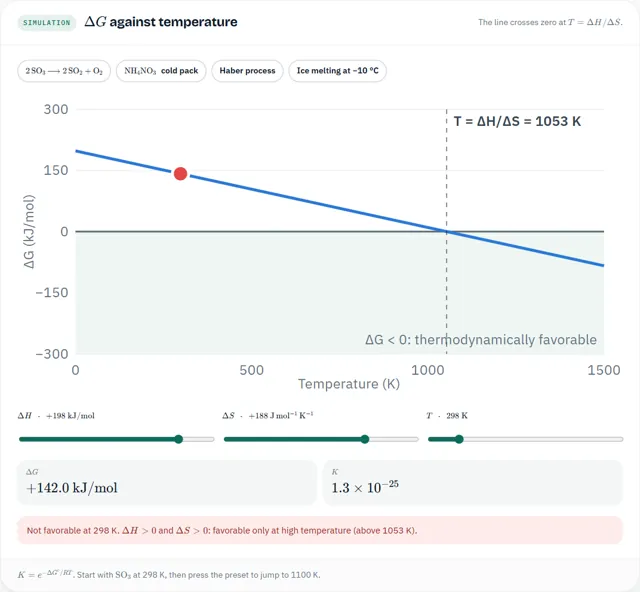
: , . Is it favorable at 25 °C? At what temperature does it become favorable?
- makes sense: 2 moles of gas become 3.
- At 298 K: . Not favorable.
- and : favorable only when outweighs .
has . Is it more favorable at 25 °C or at 95 °C?
- A gas () forms from no gas, so .
- and : the term is what makes negative.
- A larger makes more negative.
- More favorable at 95 °C.
Favorable ≠ fast.
has , yet diamonds last forever. The activation energy is enormous, so the reaction is under kinetic control: thermodynamics says it can happen, kinetics says not in your lifetime.
?A reaction has but no product forms after a week. Give one reason.Think, then tap to check
Study notes
Key concepts
Two different questions. Thermodynamics asks whether a process is favored, by comparing the starting state with the final state (ΔG°). Kinetics asks how fast it happens, which depends on the pathway, especially the activation energy (Ea) from Unit 5. These are independent. A reaction can be strongly favored and still be far too slow to notice.
Favored but not observed (ENE-4.D.1). Many thermodynamically favored processes do not occur to any measurable extent at room temperature. Familiar examples:
- Diamond turning into graphite (ΔG° < 0 at 298 K, but it takes geological times).
- Methane or paper burning in air (very favored, but nothing happens until a spark or flame supplies energy).
- Sugar reacting with oxygen in a sugar bowl.
- A mixture of H₂ and O₂ gas, which is stable for years until ignited.
Kinetic control (ENE-4.D.2). A process that is thermodynamically favored but does not proceed at a measurable rate is said to be under kinetic control. The usual reason is a high activation energy: at room temperature, too few collisions have enough energy (and the right orientation) to get over the barrier. On a Maxwell–Boltzmann curve, only a tiny fraction of molecules lie beyond Ea.
Not at equilibrium. A mixture that is not reacting is not necessarily at equilibrium. For example, a CH₄/O₂ mixture at room temperature is very far from equilibrium (K is enormous), it is simply stuck behind a high barrier. If you know a process is favored but it does not occur, conclude kinetic control, not equilibrium.
How to "unlock" a kinetically controlled reaction.
| Method | Effect on rate | Effect on ΔG° and K |
|---|---|---|
| Raise temperature | More collisions have energy ≥ Ea, so rate rises sharply | ΔG° changes only through −TΔS°; K changes |
| Add a catalyst | Provides a new pathway with lower Ea | None. ΔG°, ΔH°, ΔS° and K are unchanged |
| Spark or flame | Supplies activation energy to start a self-sustaining exothermic reaction | None |
A catalyst speeds up the forward and reverse reactions equally. It cannot make an unfavored reaction favored.
The reverse case. A thermodynamically unfavored reaction (ΔG° > 0, K < 1) can still produce a large amount of product if it is driven, for example by continuously removing a product (Q stays below K) or by coupling (Topic 9.6) or by an electric current (Topics 9.7 and 9.10).
Worked examples
Example 9.4-A. At 25 °C, the reaction CS₂(g) + 3 Cl₂(g) → CCl₄(g) + S₂Cl₂(g) is thermodynamically favored, but no product forms. At 120 °C the reaction proceeds at an observable rate. Explain both observations.
Solution. At 25 °C the activation energy is high compared with the energies of the colliding molecules, so almost no collisions are successful. The reaction is under kinetic control. At 120 °C the molecules have a higher average kinetic energy, and the distribution of kinetic energies shifts to higher values, so a much larger fraction of collisions have energy equal to or greater than Ea. Collisions also happen more often. So the rate becomes observable. The value of ΔG° tells us the reaction is favored at both temperatures, but it cannot tell us the rate.
Example 9.4-B. For C(s, diamond) → C(s, graphite), ΔG° = −2.9 kJ/molrxn at 298 K. Why do diamonds last for millions of years?
Solution. The conversion is favored, but it requires breaking strong C–C covalent bonds throughout a 3-D network solid, so the activation energy is enormous. The rate at 298 K is effectively zero. Diamond is kinetically stable but thermodynamically unstable relative to graphite.
Unit 9 study guide: exam-style free-response set, worksheet and answers.
Worked example
- The negative shows that forming water is thermodynamically favorable.
- Breaking the strong H-H and O=O bonds requires a large activation energy, so at room temperature very few collisions are energetic enough.
- A spark supplies the energy to start the reaction, which then proceeds rapidly.
- Answer: The reaction is under kinetic control: favorable but very slow because of its high activation energy.
Free-response practice
Write your answer first, then open the solution and mark yourself against it.
FRQ 9.4-1. Hydrogen peroxide decomposes: 2 H₂O₂(aq) → 2 H₂O(l) + O₂(g), ΔG° = −206 kJ/molrxn at 298 K. A bottle of 3% H₂O₂ solution can sit on a shelf for months with very little decomposition. When a small amount of solid MnO₂ is added, bubbles form immediately.
(a) Is the decomposition thermodynamically favored at 298 K? Justify.
(b) Explain why the bottle of H₂O₂ is stable on the shelf.
(c) Explain the role of MnO₂. State the effect of MnO₂ on ΔG° for the reaction.
Show the solution
(a) Yes (1 point). ΔG° < 0.
(b) The reaction is under kinetic control (1 point). Its activation energy is high, so at room temperature very few H₂O₂ molecules have enough energy to react, and the rate is extremely slow even though the reaction is favored.
(c) MnO₂ is a catalyst. It provides a reaction pathway with a lower activation energy, so many more collisions are successful and the rate increases (1 point). ΔG° is unchanged, because it depends only on the reactants and products, not on the pathway (1 point).
Common mistake
Students think a negative means a reaction happens quickly. predicts direction, not speed; the rate depends on the activation energy.
Frequently asked questions
?Why doesn't diamond turn into graphite?
The conversion is thermodynamically favorable, but the activation energy is so large that the rate at room conditions is negligible.
?Can a catalyst make an unfavorable reaction happen?
No. A catalyst lowers activation energy and speeds up a reaction, but it does not change or .
Practice questions on 9.4
- Q1The conversion of diamond to graphite is thermodynamically favorable at room temperature, yet diamonds do not visibly change. Why?
- Q2A reaction has ΔH° = −160 kJ/mol_rxn and ΔS° = +600 J/(mol_rxn·K). What can be concluded about the reaction at 200 K?
- Q3Natural gas (CH₄) leaks into a room full of air. The combustion of methane is strongly thermodynamically favored, yet no reaction occurs until a light switch sparks. Which best explains this?
- Q4Which statement about a catalyst added to a thermodynamically favored reaction is correct?
- Q5A sealed flask contains a mixture of H₂(g) and O₂(g) at 25 °C. After a year, no water has formed, although ΔG° for 2 H₂(g) + O₂(g) → 2 H₂O(l) is −474 kJ/mol_rxn. Which statement is correct?
- Q6What does "thermodynamically favorable" mean?
- Q7How can a reaction with be made to produce significant product?
- Q8Some favorable reactions are not observed at room temperature. Why?
- Q9Paper burns spontaneously once lit but does not ignite on its own at room temperature. Why?
- Q10Diamond converting to graphite has , yet diamonds last indefinitely. This is an example of:
Terms used in this topic
Stuck on a unit? Let us fix it this week.
Book a 30-minute one-to-one session for $20. Bring a test, a homework set or the topic that is not clicking.
Book a session