 AP Chemistry Tutoring
9.7 Galvanic (voltaic) and electrolytic cells
AP Chemistry Unit 9: Thermodynamics and Electrochemistry · 1 simulation · 18 practice questions
Updated · Aligned to the AP Chemistry Course and Exam Description
A galvanic (voltaic) cell uses a thermodynamically favorable redox reaction to produce electrical energy, while an electrolytic cell uses an external power source to drive an unfavorable one. In both, oxidation occurs at the anode and reduction at the cathode; electrons flow through the wire from anode to cathode and the salt bridge maintains charge balance. The standard cell potential is .
Galvanic & electrolytic cells
An Ox, Red Cat.
Anode = oxidation. Reduction = cathode. True in every cell.
Electrons flow through the wire from anode to cathode. The salt bridge keeps both beakers neutral: anions drift to the anode, cations to the cathode.
Spontaneous. Makes electricity. Anode is (−).
A battery forces it. Anode is (+).
It wins the electrons.
; = moles of electrons transferred.
Build a cell
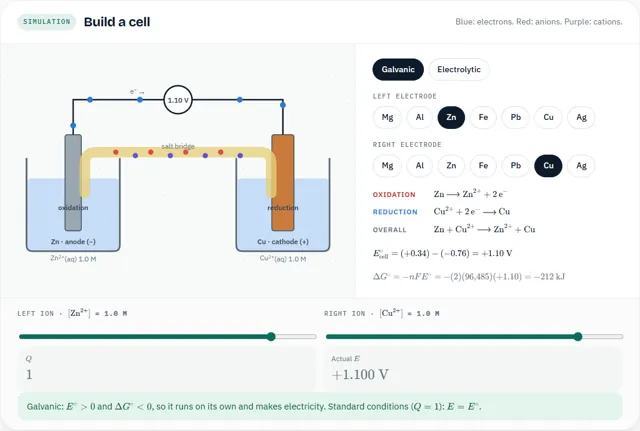
A cell is built from () and (). Find the overall reaction, and .
- has the higher , so silver is the cathode. Copper is oxidized at the anode.
- Reverse the copper half: (). Double the silver half for 2 electrons: (; is not doubled).
- Add: . .
- : favorable.
?In the / cell, which way do the electrons flow, and which electrode gains mass?Think, then tap to check
Electrons flow through the wire. is reduced to metal at the cathode, so the copper electrode gains mass and the zinc electrode loses mass.
Study notes
Key concepts
Two kinds of electrochemical cell (ENE-6.A.2). A redox reaction transfers electrons. In an electrochemical cell, the oxidation and reduction half-reactions happen in separate places, and the electrons are forced to travel through an external wire.
| Feature | Galvanic (voltaic) cell | Electrolytic cell |
|---|---|---|
| Reaction | Thermodynamically favored (ΔG° < 0, E°cell > 0) | Thermodynamically unfavored (ΔG° > 0, E°cell < 0) |
| Energy | Chemical energy → electrical energy | Electrical energy → chemical energy |
| Needs | A load (bulb, motor, voltmeter) | An external power supply (battery, DC source) |
| Anode | Oxidation | Oxidation |
| Cathode | Reduction | Reduction |
| Electrons in the wire | Flow from anode to cathode on their own | Pushed from anode to cathode by the power supply |
| Examples | Batteries in use, Zn/Cu Daniell cell, fuel cells | Electroplating, making Al, Na or Cl₂, charging a battery |
Anode and cathode (ENE-6.A.3). In every electrochemical cell, oxidation happens at the anode and reduction happens at the cathode. Memory aids: "An Ox and a Red Cat", or "LEO the lion says GER". The AP exam will not ask you to label electrodes as positive or negative, because the sign convention differs between galvanic and electrolytic cells.
What each component does (ENE-6.A.1). Questions often describe a cell in words, since you cannot see a diagram. A standard Zn/Cu galvanic cell: a Zn strip in 1.0 M Zn(NO₃)₂ in one beaker, a Cu strip in 1.0 M Cu(NO₃)₂ in another beaker, a wire joining the strips through a voltmeter, and a U-tube salt bridge of KNO₃(aq) dipping into both beakers.
| Component | Role |
|---|---|
| Anode (Zn strip) | Zn atoms lose electrons: Zn(s) → Zn²⁺(aq) + 2 e⁻. The strip loses mass. |
| Cathode (Cu strip) | Cu²⁺ ions gain electrons from the strip: Cu²⁺(aq) + 2 e⁻ → Cu(s). The strip gains mass; the blue colour of the solution fades. |
| Wire | Carries electrons from anode to cathode. Electrons never travel through the solution. |
| Salt bridge | Lets ions move between the half-cells so that each stays electrically neutral, and completes the circuit. Anions (NO₃⁻) move toward the anode compartment, where positive Zn²⁺ ions are building up. Cations (K⁺) move toward the cathode compartment, where Cu²⁺ ions are being removed. Without it, charge builds up immediately and the current stops (the measured voltage is zero). |
| Voltmeter | Measures the cell potential (driving force). A high-resistance voltmeter draws almost no current. |
| Solutions | Supply the ions taking part in each half-reaction. |
The salt bridge electrolyte must be inert: its ions must not react with the electrodes or precipitate with ions in either half-cell. For example, KCl would be a poor choice in a Ag⁺ half-cell because AgCl(s) would precipitate.
Inert electrodes and gases. When a half-reaction has no solid metal (for example Fe³⁺/Fe²⁺, or 2 H⁺/H₂), an inert electrode such as platinum or graphite carries the electrons. Its mass does not change. A gas may be produced at an electrode (bubbles of H₂ at a cathode, or O₂ or Cl₂ at an anode).
Electrolytic cells in more detail. The external power supply pulls electrons out of the anode (forcing oxidation) and pushes them into the cathode (forcing reduction). The applied voltage must be greater than the size of the (negative) cell potential.
- Molten salts. In molten NaCl (no water), Na⁺ is reduced at the cathode (Na(l) forms) and Cl⁻ is oxidized at the anode (Cl₂(g) forms). The salt must be molten, because ions in a solid lattice cannot move to the electrodes and the solid does not conduct.
- Aqueous solutions. Water can also be oxidized or reduced, and it competes with the ions. At the cathode, water (2 H₂O + 2 e⁻ → H₂ + 2 OH⁻, E° = −0.83 V) is reduced instead of very active metal ions such as Na⁺ or K⁺ (E° ≈ −2.7 to −2.9 V). The species with the more positive reduction potential is reduced first. At the anode, the species that is easiest to oxidize reacts first; I⁻ and Br⁻ are oxidized before water, and in practice Cl⁻ usually is too. So electrolysis of aqueous NaCl gives H₂ and Cl₂, not Na.
- Electroplating. The object to be plated is the cathode, in a solution of the plating metal's ions. A bar of the plating metal is often the anode; it dissolves and replaces the ions that plate out, so E°cell ≈ 0 but the external supply still has to drive the current.
Cell notation (useful shorthand). Zn(s) | Zn²⁺(aq) || Cu²⁺(aq) | Cu(s). Anode on the left, cathode on the right; a single line is a phase boundary, a double line is the salt bridge.
Particle-level descriptions (skill 6.E). Be ready to describe what particles do: at the anode, metal atoms on the surface lose electrons and enter the solution as hydrated ions; at the cathode, hydrated metal ions in solution collide with the electrode, gain electrons and are deposited as atoms; in the salt bridge, K⁺ and NO₃⁻ ions drift in opposite directions; electrons move only through the metal wire.
Modifying the experiment (skill 2.F).
| Change | Effect |
|---|---|
| Remove the salt bridge | Circuit is broken; current stops; voltage reads 0. |
| Use larger electrodes or larger volumes of solution | E°cell unchanged (it is intensive); the cell can deliver current for a longer time. |
| Replace a metal with a more active metal at the anode | E°cell increases. |
| Replace KNO₃ in the bridge with an electrolyte that precipitates with a half-cell ion | Ions removed; the cell may stop working properly. |
| Change concentrations | E changes (Topic 9.9). |
Worked examples
Example 9.7-A. A galvanic cell is built from a Ni strip in 1.0 M Ni(NO₃)₂ and a Ag strip in 1.0 M AgNO₃, joined by a wire and a KNO₃ salt bridge. As the cell operates, the Ag strip gains mass.
(a) Identify the anode and cathode and write each half-reaction.
(b) Write the overall balanced equation.
(c) State the direction of electron flow and of each ion in the salt bridge.
(d) What happens to the mass of the Ni strip and to [Ag⁺]?
Solution.
(a) Ag gains mass, so Ag⁺ is being reduced to Ag: the Ag strip is the cathode, Ag⁺(aq) + e⁻ → Ag(s). The Ni strip is the anode: Ni(s) → Ni²⁺(aq) + 2 e⁻.
(b) Multiply the silver half-reaction by 2 so electrons cancel: Ni(s) + 2 Ag⁺(aq) → Ni²⁺(aq) + 2 Ag(s).
(c) Electrons flow through the wire from the Ni strip to the Ag strip. In the salt bridge, NO₃⁻ ions move toward the Ni half-cell (balancing the new Ni²⁺) and K⁺ ions move toward the Ag half-cell (replacing the Ag⁺ that is removed).
(d) The Ni strip loses mass, because Ni atoms become Ni²⁺ ions in solution. [Ag⁺] decreases.
Example 9.7-B (electrolytic cell). An aqueous solution of KI is electrolysed using two graphite electrodes. Use E° values: K⁺/K −2.92 V, H₂O/H₂ (2 H₂O + 2 e⁻ → H₂ + 2 OH⁻) −0.83 V, I₂/I⁻ +0.53 V, O₂/H₂O +1.23 V. Predict the products at each electrode and the minimum voltage needed under standard conditions.
Solution. Cathode (reduction): the candidates are K⁺ (−2.92 V) and H₂O (−0.83 V). Water has the more positive reduction potential, so H₂(g) and OH⁻ form. Anode (oxidation): the candidates are I⁻ (oxidation potential −0.53 V) and H₂O (oxidation potential −1.23 V). I⁻ is easier to oxidize, so I₂ forms (the solution near the anode turns yellow-brown). Overall: 2 H₂O(l) + 2 I⁻(aq) → H₂(g) + 2 OH⁻(aq) + I₂(aq). E°cell = E°cathode − E°anode = (−0.83) − (+0.53) = −1.36 V. The process is unfavored, so at least 1.36 V must be applied (more in practice).
Unit 9 study guide: exam-style free-response set, worksheet and answers.
Worked example
- has the higher reduction potential, so it is reduced: Cu is the cathode; Zn is oxidized at the anode.
- .
- Electrons flow from Zn to Cu through the wire; the Zn electrode loses mass and the Cu electrode gains mass.
- Answer: Anode Zn, cathode Cu,
Free-response practice
Write your answer first, then open the solution and mark yourself against it.
FRQ 9.7-1. A student builds a galvanic cell from a Pb strip in 1.0 M Pb(NO₃)₂ and a Ag strip in 1.0 M AgNO₃. The two strips are connected through a voltmeter, and a salt bridge connects the solutions. E°(Ag⁺/Ag) = +0.80 V and E°(Pb²⁺/Pb) = −0.13 V.
(a) Identify the anode. Justify your choice.
(b) Describe what happens at the particle level at the surface of the cathode.
(c) The student has two salt-bridge solutions available, KNO₃(aq) and KCl(aq). Which should be used? Explain.
(d) The student replaces the Pb strip with a Pb strip of twice the surface area. Does the measured cell potential increase, decrease or stay the same? Explain.
Show the solution
(a) The Pb strip is the anode (1 point). Ag⁺/Ag has the more positive reduction potential, so Ag⁺ is reduced and Pb is oxidized; oxidation occurs at the anode.
(b) Hydrated Ag⁺ ions in the solution collide with the Ag strip, each gains one electron that has travelled through the wire, and becomes a Ag atom deposited on the strip (1 point).
(c) KNO₃ (1 point). Cl⁻ ions from KCl would enter the Ag half-cell and precipitate Ag⁺ as AgCl(s) (and also form PbCl₂, which is only slightly soluble), changing the ion concentrations and interfering with the cell.
(d) Stays the same (1 point). Cell potential depends on the identity of the half-reactions and the concentrations, not on the amount or surface area of electrode. (A larger electrode can let the cell run longer.)
FRQ 9.7-2. A spoon is to be silver-plated. The available equipment includes a DC power supply, a bar of pure silver, the spoon, and a solution of AgNO₃(aq).
(a) Describe how to set up the electrolytic cell: which object is the anode, which is the cathode, and which terminal of the supply the spoon is connected to so that electrons flow into it.
(b) Write the half-reaction at each electrode.
(c) Explain why the concentration of Ag⁺ in the solution stays nearly constant during plating.
(d) Explain why an external power supply is needed even though E°cell for this setup is about zero.
Show the solution
(a) The spoon is the cathode, connected so that the power supply pushes electrons into it (the negative terminal). The silver bar is the anode. Both dip into the AgNO₃ solution.
(b) Cathode (spoon): Ag⁺(aq) + e⁻ → Ag(s). Anode (bar): Ag(s) → Ag⁺(aq) + e⁻.
(c) For every Ag⁺ ion reduced onto the spoon, one Ag atom from the bar is oxidized into solution, so the number of Ag⁺ ions in solution stays the same.
(d) With identical half-reactions, there is no net chemical driving force (E°cell = 0, ΔG° = 0), so electrons will not flow from one silver piece to the other on their own. The supply provides the energy to move silver in a chosen direction, and to overcome the resistance of the solution and the extra energy needed at the electrodes.
Common mistake
Students multiply a reduction potential by the coefficient when balancing the half-reactions. is an intensive property (energy per charge), so it is never multiplied by stoichiometric coefficients.
Frequently asked questions
?Which electrode is the anode in a galvanic cell?
The anode is where oxidation occurs; in a galvanic cell it is the electrode with the lower (more negative) reduction potential.
?What does the salt bridge do?
It allows ions to flow between the half-cells so that the solutions stay electrically neutral; without it the current stops.
Practice questions on 9.7
- Q1In which direction do electrons flow in a galvanic cell?
- Q2At which electrode does oxidation occur?
- Q3What is the role of the salt bridge in a galvanic cell?
- Q4A galvanic cell has a Zn strip in 1.0 M Zn²⁺(aq) and a Cu strip in 1.0 M Cu²⁺(aq). During operation the Zn strip loses mass and the Cu strip gains mass. Which equation represents the cell reaction?
- Q5A galvanic cell has a Zn strip in 1.0 M Zn²⁺(aq) and a Cu strip in 1.0 M Cu²⁺(aq), joined by a salt bridge containing KNO₃(aq). Which describes the movement of K⁺ ions?
- Q6A galvanic cell has a Zn strip in 1.0 M Zn²⁺(aq) and a Cu strip in 1.0 M Cu²⁺(aq). As the cell operates, what happens to the concentrations of the ions?
- Q7A cell is built with a Zn electrode in 1.0 M Zn(NO₃)₂ and an Al electrode in 1.0 M Al(NO₃)₃, joined by a NaNO₃ salt bridge. E°(Al³⁺/Al) = −1.66 V and E°(Zn²⁺/Zn) = −0.76 V. Which statement is correct when the cell operates as a galvanic cell?
- Q8A student builds a galvanic cell from a Zn strip in 1.0 M Zn²⁺(aq) and a Cu strip in 1.0 M Cu²⁺(aq) (E° = 1.10 V) but forgets the salt bridge. What does the voltmeter read?
- Q9Which statement about the electrolysis of aqueous NaCl is correct?
- Q10Molten MgCl₂ is electrolysed with inert electrodes. What forms at the cathode?
- Q11A cell uses ( V) and ( V). What is for the spontaneous reaction?
- Q12A galvanic cell uses ( V) and ( V). What is ?
- Q13A galvanic cell uses ( V) and ( V). What is the overall cell reaction?
- Q14In a galvanic cell, where do the anions in the salt bridge move?
- Q15A galvanic cell runs on . What happens to over time?
- Q16A cell uses /Mg (−2.37 V) and /Pb (−0.13 V). What is the sign of for the spontaneous cell reaction?
- Q17What is the sign of for the electrolysis of molten NaCl?
- Q18A galvanic cell has Mg in and Pb in . Which electrode gains mass?
Stuck on a unit? Let us fix it this week.
Book a 30-minute one-to-one session for $20. Bring a test, a homework set or the topic that is not clicking.
Book a session