 AP Chemistry Tutoring
9.8 Cell potential and free energy
AP Chemistry Unit 9: Thermodynamics and Electrochemistry · 1 simulation · 20 practice questions
Updated · Aligned to the AP Chemistry Course and Exam Description
The cell potential of a redox reaction is directly related to its free energy change by , where is the moles of electrons transferred and . A positive gives a negative (thermodynamically favorable, ), and a negative gives a positive . Since , the result comes out in joules.
Galvanic & electrolytic cells
An Ox, Red Cat.
Anode = oxidation. Reduction = cathode. True in every cell.
Electrons flow through the wire from anode to cathode. The salt bridge keeps both beakers neutral: anions drift to the anode, cations to the cathode.
Spontaneous. Makes electricity. Anode is (−).
A battery forces it. Anode is (+).
It wins the electrons.
; = moles of electrons transferred.
Build a cell
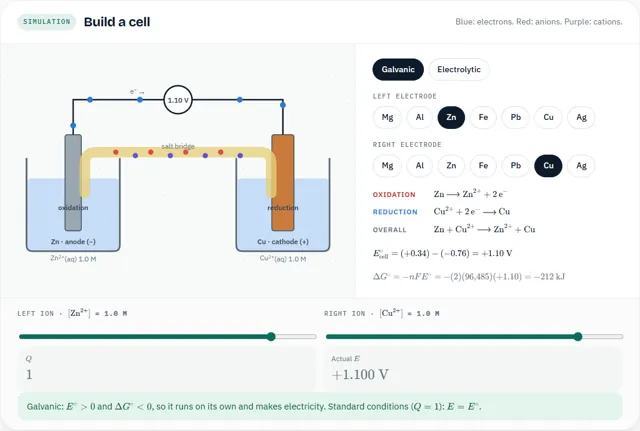
A cell is built from () and (). Find the overall reaction, and .
- has the higher , so silver is the cathode. Copper is oxidized at the anode.
- Reverse the copper half: (). Double the silver half for 2 electrons: (; is not doubled).
- Add: . .
- : favorable.
?In the / cell, which way do the electrons flow, and which electrode gains mass?Think, then tap to check
Electrons flow through the wire. is reduced to metal at the cathode, so the copper electrode gains mass and the zinc electrode loses mass.
Study notes
Key concepts
Positive voltage means favored (ENE-6.B.1). The cell potential, E (in volts, V = J/C), measures the driving force pushing electrons through the external circuit. A thermodynamically favored redox reaction gives a positive cell potential (a galvanic cell). An unfavored reaction gives a negative cell potential and needs an externally applied potential at least that large to proceed (an electrolytic cell).
Standard reduction potentials. Each half-reaction is listed as a reduction with its standard reduction potential, E°, measured against the standard hydrogen electrode (2 H⁺ + 2 e⁻ → H₂, E° = 0.00 V by definition) with all species in standard states (1 M, 1 atm, usually 298 K).
| Half-reaction | E° (V) |
|---|---|
| F₂(g) + 2 e⁻ → 2 F⁻ | +2.87 |
| Au³⁺ + 3 e⁻ → Au(s) | +1.50 |
| Cl₂(g) + 2 e⁻ → 2 Cl⁻ | +1.36 |
| O₂(g) + 4 H⁺ + 4 e⁻ → 2 H₂O(l) | +1.23 |
| Br₂(l) + 2 e⁻ → 2 Br⁻ | +1.07 |
| Ag⁺ + e⁻ → Ag(s) | +0.80 |
| Fe³⁺ + e⁻ → Fe²⁺ | +0.77 |
| I₂(s) + 2 e⁻ → 2 I⁻ | +0.53 |
| Cu²⁺ + 2 e⁻ → Cu(s) | +0.34 |
| 2 H⁺ + 2 e⁻ → H₂(g) | 0.00 |
| Pb²⁺ + 2 e⁻ → Pb(s) | −0.13 |
| Sn²⁺ + 2 e⁻ → Sn(s) | −0.14 |
| Ni²⁺ + 2 e⁻ → Ni(s) | −0.25 |
| Co²⁺ + 2 e⁻ → Co(s) | −0.28 |
| Fe²⁺ + 2 e⁻ → Fe(s) | −0.44 |
| Cr³⁺ + 3 e⁻ → Cr(s) | −0.74 |
| Zn²⁺ + 2 e⁻ → Zn(s) | −0.76 |
| 2 H₂O(l) + 2 e⁻ → H₂(g) + 2 OH⁻ | −0.83 |
| Al³⁺ + 3 e⁻ → Al(s) | −1.66 |
| Mg²⁺ + 2 e⁻ → Mg(s) | −2.37 |
| Na⁺ + e⁻ → Na(s) | −2.71 |
| K⁺ + e⁻ → K(s) | −2.92 |
| Li⁺ + e⁻ → Li(s) | −3.05 |
Reading the table: the higher (more positive) E°, the more easily the species on the left is reduced, so it is a stronger oxidizing agent (F₂ is the strongest here). The lower (more negative) E°, the more easily the species on the right is oxidized, so it is a stronger reducing agent (Li is the strongest here). A species on the left will react with a species on the right that sits below it in the table.
Calculating E°cell (ENE-6.B.2). Identify which half-reaction is the reduction (cathode) and which is the oxidation (anode). Then E°cell = E°(cathode) − E°(anode), using the reduction potentials exactly as listed. Equivalently, reverse the anode half-reaction, change the sign of its E°, and add.
For a galvanic cell made from two half-cells, the half-reaction with the more positive E° is the cathode, so E°cell is positive.
Do not multiply E° by coefficients. Cell potential is an intensive property (energy per coulomb of charge). Multiplying a half-reaction by 2 or 3 to balance electrons changes the number of electrons, but not the energy per electron, so E° stays the same. (Contrast with ΔG°, which is extensive.)
ΔG° = −nFE° (ENE-6.B.3). Free energy and cell potential are linked by
- n = moles of electrons transferred in the balanced overall equation (per mole of reaction),
- F = 96,485 C/mol e⁻ (charge on one mole of electrons),
- E° in volts (1 V = 1 J/C), so ΔG° comes out in J/molrxn.
Because of the minus sign, E° > 0 means ΔG° < 0 (favored), and E° < 0 means ΔG° > 0 (unfavored).
Finding n. Balance the half-reactions so that electrons lost = electrons gained. n is that common number. For 3 Ag⁺ + Cr → 3 Ag + Cr³⁺, each Cr loses 3 e⁻ and three Ag⁺ each gain 1 e⁻, so n = 3.
The three-way link.
| E°cell | ΔG° | K | Favorability under standard conditions |
|---|---|---|---|
| > 0 | < 0 | > 1 | Favored (galvanic) |
| = 0 | = 0 | = 1 | At equilibrium |
| < 0 | > 0 | < 1 | Unfavored (needs electrolysis) |
Combining ΔG° = −nFE° with ΔG° = −RT ln K gives ln K = nFE°/RT. A cell potential of only about 1 V gives an enormous K (for Zn/Cu, K ≈ 10³⁷), which is why redox reactions with clearly positive E° essentially go to completion.
Key equations
Worked examples
Example 9.8-A (Zn/Cu cell). Calculate E°cell and ΔG° for Zn(s) + Cu²⁺(aq) → Zn²⁺(aq) + Cu(s).
Solution. Cu²⁺ is reduced (cathode, +0.34 V); Zn is oxidized (anode, −0.76 V).
n = 2.
Example 9.8-B (silver/chromium cell, n = 3). Find E°, ΔG° and the order of magnitude of K at 298 K for 3 Ag⁺(aq) + Cr(s) → 3 Ag(s) + Cr³⁺(aq).
Solution. E° = 0.80 − (−0.74) = 1.54 V (not 3 × 0.80). n = 3. ΔG° = −(3)(96,485)(1.54) = −4.46 × 10⁵ J/molrxn = −446 kJ/molrxn. ln K = (3)(96,485)(1.54) ÷ [(8.314)(298)] = 180, so K ≈ e¹⁸⁰ ≈ 10⁷⁸.
Example 9.8-C (unknown half-cell potential). A cell is built from Ag⁺/Ag and Ni²⁺/Ni half-cells under standard conditions. The measured E°cell is +1.05 V, and Ag⁺ ions are reduced. Find E° for Ni²⁺ + 2 e⁻ → Ni.
Solution. Ag⁺ is reduced, so Ag is the cathode: 1.05 = 0.80 − E°(Ni), so E°(Ni²⁺/Ni) = 0.80 − 1.05 = −0.25 V.
Example 9.8-D (is a reaction favored?). Will Cu(s) dissolve in 1 M HCl to produce H₂(g)?
Solution. Proposed reaction: Cu + 2 H⁺ → Cu²⁺ + H₂. Cathode H⁺/H₂ (0.00 V), anode Cu²⁺/Cu (+0.34 V). E° = 0.00 − 0.34 = −0.34 V < 0, so ΔG° > 0: not favored. Copper does not dissolve in HCl.
Unit 9 study guide: exam-style free-response set, worksheet and answers.
Worked example
- Two electrons are transferred: .
- .
- Convert: .
- Answer:
Free-response practice
Write your answer first, then open the solution and mark yourself against it.
FRQ 9.8-1. A galvanic cell is built from Mg/Mg²⁺ and Cu/Cu²⁺ half-cells under standard conditions.
(a) Write the balanced net-ionic equation for the cell reaction.
(b) Calculate E°cell.
(c) Calculate ΔG° in kJ/molrxn.
(d) Is K for the reaction greater than 1, equal to 1 or less than 1? Justify without calculating K.
(e) A student says that the reaction Cu(s) + Mg²⁺(aq) → Cu²⁺(aq) + Mg(s) could also be used to make a galvanic cell. Explain why the student is wrong.
Show the solution
(a) Mg(s) + Cu²⁺(aq) → Mg²⁺(aq) + Cu(s) (1 point).
(b) E° = 0.34 − (−2.37) = +2.71 V (1 point).
(c) ΔG° = −(2)(96,485)(2.71) = −5.23 × 10⁵ J/molrxn = −523 kJ/molrxn (1 point, units required).
(d) K > 1 (1 point). ΔG° is negative, and ΔG° = −RT ln K, so ln K > 0.
(e) That reaction is the reverse of (a), so E° = −2.71 V and ΔG° = +523 kJ/molrxn. It is not thermodynamically favored and would need an external power supply (an electrolytic cell), so it cannot produce electricity (1 point).
FRQ 9.8-2. Modelled on the style of 2018 AP FRQ Q6(b). A student builds a standard galvanic cell from a Ag electrode in 1.0 M AgNO₃ and a Co electrode in 1.0 M Co(NO₃)₂. The measured cell potential is +1.08 V, and the Ag electrode gains mass.
(a) Calculate E° for Co²⁺ + 2 e⁻ → Co.
(b) Write the balanced net-ionic equation for the overall reaction.
(c) Calculate ΔG° for the overall reaction in J/molrxn.
Show the solution
(a) Ag⁺ is reduced (Ag gains mass), so Ag is the cathode: 1.08 = 0.80 − E°(Co), so E°(Co²⁺/Co) = −0.28 V (1 point).
(b) Co(s) + 2 Ag⁺(aq) → Co²⁺(aq) + 2 Ag(s) (1 point).
(c) n = 2. ΔG° = −(2)(96,485)(1.08) = −2.08 × 10⁵ J/molrxn (1 point).
Common mistake
Students use the wrong , such as the number of atoms or 1 by default. is the number of moles of electrons transferred in the balanced overall reaction.
Frequently asked questions
?What is Faraday's constant?
, the charge on one mole of electrons; it is on the AP equation sheet.
?If E cell is positive, is the reaction favorable?
Yes. A positive means is negative and .
Practice questions on 9.8
- Q1Standard reduction potentials are +0.34 V for and −0.76 V for . What is for a galvanic cell made from these two half-cells?
- Q2What is for a cell reaction that transfers 2 mol of electrons and has ? ()
- Q3As a galvanic cell operates and its reaction approaches equilibrium, what happens to the cell voltage?
- Q4A galvanic cell uses () and (). What is ?
- Q5Using Cu²⁺ + 2 e⁻ → Cu (E° = +0.34 V) and Zn²⁺ + 2 e⁻ → Zn (E° = −0.76 V), which is correct for the galvanic cell?
- Q6A galvanic cell is made from half-cells with standard reduction potentials +0.34 V and −0.44 V. What is E°cell?
- Q7For Au⁺ + e⁻ → Au (E° = +1.69 V) and Rh³⁺ + 3 e⁻ → Rh (E° = +0.76 V), which expression gives E° for the galvanic cell 3 Au⁺ + Rh → 3 Au + Rh³⁺?
- Q8Half-reactions: Ag⁺ + e⁻ → Ag (E° = +0.80 V) and Cr³⁺ + 3 e⁻ → Cr (E° = −0.74 V). What is E° for a standard galvanic cell made from these half-cells?
- Q9A redox reaction has K = 1 × 10⁶ at 298 K. Which is correct?
- Q10Fe²⁺ + 2 e⁻ → Fe has E° = −0.44 V. Four metals have reduction potentials for their ions of W: +0.80 V, X: +0.34 V, Y: −1.66 V, Z: −0.13 V. Which metal can reduce Fe²⁺ to Fe in a thermodynamically favored reaction?
- Q11Standard reduction potentials: Ag⁺/Ag +0.80 V, Cu²⁺/Cu +0.34 V, Zn²⁺/Zn −0.76 V, Al³⁺/Al −1.66 V. Which species is the strongest oxidizing agent among Ag⁺, Cu²⁺, Zn²⁺ and Al³⁺?
- Q12For a reaction in an electrochemical cell, ΔG° = +96.5 kJ/mol_rxn and n = 1. What is E°?
- Q13A galvanic cell uses half-cells with reduction potentials of 0.80 V and −0.76 V. What is ?
- Q14What is for a galvanic cell made from /Ag (0.80 V, 1 electron) and /Al (−1.66 V, 3 electrons)?
- Q15In a Zn/Ag galvanic cell, toward which electrode do electrons flow through the wire?
- Q16 ( V) is to be reduced spontaneously by pairing it with the oxidation of another metal. Which metal works?
- Q17A redox reaction has . What are the signs of and ?
- Q18For a thermodynamically favorable redox reaction under standard conditions:
- Q19Which is the strongest oxidizing agent? (Reduction potentials: 2.87, 1.36, 1.07, 0.54 V.)
- Q20Which metal is most easily oxidized? (Reduction potentials: Li −3.04, Zn −0.76, Cu 0.34, Ag 0.80 V.)
Stuck on a unit? Let us fix it this week.
Book a 30-minute one-to-one session for $20. Bring a test, a homework set or the topic that is not clicking.
Book a session